While this site, blog, podcast etc. is mostly about radio of the past, I just noticed that this Saturday is National Radio Day… a good reminder to visit TODAY’s radio news broadcasters and programmers who value the storytelling power of the human voice!
Meanwhile, for a master-of-all-media voice from the past, I’ve been building a whole page about newspaperman-turned-radio-star Walter Winchell, his movies, and his television incarnations — including audio and video samples.
While not exactly a “journalism procedural,” the romantic comedy The Philadelphia Story does feature a reporter and photographer on the trail of a high-society wedding — with the reporter literally getting in over his head. (In the swimming pool, by moonlight, with the red-haired bride-to-be.)
Other than that small lesson in journalistic detachment, and a hint of critique for tabloid obsessions over society celebrities, this Philadelphia story is much more about who is getting-the-girl than whether anyone is actually getting a story.
Radio anthology series producers apparently loved the tale, which was based on Philip Barry’s play and filmed in 1940 — with an all-star cast of Katharine Hepburn, Cary Grant and James Stewart as, respectively, the about-to-be-remarried socialite Tracy Lord, her ex-husband C.K. Dexter Haven, and swimming-pool-susceptible reporter Mike Connor. Ruth Hussey played Liz Imbrie, the Spy magazine photographer romantically focused on Connor.
What might journalism students or newspaper readers subconsciously take away from the story? “Don’t drink on the job and fall in love with the subject of your story,” might be a simple take-away. The editor, reporter and photographer’s differing opinions about the news value of a celebrity wedding story may be food for thought. Their technique of getting access to the event may raise questions (there’s a hint of blackmail involved). So might the suggestion that there are two economic classes — the reporters who have to make a living, the wealthy socialites who are “news” simply because of their money.
There’s also a seed here for of a discussion of the intellectual divide between journalism and other kinds of writing — Mike Connor seems conflicted about his two careers as “serious” author of fiction and as writer of society news for Spy.
“Can you imagine a grown-up man sinking so low?” Miss Lord remarks at one point. Unfortunately, more serious forms of journalism beyond the gossip photo-magazine do not enter into the conversation.
On the radio, the story was presented at least a half-dozen times, with a variety of casts and script modifications. The original stars recreated their roles in 1942 for Cecil B. DeMille’s wartime-renamed (Lux Theater) Victory Theater. (Click the program name to download or play an MP3 if an audio player icon wasn’t visible at the top of the page.)
See my Philadelphia Story page to play several other radio productions — including one with a surprise appearance by Lois Lane!
I’ve just caught up with the Old Time Radio Researchers Group library updates from 11 months ago and discovered that the group’s collection of “Douglas of the World” stored at the Internet Archive now has four episodes — a 300 percent increase!
As a former reporter on The Hartford Courant, a historic newspaper that has seen more-historic days, I’m fascinated by “Douglas of The World” and its invocation of another historic newspaper name.
Why? It’s great to know that the legendary New York World still had a (fictional) Paris office and foreign correspondents hard at work in 1953 — 22 years after the paper really closed its doors in the first of a series of majors. That was when founder Joseph Pulitzer’s sons sold the paper to a chain, which added its name to the lesser Evening Telegram. “The World-Telegram and The Sun” of 1953 eventually merged with other already hyphenated papers, finishing up as the “World Journal Tribune,” representing what had been seven historic New York papers. (A Library of Congress page mentions that The Sun had already absorbed other titles; its first daily edition merged with The Herald ran to 116 pages.)
In fact, the folks at Columbia University’s Graduate School of Journalism announced a couple of months ago that they plan to revive The New York World name as an online news project. The last I heard the project was to launch this summer, which in New York may mean “before fall classes start.”
Anyhow, back to “Douglas of the World.” I plan to write more about this series as I listen and dig into it. This first episode raises plenty of questions:
Called The Terrorists (click the title if you don’t see an audio-player icon) and dated 1953, the half-hour episode sends intrepid reporter Brad Douglas (played by Jack Moyles) to a world of intrigue in Tehran, Iran. What’s especially intriguing is that the program was produced by or for the U.S. Armed Forces Radio Service in the early days of the Cold War, right at the shift from the Truman administration to Eisenhower, and just before the CIA-involved coup that unseated Prime Minister Mohammad Mossadegh.
There are, as they say, “spoilers” in this blog post, so you may want to stop reading here and listen to the program. It’s only a half-hour.
Prime Minister Mossadegh is Douglas’s assignment, although they never meet. The reporter winds up kidnapped by agents of the Iranian Communist Party, the Tudeh, who force him to write a dispatch blaming their terrorist activities on Mossadegh’s Nationalist party.
Before and during his capture, Douglas gets descriptions of the Iranian situation from his editor, a taxi driver, a hotel concierge, and from a beautiful Iranian woman and her brother, a petroleum engineer.
Mossadegh is still in power at the end of the program. According to archives of DigitalDeliToo’s research in “Stars and Stripes” newspaper program logs, the “Douglas of the World” Tehran episode was broadcast in March, 1953. The CIA-engineered coup was that August. It would be fascinating to know what roles government agencies played in production of the series!
As Douglas says to his editor, who finds Mossadegh worth a major story, “Iran, Middle East, ‘danger spot of the world,’ our distinguished competitor The Times called it.” The editor wants Douglas on the ground in Tehran getting the real story, talking to taxi drivers, shoe makers, Kurdish herdsmen and unemployed oil workers, capturing “the flavor of the country itself.”
The correspondent arrives at his Tehran hotel in a taxi that has just driven through a gunfight between police and, his driver says, “the Tudeh, local Communists…” a handy stereotype for the Cold War era, but with Mossadegh at first sounding like the hero of the story:
“By terror and lawlessness, they hope to strip us of our friends and make us easy prey for their masters in Moscow. Ah, but they have forgotten Mohammed Mossadegh, who ran them out in ’46. He is a tough man. Nobody pushes him around. He would have made a fine taxi driver.”
Could that last line be a subtle hint of a coup to come?
A few minutes later, the reporter meets a hotel manager, Petros, who is learning English from newspapers and comic strips. He’s a big fan of American popular culture, in particular Li’l Abner‘s Mammy Yokum, whose “Double Whammy” comes in handy later. Petros (is the hint of petroleum in his name a coincidence?) is less enamored with the prime minister, who had nationalized the property of the Anglo-Iranian Oil Company in 1951.*
As hotel manager Petros says, in a conversation with a slightly distracted Douglas:
Petros: “Mossadegh would rather see the ruin of Iran than give it to the British. The pipelines are empty. The big refineries idle. The oil for free people lies under the earth. The common people suffer for the pride of a few. The Russians smile and wait. It is all most unhappy.”
Douglas: “Hey, that girl over there, the pretty one…”
Petros: “Where? Oh, the one with the excellent figure and beckoning eyes… She is very lovely. If I were you, I would take the chance…”
The beautiful woman, it turns out, needs Douglas’s help finding her oil engineer brother, who disappeared after visiting mysterious rug merchants.
When Douglas finally gets to meet him, the engineer says “true Iranian patriots” are for Mossadegh, while the Communists are trying to discredit him — which turns out to be their plan for Brad Douglas, too. If you have listened to the program, you’ve heard the attempted Communist propaganda story, followed by Douglas’s real dispatch. It ends like this:
Today, Iran shares the tension we find throughout the free world. Iran wants to keep her identity, her freedom. This is impossible without the friendship of the West. Iran desires friendly relations with all nations and she’s determined to resist aggression, come what may.
That draft meets with the approval of Petros, the hotel manager and Western comic-strip enthusiast. I suppose Douglas’s positive statements about “Iran” could apply to either Mossadegh or the CIA-backed military coup that, five months later, ousted him and put the Shah back on his throne — and put the oil back in British-friendly pipelines.
If, like me, you’re not up on your 60-year-old history of Iran and intrigued by all of this, here are some research links. Before you dive into the National Security Archive CIA papers mentioned above, I recommend The New York TimesSecrets of History: The CIA in Iran project, based on “the Central Intelligence Agency’s secret history of its covert operation to overthrow Iran’s government in 1953.” See James Risen’s article there, C.I.A. Tried, With Little Success, to Use U.S. Press in Coup, for some of the real “media intrigue” at the time.
(This is way out of my scholarly depth, but you might also see Mark Curtis’ book Web of Deceit on British oil interests’ role in the coup in Iran, 1953, or All the Shah’s Men, a 2003 book by Stephen Kinzer.)
The result of the CIA’s efforts has been called “the first peacetime use of covert action by the United States to overthrow a foreign government.” Did the CIA’s attempt to manipulate the press in the process include the fictional “Douglas of the World” series, or was this episode (as it seems on first listening) still following the Truman administration line?
Update, January 2020: A couple of years after my first visiting that Mossadegh page, I returned and noticed that the site had discovered “Douglas of the World”! The Mohammad Mossadegh historical website prepared a synopsis and analysis, concluding… that the program was difficult to explain, appearing to be pro-Mossadegh propaganda from a U.S. government agency while another agency was in the process of overthrowing him.
Like I said, Iran isn’t a focus of my research, but I’ve done a little more on this “Douglas of the World” series. The Moscow and U.N. episodes should be interesting.
One of my earliest sources on the series was, as is often the case, pioneer collector J. David Goldin’s Radio GoldIndex, which lists three episodes. Goldin identifies producers, directors, writers and cast members for each episode.
After writing the first draft of this page, I discovered that another one of my “usual suspects” has been on the case, doing their usual excellent work, the radio historian site “Digital Deli Too.” Alas, the original is not currently available, but an Internet Archive copy of Digital Deli Too’s Douglas of the World page is still the most comprehensive resource on the program I’ve seen, using files of the military newspaper Stars & Stripes to list 22 episodes of the six-month run that are not in the publicly shared digital archives or, as the old-time radio collectors say, “in circulation.”
The authors’ analysis of the Tehran episode concludes that,
“The resulting Douglas of The World episode, “The Terrorists,” while characterizing Dr. Mossadegh as a patriot and true hero of Iran, nevertheless portrayed the CIA-instigated nationalist movement as growing, communist-inspired movement against Mossadegh. This was of course the CIA’s disinformation intent from the outset.”
(Other sources suggest the CIA plot was to make Mossadegh appear too weak to resist the communists, or even to make him seem pro-communist or anti-Islam.)
For students or other readers young enough to be surprised that the word “Terrorism” and issues of Middle Eastern oil have been popping up in the news for more than a half-century, try Edward Said’s 1978 book, Orientalism. It is a good starting point toward a broader picture of Western literary and cultural portrayals of the Middle East — from our “Douglas” radio episode’s rug merchants and exotic beautiful women to images of violence and “terrorists.” See Orientalism previewed with Said by UMass professor Sut Jhally in this video interview.
Original post updated with quotes from episode, additional links and editing Aug. 6-9, 2011, and again on Aug. 20, 2013, replacing the variant spellings (e.g. “Mossadeq”) with “Mossadegh” for consistency and adding a link to the latest publications of 1953 CIA documents. Updated in January 2020 with Internet Archive “Wayback Machine” links to copies of some earlier cited website articles that are no longer available at their original addresses.
Here’s one from the journalist’s “be careful what you wish for” department.
Rand’s Esoteric OTR‘s collection of Front Page Drama episodes captures a 1930s-50s radio show that was a fascinating crossover between radio, newspapers and public relations. The program in question was one of the Hearst newspaper chain’s attempts to use radio to directly promote Sunday sales of its local newspapers around the country. (Another was “The Club Car Special,” based on Hearst’s syndicated March of Events and City Life Sections, including cartoons and humor columns by the likes of Will Rogers and George Ade.)
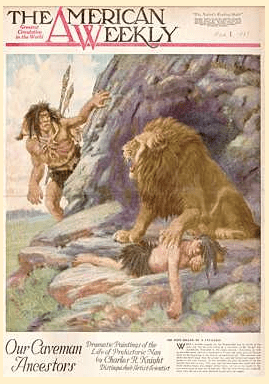
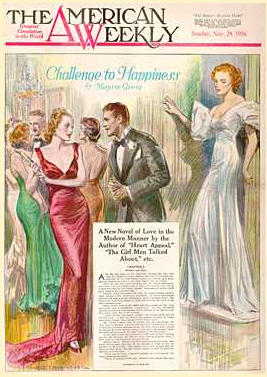
Going by the full name, “The American Weekly Program: Front Page Drama,” the radio series showcased a “true life story” from the forthcoming American Weekly magazine, a colorful tabloid full of fiction and news that claimed the “Greatest circulation in the world” and was carried by Hearst-owned Sunday newspapers. The covers shown here capture the flavor of the magazine, although they are unrelated to the specific radio broadcasts mentioned below. The samples are from an author and collector’s website about classic illustrators.
Judging by Randy Riddle’s collection of transcription disks and titles in other collectors’ logs of the show, most “Front Page Drama” episodes appear to have focused on well-acted short dramatic presentation of that week’s story — investigators uncovering a fraud spiritualist, police investigating murder, mysterious happenings on an isolated lighthouse, and more.
But — just as journalism students are taught — the reporters were generally not part of their own stories, with a few exceptions. This is one.
A 1934 American Weekly cover; click to see more
A Perfect Pair is the story of a reporter for a small-town daily, “The Bee,” stumbling on a big-time story. Another old-time radio collector I contacted lives near the home of the Newtown Bee newspaper in Connecticut, and was convinced that paper was the source of a radio story, possibly this one. However, the paper in the story is called the “Brownsville Bee” — and that was once the name of a West Tennessee paper — unless, as other dramatic series sometimes announce, “names have been changed to protect the innocent.”
Still, the description of the weekly paper’s office and editor at the beginning are classics, as is the reporter’s lament about covering ladies luncheons, society notes and other routine local news. What was true in Brownsville was probably true in Newtown, and if I ever find a collection of 1934 American Weekly editions, I’ll check the story itself.
If your browser does not show an audio player, click the title to download the MP3, or go to Rand’s original podcast, Front Page Drama: A Perfect Pair
I haven’t heard other American Weekly episodes where a newspaper reporter’s own life is dramatized, although J.David Goldin’s Radio GoldIndex and compilations by a few dealers in MP3 collections include a Front Page Drama episode from August 15, 1937, titled “Girl Reporter,” which Goldin describes as “cub reporter shows the old city editor a big story right under his nose.”
Radio, similarly, kept the idea of the “old media” newspaper and career of newspaper reporter right in the ear of the audience for radio, the “new media” in town.
MGM Theater of the Air didn’t get the original movie cast for its 1950 radio production of the screwball comedy Slightly Dangerous, but Celeste Holm made a charming Peggy Evans (or “Miss X”) — a lunch-counter waitress so bored with her life that she fakes suicide to erase her past before moving to New York. (Click the title to download an MP3 file if an audio player icon isn’t visible.)
While looking up at the tall buildings, she walks backward into a newspaper delivery truck — and into the headlines as an amnesia victim and suspected long-lost heiress. Peggy isn’t a journalist, but she finds the newspaper staff, scared of liability suits, to be more than helpful. It’s probably taking this film more seriously than it deserves, but there’s a lot to discuss here about deception, “construction of reality,” gullibility and more.
Crowther never mentioned the role of the newspapers in what he considered a “labored, vapid” rags-to-ritches story. Perhaps from his lofty seat at the Times he couldn’t imagine a newspaper so gullible and ready to deceive both itself and its readers. Or maybe there really wasn’t enough of a story here to satisfy him for a feature film… but just enough for an hour of radio.
For philosophy and ethics students, there will be questions about personal honesty and integrity beyond those in the Society of Professional Journalists code.
The 1940 Alfred Hitchcock film “Foreign Correspondent” was nominated for a half-dozen Academy Awards, which more than qualified it for a radio adaptation on Squibb’s Academy Award Theater radio series in 1946. (Actually winning an Oscar wasn’t required; in fact, for some reason the announcer only mentions four nominations.)
Boiling down a full-length espionage thriller into a 30-minute radio script meant writer Frank Wilson had to leave out a lot. Academy Award’s Foreign Correspondent (click to play or download MP3) couldn’t show you the classic trenchcoats, Dutch windmills or Hitchcock’s visual tricks, including a dramatic rooftop escape, a clever use of umbrellas, and a famous plane crash at sea that the movie trailer called “The most thrilling scene ever filmed!”
Did the radio adaptation maintain enough of the suspense? Did the title character still demonstrate characteristics we associate with good journalists? To answer those questions, it will be interesting if some students in my fall class listen to this broadcast without ever seeing the film, while others watch the film (available on Hulu and IMDB.com) before or after hearing the broadcast. If you want to try the radio-first experiment, you should resist the temptation to preview the YouTube clips below. In fact, it would be a good idea to stop reading and click the “play” button right now.
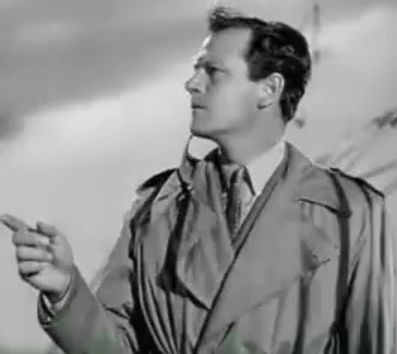
For the radio version, Joseph Cotten took Joel McCrea’s place at the last minute, playing the unlikely named reporter, Johnny Jones, who wrote under the equally unlikely name Huntley Haverstock. It’s easy enough to picture Cotten in that reportorial trenchcoat, since classic film fans will remember him as publisher Charles Foster Kane’s right-hand man Jedediah Leland in “Citizen Kane,” and as the pulp-fiction writer Holly Martins in “The Third Man.”
At the start of the film version of “Foreign Correspondent,” an editor decides to send an experienced crime reporter to Europe, rather than someone more schooled in foreign diplomacy, which in retrospect was a pretty good idea. Unfortunately, that conversation is among several with memorable quotes that didn’t make the radio script, for one reason or another. Among them: “Give me an expense account and I’ll cover anything” and “I don’t want ‘correspondence,’ I want news!”
The radio version is told in flashback, with Johnny Jones as narrator. In both media, he lands in England on the eve of World War II, right in the middle of a murder-and-spies plot full of the kind of twists, tension, romance and moments of humor Hitchcock was already famous for. (The director made this film in Hollywood after creating two earlier spy films for British companies, “The 30 Steps” and “The Lady Vanishes,” neither of which, alas, centers around a journalist dodging spies in his bathrobe, boxers and garters like this one.)
Reporter Jones/Haverstock (film version), on his job and the spies pursuing him:
“They’ll stop at nothing. I seem to know too much, and they’re right. I don’t know the ins and outs of your crackpot peace movement. And I don’t know what’s wrong with Europe. But I do know a story when I see one and I’ll keep after it until I get it or it gets me.”
The film was inspired by Chicago Tribune reporter Vincent Sheean’s Personal History, a 1935 memoir about covering the early days of Fascism. It was republished in 1940, the year the movie opened, while a still-neutral United States followed news of the all-too-real Battle of Britain. Hitchcock and screen writer Ben Hecht, a former newspaperman, closed the film with a passionate radio speech, with Jones/Haverstock calling for American support as bombs fell on London. (See clip at YouTube.)
The emotional impact of the film and radio versions on their original audiences must have been quite different, the film being released while real bombs were falling, but the radio adaptation not coming until a year after the war ended. The real suspense in Europe was over. So was, apparently, the need for journalists to make heroic curtain speeches like this:
“Keep those lights burning, cover them with steel, ring them with guns, build a canopy of battleships and bombing planes around them and, hello, America, hang on to your lights, they’re the only lights in the world.”
Who knows, if Academy Award had been an hour-long radio program, perhaps the writers could have had Johnny Jones, former crime reporter, come back and cover the Nuremberg Trials.
Portraying hand-to-hand combat was never one of radio’s strong points, but this mixture of journalism and judo is worth a bow, at least as a vehicle to discuss some of the quirks of radio’s approach to movie adaptations. As a bonus, we have the film itself.
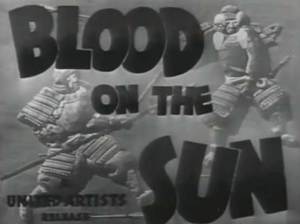
The series Academy Award Theater offered several newspaper-journalist dramas that I’ll be writing about here, starting today with “Blood on the Sun,” which you can read more about at its Internet Movie Database link.
When Squibb sponsored its radio “anthology” series in 1946, it stretched the “Academy Award” title a bit, hinting at a collection of “Best Picture” winners, but providing something else. It did feature Oscar-nominated players and Oscar-connected films, but with plenty of mixing and matching. “Blood on the Sun” is a good example. (Click the title to download the John Garfield version as an MP3 if no player icon appears.)
The “Academy Award” connection for the radio broadcast was a double one, thanks to a casting switch that put John Garfield in the James Cagney leading role as a judo-expert foreign correspondent, uncovering secret anti-American plans in pre-war Japan. Garfield had been nominated for an Oscar, but in an unrelated — and very different — film, as a young composer in 1938’s “Four Daughters.”
“Blood on the Sun” itself actually won a 1946 Oscar, but it was for art direction-interior decoration, skills that don’t amount to much on radio. James Cagney and his original co-star Sylvia Sydney appeared in this Dec.3, 1945 Lux Theater Blood on the Sun radio version (click to download if there is no player).
Historical context: Remember that was at the end of the war — four months after Hiroshima and Japan’s surrender, and just a few days before the fourth anniversary of the attack on Pearl Harbor, as noted in the introduction by host/producer William Keighley, who reminisces about the days before the war — before he launches into a Lux soap promotion.
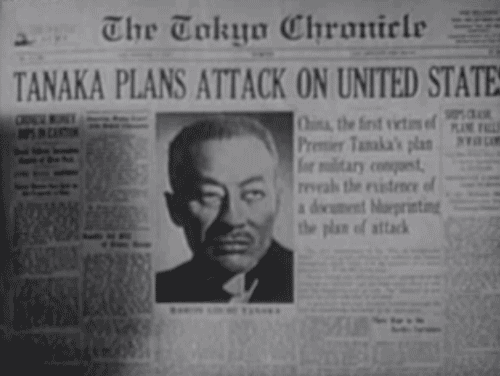
Blood on the Sun's fictional English-language Tokyo paper "reported" a secret plot a decade before Pearl Harbor.
Students of history — military, movie or journalistic — could do more research, starting with Bosley Crowther’s archived 1945 review of the film in The New York Times, which notes that the role of a newspaper in the film is “quite contrary to the facts that history tells us.” (A controversial “Tanaka Plan” was actually reported and became an anti-Japanese propaganda tool, but the American-owned newspaper’s role shown in the movie is fiction. In fact, the document is now widely considered to have been a forgery.)
Here’s Crowther’s June 29, 1945, closing paragraph, retrieved from the Times archive via ProQuest Historical Newspapers. Crowther was writing between the German surrender that spring and America’s atomic bomb attacks on Japan that August:
“So we have here an entertaining movie in the time-honored Cagney groove — tough, hard-hitting and explosive, with just enough rudimentary suspense. But let’s not approve it too quickly; it treads to boldly upon critical ground. In the first place, it makes a pulpwood fiction out of a historic incident. And, more than that, it puts the Japs in the popular but highly deceptive ‘monkey’ class. A true comprehension of our enemies and the sort of people with whom we’ll later have to cope is brusquely waylaid by a picture as glibly cocky as ‘Blood on the Sun.'” (Jun 29, 1945; The New York Times (1851 – 2007) pg. 12)
Video bonus:
The full Cagney movie is also available in various digital video formats at both the archive.org film collection, IMDB/hulu.com and YouTube, apparently because its copyright wasn’t renewed.
Trivia bonus:
One last bit of journalism-movie trivia: True, there was no big journalism theme in John Garfield’s “Four Daughters,” but Hollywood is a small town. One of the four daughters of that title was played by Lola Lane, perhaps even better known for lending most of her name to Superman’s feisty reporter girlfriend, after Lola played risk-taking reporters in other 1930s movies, especially “Torchy Blane in Panama” and “Death from a Distance” — enough to inspire a young comic book author.
Thanks to Old Time Radio Researchers collections at the Internet Archive here are two versions of what June 6, 1944, sounded like to the World War II era listening audience.
The first presents 45 minutes of selections from the actual all-night CBS radio news broadcast, starting after midnight with the CBS and Associated Press translations of reports of an “invasion” overheard from German radio, cautions about possibly deceptive announcements, and eventually the allies’ confirmation, with reports from Edward R. Murrow and Gen. Eisenhower.
(For more about CBS’s Robert Trout, who anchored the marathon early morning coverage, see this NPR memorial at the time of his death in 2000, and a North Carolina History Project biography.)
The second item is more in keeping with my podcast theme of radio drama. During the war years, the United Press, which competed with Associated Press for newspaper and broadcast affiliates, created a dramatic series portraying the work of its foreign correspondents, titled “Soldiers of the Press.”
This Soldiers of the Press D-Day Invasion episode was broadcast several weeks after the events depicted, and presents behind the scenes stories of the day’s coverage as a whole, from reporters starting their secret assignments to UP editors back in the United States waiting for the official dispatches — quite similar to Robert Trout’s situation at CBS.
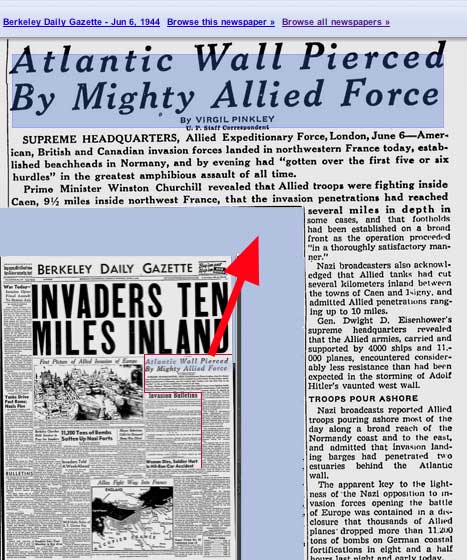
Virgil Pinkley, European general manager of United Press, is featured in the opening of the broadcast, and had the byline on the invasion story.
Most episodes of the Soldiers of the Press series focused on a single UP war correspondent on the front lines, in a “how I got the story” format, complete with “live” interviews, first-person narration and battlefield sound effects. As a result, many oldtime-radio collections incorrectly identify the speakers as United Press reporters, rather than actors back in a New York studio.
Virgil Pinkley, his assistant Ed Beattie, and correspondents including Collie Small, Leo Disher and Richard MacMillan are named in the D-Day Invasion episode. As usual, the actors voicing their “roles” aren’t identified. According to Pinkley’s 1992 Los Angeles Times obituary, he landed his job with United Press in London in 1929, after working his way to Europe on a cattle boat. During the war, he was head of UP operations in Europe and traveled to 43 countries. He was a vice president at UP when he returned to his native state of California, becoming publisher of the Los Angeles Mirror and other papers.
Former United Press correspondent Walter Cronkite, on an NPR program, commented years later on the strangeness of hearing an unidentified New York actor saying “This is Walter Cronkite…” and reading one of his UP dispatches in what Cronkite characterized as an “action-adventure show” promoting the wire service.
Ironically, Cronkite’s own voice became more familiar than most of those 1940s radio stars — as reporter and anchor on CBS radio and television, reporting two more wars, the Civil Rights movement and the Apollo moon landings. Cronkite also returned to D-Day’s Omaha Beach in 1963 with Eisenhower for a 20-years-after feature, and reminisced about that trip and D-Day for NPR.
Cronkite’s role in D-Day coverage is not headlined in the “Invasion” episode of Soldiers of the Press, but other stories of his were given the full Soldiers of the Press treatment in programs that are part of the Old Time Radio Researchers Group collection at Archive.org.
Here are a Cronkite episode from 1943 and two from 1945.
Dry Martini
Symbol of Caduceus
Grease Monkey
(Alas, volunteer-produced online archive program file names and notes have had numerous typographical errors over the years, gradually being corrected — including references to Walter “Cronkike,” Richard “McMillan,” and Virgil “Pinkney.”)
While Cronkite is not mentioned, the June 1944 Soldiers of the Press broadcast is fascinating, if understandably short on details. Check out history.com’s D-Day page or The Library of Congress for some perspective — including statistics that couldn’t be told back then: 18,000 paratroopers leading the way for 176,000 troops who arrived on history’s largest invasion fleet, some 6,000 vessels, supported by 13,000 aircraft. For more personal accounts, see the veterans’ stories in the Library of Congress’s Veterans History Project: D-Day 60th anniversary.
Research note: Times subscribers can read this page in detail using the “Times Machine” website and simply looking up the date, or following this link. Searching for that “extra” using the big page-one “Allied Armies Land…” banner headline may not work, since the headline covers several stories. When I first posted this article, the headline did get them to the full page using the Times archive in our library’s Proquest Historical Newspapers subscription.
[Link address updates and other minor editing here June 5, 2019, March 28, 2021, and June 6, 2024, along with the paragraph about George Hicks’ recordings.]
From a 1940s Green Hornet comic book. In all media, publisher Britt Reid kept his Green Hornet identity secret from his reporters, especially his not the most competent staff member, ex-cop Mike Axford.
Is a newspaper journalist the people’s watchdog or a government lapdog? How observant should a reporter be? And what should a city editor have for lunch?
This Green Hornet radio episode, There Was a Crooked Man, is a place to tackle those questions — and to start a more general discussion of the portrayal of newspaper journalists in radio dramas.
As the story opens, publisher Britt Reid faces a decision about making a deal for access to government secrets, but it has a personal twist: A prosecutor offers him exclusive information for a racket-busting story, but in exchange he wants all that The Daily Sentinel knows about the Green Hornet.
It would be one ethical question for a newspaper to cut an information-swap, but in this case should the truth-dealing publisher tell an outright lie to hide the fact that he is the city’s green-masked Robin Hood? That question probably doesn’t come up at many papers.
But even an adventure series like The Green Hornet gave listeners some idea of questions real-world journalists really did face then and still do today.
For example, before the prosecutor offers his info-exchange proposal, Reid makes a statement worthy of discussion in any media ethics class:
“The simplest way to keep things OUT of the paper… is to confide in a newspaperman. If he thinks you’re trying to hide something and put one over on him, he’ll get answers and publish them.”
The same episode gives us an opportunity to observe the reporting techniques of Sentinel reporter Ed Lowry, who enters the story trying to get information from the prosecutor’s daughter at the airport. He’s observant and has a good memory, recognizing her low-numbered license plate on her roadster.
Lowry generally sounds like a street-wise, tough investigator, if not the most cultivated journalism school grad. His grammar is rough around the edges. He catches himself starting to refer to the prosecutor as “your old man…” and shifts to “your father…” His techniques include a bit of flattery, “If anyone can smash this graft ring, he’s the man to do it…”
Later, there are scenes with the reporter and publisher comparing notes at the office, and Reid taking a direct hands-on approach, more like a managing editor. (The city editor is at lunch at the time. “Lunch? I thought a city editor lived on ink and paper,” Lowry remarks, before heading for the publisher’s office.)
Radio’s Green Hornet plots from 1936 to 1952 relied much more heavily on Reid’s connection with The Daily Sentinel newspaper and its staff than did the 1966-67 television series, with its weapons and kung-fu focus, or the 2011 feature film, full of explosions and special effect enhancements. In addition to Lowry and Lenore “Casey” Case (secretary and wannabe-reporter), the most prominent Sentinel staff member was also the series’ comic relief, former policeman Michael Axford, sent by Reid’s father to keep an eye on the young publisher as combination reporter and bodyguard.
This “There Was a Crooked Man” appears to be one of the earliest-recorded Green Hornet radio episodes, from May 24, 1938, despite Internet sources that put a date a year later in its file name. This copy is at the Old Time Radio Researchers Group Library.
At “FreeOTRshows.com” and similar online archives, the episode has been dated May 23, 1939, but inaccurate information is duplicated widely at for-sale and free-download sites on the Internet, often based on early collectors’ tape-swapping or mp3 files that were exchanged anonymously over computer bulletin boards. (For more consistent research and better audio quality Radio Spirits offers sets of commercial recordings on CD, which sometimes can be found at libraries.)
Perhaps the best source: Hornet historians Martin Grams Jr. and Terry Salomonson based a 802-page book, The Green Hornet, on scripts registered with the U.S. copyright office and transcription disks archived by the production company. They identify two episodes with “There Was a Crooked Man” as a title, one recorded as a live-transcription disk on May 24, 1938, a demo made a year before recording became standard practice. That episode was #239, about the kidnapping of a prosecutor’s daughter, which is the story we have here. The other “There Was a Crooked Man” in Grams & Salomonson is script #330, broadcast April 6, 1939, a story of a horserace racket.
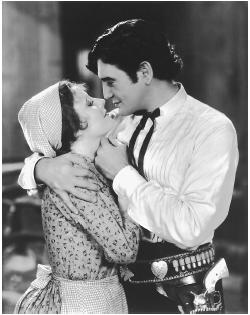
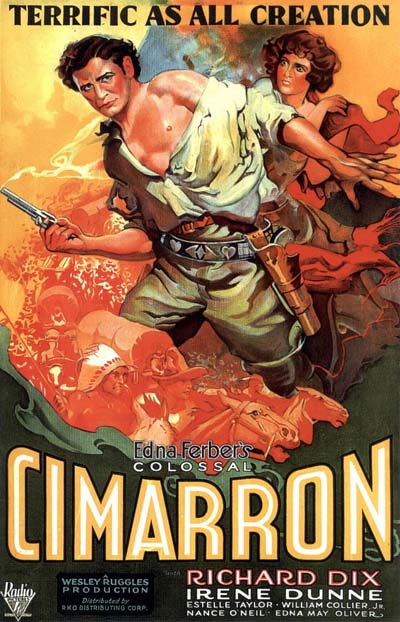
In both versions of the movie “Cimarron,” the visual spectacle of the 1889 Oklahoma Land Rush may have stolen the show. But in two radio adaptations, the story all belonged to Irene Dunne‘s portrayal of Sabra Cravat, frontier wife, mother and — although she hadn’t planned it — editor of a scrappy newspaper called the Osage Wigwam.
It’s not just that radio loses the visual spectacle of the settlers’ stampede and her husband Yancey’s gunfights — both radio adaptations make Sabra the narrator of the story and enlist Dunne’s star quality as “First Lady of Hollywood.” (While gun-toting Richard Dix’s name came first at the movies, the openings of the radio versions don’t even identify her leading men. Dix was not involved in either production.) The radio versions also manage to compress the 40-year story of the Cravats and Oklahoma — two hours of film — into a half-hour!
Pulitzer-Prize-winner (for fiction) and former newspaper woman Edna Ferber‘s novel, of course, had already been compressed in the film adaptation, losing such details as her description of the controversial nature of Cravat’s original newspaper:
“Its very name was a scandal: The Wichita Wigwam. And just below this: All the News. Any Scandal Not Libelous. Published Once a week if Convenient.”
Its Oklahoma successor was the paper inherited by Sabra Cravat. Dunne created the role for the Academy Award winning 1931 film. On the radio, she starred in both a Cavalcade of America: Cimarron in 1941…
(Click the title to play or download if your browser does not show a “player” icon.) An actress of 40 or 50 could play a young bride more easily at the microphone than on the movie lot. For the screen, makeup and her vocal skills had worked the transformation in the opposite director for her portrayal of Sabra from youth through old age.
1931 Cimarron film poster
As for the newspaper, Sabra’s first steps into journalism are cautious ones. Here, she and Yancey discuss his plans for the Osage Wigwam:
Sabra: “Yancey, you’re going to be very careful what you print in the paper, aren’t you? Yancey: “Careful, me?” Sabra: Did you know that Tom Carter, the last man who ran a paper out here was found shot right through the heart? Yancey: Not through the center, though. The bullet barely pierced the heart. It was sloppy shooting. Sabra: Sloppy shooting or not, he wasn’t able to write about it the next day.
All, however, is well: Yancey reveals that not only is he a lawyer and a newspaperman, he’s also the fastest gun in town. And Sabra reveals that she’s up to the task of running the paper while he’s busy carving notches in his six-gun and heading off for the next land-rush, the war in Cuba, or the Oklahoma oil fields.
Her part in the newspaper starts with women’s features. But when he suggests selling the paper and heading for the Cherokee Strip (“We’re frontier people, Sabra, we have to move on as the West moves…”), she winds up being the newspaper’s editor for five years:
“And believe me they were five years of reform… I was fighting for the day when Osage could take its place in the sun with Wichita and Kansas City… I wrote editorials… I denounced politicians… I fought for law and order and the sanctity of the home…”
Her editorials have two unforeseen effects: First, a saloon owner burns down the newspaper and the Cravat homestead. Yancey comes galloping back, but only to announce that he’s enlisted in the Rough Riders, then gallop off again… while the 20th century comes roaring in, and oil makes Osage a metropolis. Next, Sabra’s editorial prominence gets her elected to Congress.
Also made into a 1960 film with Glenn Ford and Maria Schell, “Cimarron” started as a best-seller by Pulitzer-winning novelist and former newspaper woman Edna Ferber. Ferber’s first book, in fact, was another story of a young woman and a newspaper, Dawn O’Hara, available at the University of Virginia Electronic Text Center and at Project Gutenberg. Her Pulitzer Prize, however, was for So Big, about a woman whose son disappoints her by becoming a stock broker. Perhaps it would have had a happier ending if he became a newspaperman. Maybe not, judging by the career of Dawn O’Hara’s husband, a top-notch reporter who goes quite mad early in the novel by that name.
Ferber’s 1940 autobiography, A Peculiar Treasure, says that the newspapering in both Dawn O’Hara and Cimarron was informed by her own experiences in Wisconsin newsrooms, starting in 1902 at the age of 17 with a salary of $3 a week.
“I wouldn’t swap that year and a half of small-town newspaper reporting for any four years of college education… I learned how to sketch in human beings with a few rapid words, I learned to see, to observe, to remember; learned, in short, the first rules of writing.” (p. 103, Peculiar Treasure).
Irene Dunne, meanwhile, went on to play a very different small-town newspaper editor in her own radio series, “Bright Star,” subtitled, “The Irene Dunne and Fred MacMurray Show,” which I’ll get to in future episodes of JHeroes.
Without Irene Dunne, at least two other radio “anthology” series, FordTheater and LuxTheatre, broadcast adaptations of Cimarron, but I haven’t found copies of them on any of the usual collector/historian Web sites. The listings tend to say “N/A.” It’s too bad — it would be fascinating to hear Clark Gable — who played many newspaper roles — as Yancey Cravat!
Updated: Since writing the first-posted draft of this page, I’ve read the novels Cimarron and Dawn O’Hara and parts of Ferber’s autobiography referring to the role her own newspaper experience played in both books. I’ve written a bit more about Ferber’s observations on What writing is…
Was there a historical Sabra Cravat? The Cavalcade broadcast doesn’t mention Ferber’s research methods or inspiration, but Elva Shartel Ferguson, Oklahoma journalist, wife of an Oklahoma territory governor and co-founder of the Watonga Republican newspaper, clearly was an influence — although not the sole model, according to Ferber. The Oklahoma Historical Society lists several resources about Ferguson, as well as her own 1937 book, They Carried the Torch: The Story of Oklahoma’s Pioneer Newspapers.

 While this site, blog, podcast etc. is mostly about radio of the past, I just noticed that this Saturday is National Radio Day… a good reminder to visit TODAY’s radio news broadcasters and programmers who value the storytelling power of the human voice!




 Newspaper Heroes on the Air