Sabra Cravat, Frontier Editor

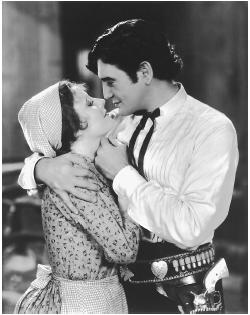
Gun-toting Richard Dix as Yancey Cravat, and Irene Dunne in frontierswoman apron

Irene Dunne & Richard Dix in Cimarron

In both versions of the movie “Cimarron,” the visual spectacle of the 1889 Oklahoma Land Rush may have stolen the show. But in two radio adaptations, the story all belonged to Irene Dunne‘s portrayal of Sabra Cravat, frontier wife, mother and — although she hadn’t planned it — editor of a scrappy newspaper called the Osage Wigwam.

It’s not just that radio loses the visual spectacle of the settlers’ stampede and her husband Yancey’s gunfights — both radio adaptations make Sabra the narrator of the story and enlist Dunne’s star quality as “First Lady of Hollywood.” (While gun-toting Richard Dix’s name came first at the movies, the openings of the radio versions don’t even identify her leading men. Dix was not involved in either production.) The radio versions also manage to compress the 40-year story of the Cravats and Oklahoma — two hours of film — into a half-hour!

Pulitzer-Prize-winner (for fiction) and former newspaper woman Edna Ferber‘s novel, of course, had already been compressed in the film adaptation, losing such details as her description of the controversial nature of Cravat’s original newspaper:

“Its very name was a scandal: The Wichita Wigwam. And just below this: All the News. Any Scandal Not Libelous. Published Once a week if Convenient.”

Its Oklahoma successor was the paper inherited by Sabra Cravat. Dunne created the role for the Academy Award winning 1931 film. On the radio, she starred in both a Cavalcade of America: Cimarron in 1941…

and a Hallmark Playhouse: Cimarron in 1948…

(Click the title to play or download if your browser does not show a “player” icon.) An actress of 40 or 50 could play a young bride more easily at the microphone than on the movie lot. For the screen, makeup and her vocal skills had worked the transformation in the opposite director for her portrayal of Sabra from youth through old age.

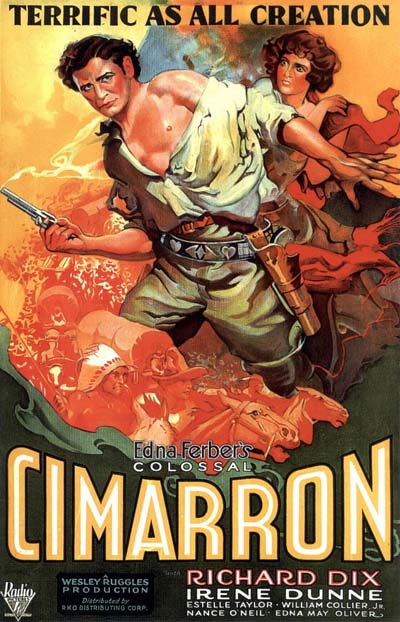
1931 Cimarron film poster

1931 Cimarron film poster

As for the newspaper, Sabra’s first steps into journalism are cautious ones. Here, she and Yancey discuss his plans for the Osage Wigwam:

Sabra: “Yancey, you’re going to be very careful what you print in the paper, aren’t you?
Yancey: “Careful, me?”
Sabra: Did you know that Tom Carter, the last man who ran a paper out here
was found shot right through the heart?
Yancey: Not through the center, though. The bullet barely pierced the heart. It was sloppy shooting.
Sabra: Sloppy shooting or not, he wasn’t able to write about it the next day.

All, however, is well: Yancey reveals that not only is he a lawyer and a newspaperman, he’s also the fastest gun in town. And Sabra reveals that she’s up to the task of running the paper while he’s busy carving notches in his six-gun and heading off for the next land-rush, the war in Cuba, or the Oklahoma oil fields.

Her part in the newspaper starts with women’s features. But when he suggests selling the paper and heading for the Cherokee Strip (“We’re frontier people, Sabra, we have to move on as the West moves…”), she winds up being the newspaper’s editor for five years:

“And believe me they were five years of reform… I was fighting for the day when Osage could take its place in the sun with Wichita and Kansas City… I wrote editorials… I denounced politicians… I fought for law and order and the sanctity of the home…”

Her editorials have two unforeseen effects: First, a saloon owner burns down the newspaper and the Cravat homestead. Yancey comes galloping back, but only to announce that he’s enlisted in the Rough Riders, then gallop off again… while the 20th century comes roaring in, and oil makes Osage a metropolis. Next, Sabra’s editorial prominence gets her elected to Congress.

Also made into a 1960 film with Glenn Ford and Maria Schell, “Cimarron” started as a best-seller by Pulitzer-winning novelist and former newspaper woman Edna Ferber. Ferber’s first book, in fact, was another story of a young woman and a newspaper, Dawn O’Hara, available at the University of Virginia Electronic Text Center and at Project Gutenberg. Her Pulitzer Prize, however, was for So Big, about a woman whose son disappoints her by becoming a stock broker. Perhaps it would have had a happier ending if he became a newspaperman. Maybe not, judging by the career of Dawn O’Hara’s husband, a top-notch reporter who goes quite mad early in the novel by that name.

Ferber’s 1940 autobiography, A Peculiar Treasure, says that the newspapering in both Dawn O’Hara and Cimarron was informed by her own experiences in Wisconsin newsrooms, starting in 1902 at the age of 17 with a salary of $3 a week.

“I wouldn’t swap that year and a half of small-town newspaper reporting for any four years of college education… I learned how to sketch in human beings with a few rapid words, I learned to see, to observe, to remember; learned, in short, the first rules of writing.” (p. 103, Peculiar Treasure).

Irene Dunne, meanwhile, went on to play a very different small-town newspaper editor in her own radio series, “Bright Star,” subtitled, “The Irene Dunne and Fred MacMurray Show,” which I’ll get to in future episodes of JHeroes.


Note: The linked audio files include one from the Internet Archive collection of Dupont Cavalcade of America episodes, and one from the Internet Archive version of the Hallmark broadcast, which has several minutes missing.

Without Irene Dunne, at least two other radio “anthology” series, Ford Theater and Lux Theatre, broadcast adaptations of Cimarron, but I haven’t found copies of them on any of the usual collector/historian Web sites. The listings tend to say “N/A.” It’s too bad — it would be fascinating to hear Clark Gable — who played many newspaper roles — as Yancey Cravat!

Updated: Since writing the first-posted draft of this page, I’ve read the novels Cimarron and Dawn O’Hara and parts of Ferber’s autobiography referring to the role her own newspaper experience played in both books. I’ve written a bit more about Ferber’s observations on What writing is…

Was there a historical Sabra Cravat?
The Cavalcade broadcast doesn’t mention Ferber’s research methods or inspiration, but Elva Shartel Ferguson, Oklahoma journalist, wife of an Oklahoma territory governor and co-founder of the Watonga Republican newspaper, clearly was an influence — although not the sole model, according to Ferber. The Oklahoma Historical Society lists several resources about Ferguson, as well as her own 1937 book, They Carried the Torch: The Story of Oklahoma’s Pioneer Newspapers.

Posted in 19th century, adaptations, cavalcade, editors, Hallmark, journalism, movies, newspapers, radio, women | Leave a comment

Deadline U.S.A. — radio edition of a classic newspaper film

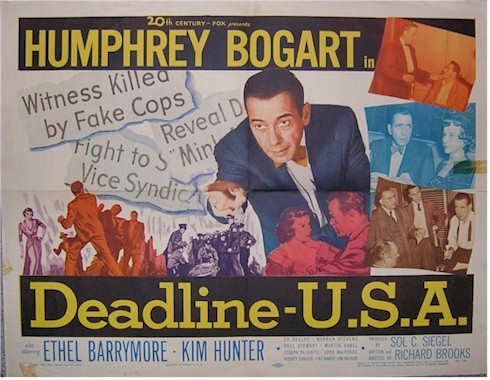
Deadline U.S.A. movie posterThe movie poster gives you the general idea of the plot, but here is the radio version of a classic “heroic newspapermen” movie called Deadline U.S.A. (click to play or download the mp3 if a “player” icon isn’t visible below). You don’t get Bogart, but it’s still a great story.

This version was broadcast by the anthology series Lux Radio Theater in 1953, a year after the film’s release, and rebroadcast on Armed Forces Radio as Hollywood RadioTheater, minus the soap selling. That is the version offered here, via the old-time radio collection at the Internet Archive (archive.org).
Lux/Hollywood was one of several radio anthology series that regularly produced abbreviated versions of feature film plots.

Humphrey Bogart made a memorable editor — dedicated to the news and to his about-to-be-sold newspaper, even if he did, for some reason, call everybody “baby.” Maybe that was “hip” in 1952?

On radio, Dan Dailey has the editor’s role and does a pretty good job getting out a broadcast edition of the story. His rapidfire delivery is full of anger, fatigue and frustration. (And, in one scene, inebriation — probably hard to do on radio without sounding like a buffoon.) Overall, I miss Bogart’s more subtle portrayal. Maybe in the fall I’ll be able to get students to compare the two.

Like many other “newspaper” tales, “Deadline U.S.A.” has an internal love story and observations about troubled newspaper marriages. In the radio version, one of the strongest scenes is the editor’s conversation with his publisher’s widow about her late husband and the neglected daughters who now plan to sell the paper he founded.

Both on film and on the radio, the paper is in trouble, and the editor delivers solid testimony on the public’s need for civic-minded newspapers, and for competition among then, and he delivers a moving closing speech over the roar of the press.

The radio cast also includes one of radio’s most familiar voices, William Conrad, who popped up in several episodes of “Night Beat,” sometimes as a reporter or editor, and memorably played the city editor in another classic “newspaper movie,” Jack Webb’s day full of deadlines called “–30–.”


For more on “Deadline U.S.A.,” the film, a Google search will provide plenty of testimonials calling it one of the greatest newspaper films, praising Bogart’s performance in the original, and wondering why it has not been released on DVD… along with disgruntled fans’ latest uploads of clips to YouTube.

UPDATE (Nov.2011): Margate Entertainment’s TVS Home Video came out with a DVD release, apparently based on a Fox Movie Channel version. It’s available through Amazon.com (including an online rental) and TV4U.com


Note: I previously combined this item with one about the radio play, “Correction,” which features the dark side of the power of the press, when used irresponsibly. But giving “Deadline U.S.A.” its own page felt like a more positive view of journalism to end the semester, even if its message about the economics of newspapers isn’t the most hopeful. For a more upbeat take on the news media of 2011, I’ve been recommending this speech by Eric Newton of the Knight Foundation.

Posted in 1950s, closing, editors, ethics, journalism, movies, newspapers, Pulitzer Prize | 2 Comments

A critical view of an irresponsible newspaper

One of the strongest critiques of journalistic ethics to be heard on classic radio was broadcast by NBC Radio City Playhouse. The original radioplay Correction is a 1949 newsroom drama with a person hurt by a news story showing up with a gun instead of a libel lawyer. (Click The file name if an audio player does not appear below.)

In that regard, you might compare it to the opening episode of Big Town a decade earlier, itself owing a lot to the film Five Star Final.

“Correction” also features the highest-stakes bit of mass media audience survey research on record, when the editor is forced at gunpoint to call readers and interview them about what they remember of the libelous story.

The story is not all indictment of the press — the picture of the gossip-hungry public isn’t pretty either. But you have to listen carefully to hear any optimism about the news business.


For more about NBC’s Radio City Playhouse, see the painstakingly researched history at DigitalDeli Too.


For an uplifting contrast, meet some heroic newspaper folks in the radio version of Deadline U.S.A., which I previously included with this post — but decide to give a page of its own.

Posted in ethics, journalism, newspapers, publishers | Leave a comment

This Press Photographer didn’t need pictures!

… because he was on radio. The show began as “Flashgun Casey, Press Photographer,” although its later name “Crime Photographer” was a better description of its typical plotlines — more detective stories than journalism-procedurals.

However, I love the film “Meet Flash Casey” that preceded the radio series by a few years. Both were based on a pulp-fiction character by the same name. (For some of you, this will look awfully familiar — I posted the film clip at my Other Journalism blog last year because this one wasn’t up and running yet. With the semester coming to a close, I think the opening graduation scene makes the fim timely again.)

Like his first boss, a crusty editor who greets him with “Not THE Flash Casey!… Never heard of you,” you should get to know Flash Casey, radio’s best news photographer. For a dozen years on radio, plus film, comic book and TV incarnations, Casey was the classic wise-cracking, fedora-wearing newspaper cameraman. In this 1938 film clip, he’s right out of college, hat-in-hand looking for his first job.

Casey as comic book hero

Casey in the comics

Message for graduates: Finding a job may be rough today, but it has rarely been easy. Still, like Casey, you never know whom you might run into. (Watch the clip, or the full-length Here’s Flash Casey, at Archive.org.) His attitude, camera and sense of a humor already show promise, even if it is only a B-movie. Notice, too, how the newspaper’s spin-off magazine and competition between the two editors add plot twists and opportunities for young Casey..

Also, if you’re interested in “new technology,” watch for the appearance of a pre-war Leica 35mm camera later in the film, along with several scenes worth discussing in a media-ethics class.

During his long run on radio, Casey was the old pro, not the young graduate in the movie. In the series called “Casey, Crime Photographer” or just “Crime Photographer,” he was the “ace cameraman who covers the crime news of a great city,” usually with the help of reporter Ann Williams and the regulars at the Blue Note Cafe. Most of the plots involved more crime-solving than crime-reporting, but often had very good jazz piano in the background. And the original intro must have warmed the hearts of news photographers in the audience:

“Out of a big city’s roaring life, out of a great newspaper’s pounding heart, come the exciting adventures of a man with a camera, Flashgun Casey, Press Photographer…
Tough, daring, typical of the men who often risk their lives so that you may see the news as well as read it. Their salaries are not large and they seldom get much credit but their lives are packed with danger and thrills.”

Casey entered the radio world in 1943 carrying a case full of breakable Speed Graphic photo plates after grudgingly covering a movie star’s wedding for the Morning Express. As he put it, “I was knee deep in celebrities… white satin and orchids fairly drip from the lens.” But in the darkroom, he discovered that wasn’t true — because this was The Case of the Switched Plates. (click the title to play or download the program if no player icon is visible below)

Casey’s they-all-look-alike press camera and plate case lead to a plot about a mixup, “developing” evidence of a crime, and a discussion of press reporters lifestyles, including their need to moonlight and the temptations of hanging around with nightclub entertainers and fashion models with expensive tastes.

There’s also a classic bit of old technology — Casey gets a lead by overhearing a call from the next phone booth, which also provides some good banter with his editor:

Casey: “I just got some shots for the morning paper and if I were you I’d leave plenty of space on the front page…”
Burt: “Well you better get back with something soon or I’ll hold a four line spread in the obituaries for you…”

If you like what you hear on this page, see the Old Time Radio Researchers Group collection — which is huge, divided into several zip archive files, some of which include comic books as well as the radio shows. There’s a separate page of single episodes, including the ones below. Perhaps not coincidentally, the actor who played Casey, Staats Cotsworth, also was among the actors who played another radio journalist, the title role in the daytime drama, “Front Page Farrell,” which I’ll get to some other day.

Two more Casey radio episodes:

For further exploration of journalism issues, this 1947 tale is “Bright New Star,” in which Casey and Annie present some time-honored skepticism about press-agentry and publicity-seekers.
Finally, this third episode, from 1954, is “Source of Information,” in which Casey has a visit from a down-on-his-luck former reporter who has been sitting on a big expose for, perhaps, too long.


The Old Time Radio Researchers Group’s Casey collection at the Internet Archive has 77 episodes of the radio series, from 1943 to 1954.

Sources: For a terrific illustrated exploration of all things Casey, see DigitalDeliToo’s Definitive Casey Guide.

There’s also a book, by J. Randolph Cox and David S. Siegel, Flashgun Casey, Crime Photographer: From the Pulps to Radio And Beyond, published by William F Nolan, Yorktown Heights, NY: Book Hunter Press.

More: See Casey on Wikipedia

Posted in crime, magazines, newspapers, photographer, reporters | Leave a comment

Press Warrior: Richard Harding Davis

Richard Harding Davis portrait, c. 1890

Richard Harding Davis

The title of this Cavalcade of America wartime episode, “Soldier of a Free Press” (1942), certainly describes Richard Harding Davis, star reporter from the Spanish American War through World War I. The radio broadcast’s brief biography of the most famous war reporter of a century ago, superficial and gung-ho though it may be, could be a good starting point for a classroom  discussion of media ethics in any era.

Do a reporter’s loyalties lie with some abstract concept of journalism, or with his or her nation (at least in time of war), or with a media organization? The latter loyalty may be rare today, after a century of consolidations, convergences and careers that flip-flop between press and publicity. Devotion to a particular newspaper or to the news business itself may have been stronger in Davis’s day.

The text below, the opening of Davis’s fictional story “The Reporter Who Made Himself King,”  captures a sense of enthusiasm for newspaper journalism that also may be rare now. I think it summarizes old-time reporters’ attitudes that are echoed in many of the radio programs I’m posting here about journalists, real and fictional.

Davis’s full Reporter/King story is available at various places online. I’ve seen no evidence that it was ever dramatized for radio, and “Soldier of a Free Press” from Cavalcade is the only Davis biography I’ve found in radio archives. However, the stories of other real-life “Soldiers of the Press” were broadcast often during World War II — that was even the title of a radio series dramatizing the lives of United Press correspondents in the 1940s. I’ll be getting to them in future episodes of this blog and podcast.

For now, here is an excerpt from Davis’s tale of a young reporter’s adventures — with a couple of passages in bold for your attention, including one 100-word sentence that demonstrates a decidedly pre-Internet, multi-semicolon writing style, but still does its job:

Davis, Richard Harding, 1864-1916. The Reporter Who Made Himself King, from full text at the Electronic Text Center, University of Virginia

The Old Time Journalist will tell you that the best reporter is the one who works his way up. He holds that the only way to start is as a printer’s devil or as an office boy, to learn in time to set type, to graduate from a compositor into a stenographer, and as a stenographer take down speeches at public meetings, and so finally grow into a real reporter, with a fire badge on your left suspender, and a speaking acquaintance with all the greatest men in the city, not even excepting Police Captains.

That is the old time journalist’s idea of it. That is the way he was trained, and that is why at the age of sixty he is still a reporter. If you train up a youth in this way, he will go into reporting with too full a knowledge of the newspaper business, with no illusions concerning it, and with no ignorant enthusiasms, but with a keen and justifiable impression that he is not paid enough for what he does. And he will only do what he is paid to do.

Now, you cannot pay a good reporter for what he does, because he does not work for pay. He works for his paper. He gives his time, his health, his brains, his sleeping hours, and his eating hours, and sometimes his life, to get news for it. He thinks the sun rises only that men may have light by which to read it. But if he has been in a newspaper office from his youth up, he finds out before he becomes a reporter that this is not so, and loses his real value. He should come right out of the University where he has been doing “campus notes” for the college weekly, and be pitchforked out into city work without knowing whether the Battery is at Harlem or Hunter’s Point, and with the idea that he is a Moulder of Public Opinion and that the Power of the Press is greater than the Power of Money, and that the few lines he writes are of more value in the Editor’s eyes than is the column of advertising on the last page, which they are not.

After three years — it is sometimes longer, sometimes not so long — he finds out that he has given his nerves and his youth and his enthusiasm in exchange for a general fund of miscellaneous knowledge, the opportunity of personal encounter with all the greatest and most remarkable men and events that have risen in those three years, and a  great fund of resource and patience. He will find that he has crowded the experiences of the lifetime of the ordinary young business man, doctor, or lawyer, or man about town, into three short years; that he has learned to think and to act quickly, to be patient and unmoved when everyone else has lost his head, actually or figuratively speaking; to write as fast as another man can talk, and to be able to talk with authority on matters of which other men do not venture even to think until they have read what he has written with a copy-boy at his elbow on the night previous.

It is necessary for you to know this, that you may understand what manner of man young Albert Gordon was.

Young Gordon had been a reporter just three years. He had left Yale when his last living relative died, and had taken the morning train for New York, where they had promised him reportorial work on one of the innumerable Greatest New York Dailies. He arrived at the office at noon, and was sent back over the same road on which he had just come, to Spuyten Duyvil, where a train had been wrecked and everybody of consequence to suburban New York killed. One of the old reporters hurried him to the office again with his “copy,” and after he had delivered that, he was  sent to the Tombs to talk French to a man in Murderers’ Row, who could not talk anything else, but who had shown some international skill in the use of a jimmy. And at eight, he covered a flower-show in Madison Square Garden; and at eleven was sent over the Brooklyn Bridge in a cab to watch a fire and make guesses at the losses to the insurance companies.

He went to bed at one, and dreamed of shattered locomotives, human beings lying still with blankets over them, rows of cells, and banks of beautiful flowers nodding their heads to the tunes of the brass band in the gallery. He decided when he awoke the next morning that he had entered upon a picturesque and exciting career, and as one day followed another, he became more and more convinced of it, and more and more devoted to it. He was twenty then, and he was now twenty-three, and in that time had become a great reporter, and had been to Presidential conventions in Chicago, revolutions in Hayti, Indian outbreaks on the Plains, and midnight meetings of moonlighters in Tennessee, and had seen what work earthquakes, floods, fire, and fever could do in great cities, and had contradicted the President, and borrowed matches from burglars. And now he thought he would like to rest and breathe a bit, and not to work again unless as a war correspondent.

The only obstacle to his becoming a great war correspondent lay in the fact that there was no war, and a war correspondent without a war is about as absurd an individual as a general without an army. He read the papers every morning on the elevated trains for war clouds; but though there were many war clouds, they always drifted apart, and peace smiled again. This was very disappointing to young Gordon, and he became more and more keenly discouraged.

And then as war work was out of the question, he decided to write his novel. It was to be a novel of New York life, and he wanted a quiet place in which to work on it. He was already making inquiries among the suburban residents of his acquaintance for just such a quiet spot, when he received an offer to go to the Island of Opeki in the North Pacific Ocean, as secretary to the American consul at that place…

See full story.


Other sources:
Richard Harding Davis: Adventures and Letters at Virginia.edu and Google e-book version.


Footnote — While the “Reporter Who Made Himself King” passage sounds like an endorsement of a naive college-boy introduction to journalism, Davis himself is a special case. He was a second-generation journalist on both sides: His mother Rebecca Harding Davis was a reporter for Horace Greeley‘s Tribune as well as a writer of fiction; his father, Lemuel Clarke Davis, was editor of the Philadelphia Public Ledger.


Another of Richard Harding Davis’s fictional creations, a copyboy-turned-reporter named Gallegher, briefly made it to television in the 1960s as a Disney mini-series. TV episode summaries and a copy of Davis’s first Gallegher story are available here at FlyingDreams.org

Posted in 1900s, 19th century, foreign correspondents, international, journalism, newspapers, reporters | Leave a comment

Reporting tips: Lois Lane at work

Here’s Lois Lane’s first on-air interview, in the episode about Stolen Fuel for the Atomic Beam Machine from the 1940 Superman radio serial. (Click the title to download an MP3 if a player icon isn’t visible.) As mentioned here last week, Miss Lane reluctantly accepted the assignment to talk to America’s leading atomic energy researcher. The interview is in progress when we join the new episode, and we hear her asking one of the best follow-up questions in the reporter’s arsenal: “What do you mean?”

In fact, her interview is a pretty good collection of open-ended questions:

  • “Now tell me about the machine, the atomic beam…”
  • Why do you think it was stolen?”
  • “Can you tell me how the machine works…?”

Along with being a good interviewer, Lois also shows her scrappy, competitive nature, accusing Clark Kent of trying to “horn in on my story,” and later of being a bit too mild-mannered. Courage is one of the things she expects in a reporter:

“Well, are your worries about being blown sky high quite laid to rest, Mr. Kent? You thought the paper would be blown up tonight, didn’t you… And yet you take the first chance you get to run out like a rat and leave the rest of them there to face whatever happens… I can stand freshness and amazing luck and even boasting, but not cowardice, Mr. Kent.”

The next episode wraps up the story with more super-heroics than reporting, including Superman’s first dramatic rescue of Lois, in Threat to the Planet Building.

The villains have an appropriately bad-guy sexist attitude toward women reporters. When they intercept Lois on her way to get the police, they drag her to their boss: “Got a visitor for you chief… She belongs to the fella from the newspaper.”

“Belongs to…”! Ouch! I’m disappointed that the script writer didn’t give Lois any great comeback for that remark. She just gets to say things like “Put me down. You beast! You fiend! Let me go! Stop!” Popular culture does act a bit schizophrenic about women reporters — smart, curious, risk-takers one day, “damsel in distress” the next.

Later, the Yellow Mask threatens to drop Lois out of a plane without a parachute. Clark Kent’s response is, as mentioned last week, surprising, even if it doesn’t impress Lois. In any case, he and a news photographer named Mike are off to cover a fire next, another example of the radio serial’s emphasis on newspaper journalism as a source of plots, and its making more use of Clark and Lois as reporters than younger Superman viewers might have seen.


My audio links are to downloadable episodes from two sets of Internet Archive Superman pages, presumably uploaded by different collectors, but with different gaps in the collections and varying audio quality. (The second link is to a large, multi-page collection; it is missing episode 8, although it has better copies of episodes 9 and 10 — the stand-alone fire story — if MP3 file size is an indicator of quality.)

If you’re inclined to become a regular listener to the archived programs, be warned that later stories in the Superman radio serial took more than three episodes to tell. The program’s first months of three-times-a-week broadcasts gave listeners frequent entry points and strong cliff-hanger elements at the end of each episode.

I hate to ruin the suspense, but despite a plane crash at the end of the episodes I’ve posted here, the dastardly Yellow Mask returned more than once. That fall his $5 million jewel robbery spanned 15 episodes — taking a month and a half to tell.

Posted in 1940s, Clark Kent, Lois Lane, reporters, reporting, Superman | Leave a comment

Meet Lois Lane, high-flying journalist

… but bored by atomic energy

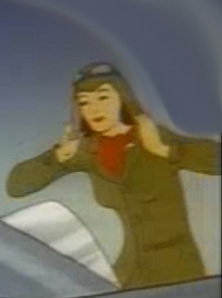
Lois in pilot's helmet, 1941

Episode 7 of the Superman radio series introduced Lois Lane to the listening audience in February 1940, in a storyline titled, “The Atomic Beam Machine.” (Click to download mp3 audio from the Internet Archive, if you don’t see an audio-player icon.)

While Superman movies have focused on threats to the universe-as-we-know-it, the 1940s radio adventures gave a better picture of Clark and Lois at work as reporters — both highly skilled and very confident ones: The 12-minute episode 6 opens with Kent calling Perry White asking him to “stop the presses” for his first story — and White does it!

The next plot, previewed at the close of episode 6 and running through the next three days, literally makes The Daily Planet the center of the plot: A villain (“The Yellow Mask”) steals a top-secret atomic weapon and threatens to fly by and blow up the newspaper building.

Half-way through episode 7 (the one enclosed above), the new guy at the Planet meets experienced reporter Lois Lane for the first time. He’s just back from his first assignment — which brought him that page one scoop, assisted by some skills we still don’t teach in journalism school. You know — flying, X-ray vision, super-hearing, that sort of thing. But Clark Kent managed to keep his reporting techniques a secret, even the transcontinental-flying-without-a-plane part.

Regardless, Lois is not impressed. She calls him “the boy wonder,” “mister star reporter” and “the white-haired boy.” (At first I wondered whether that was a joke crossing “fair-haired boy” with the name of editor Perry White, but a couple of dictionaries convinced me the “white-haired” phrase was in general use as a synonym for “a favorite.” I’ve also heard it used in other radio shows of the 1940s.)

Lois: “They tell me you talked yourself into a job went out west and came back with the biggest story of the month, all in less than a week. You’ve got the old man hypnotized. He thinks you’re Horace Greeley.”

That made me wonder: Did the average school-age listener to Superman in 1940 know about Greeley — the 19th century New York Tribune editor? Apparently so. I’ve heard other references to him in unrelated radio series.

I suspect that a Tribune centennial, hyped by the still-publishing Herald-Tribune had Greeley in the news and the public consciousness, as mentioned in the Cavalcade of America Margaret Fuller episode I posted here last time. (Too bad my library doesn’t have digital archives of the Herald-Tribune from that era; I’d be off looking for more evidence of Greeley-promotion.)

Meanwhile back in the Superman episode… Lois even suggests that Kent made up the threat to blow up The Daily Planet — the story he is investigating.

Journalism students and historians may find it ironic that Lois is not very impressed by her own new assignment, in 1940, to interview the “leading American investigator in the field of atomic energy.” Even editor Perry White suggests that it’s just “human interest stuff,” a softer news story than her usual beat. Here’s most of the conversation:

White: “Oh, I’ve got a job for you Lois.”

Lois: “A good job?”

White: “No. Go out and interview a scientist. Human interest stuff… Leading American investigator in the field of atomic energy.”

Lois: “Must we, chief?”

White: “Yeah come on, get going, Lois… This paper has always been tied in with science… He said somebody stole a new machine he invented… He seemed pretty worried… Sounds cracked, but it may make a yarn. Now on your way, girlie.”

I’m not going to podcast all of the Superman episodes here, but the seriously interested can get all of the story in the Superman collection at Archive.org. Interestingly, in episode number nine, the thrilling conclusion of this tale, Clark Kent reveals a skill no one expected: He knows how to fly — not as Superman, but by taking the controls of an airplane in an emergency attempt to rescue Lois.

A year later, as shown in the snapshot above, one of the early Superman cartoons had Lois as the one donning a high-tech 1941 pilot’s helmet and taking the controls of an open-cockpit plane to get to a story in a hurry. Reporters used to have some pretty impressive skills! Perhaps the audience expected them, having been brought up on the “stunt-girl” adventures of real-life reporters like Nellie Bly, radio reminders and all.

At the climax of the radio episode, however, Lois is falling through mid-air and Superman is the one doing the flying. Later, as that episode ends, reports of a fire and a woman trapped on a 20th floor comes into the newsroom, and Kent is begging White for the assignment, “maybe I can do something.” This newspaper job certainly seems to be everything the professor predicted, when he told him to find work on a great metropolitan daily.

This is all by way of suggesting that even at its most “cartoonish,” old-time radio serial portrayals of journalists had them covering the news — sometimes realistically, sometimes fantastically, but generally getting the story in somewhat heroic fashion.

Posted in Clark Kent, Horace Greeley, Lois Lane, reporters, Superman, women | Leave a comment

Margaret Fuller’s fountain of firsts

Updated: 2014 with a link to a new biography, and shifted to more printable “page” format with editing in 2020, as “Margaret Fuller, The Heart and the Fountain.”

Margaret Fuller was an author, the first editor of the transcendentalist magazine The Dial, and the nation’s first woman foreign correspondent. Margaret Fuller DaguerreotypeShe went to Europe in the 1840s for Horace Greeley’s New York Tribune.
The Heart & the Fountain (download) is the title of DuPont Cavalcade of America’s half-hour dramatized biography of this “woman of astonishing genius in American journalism,” as the 1941 broadcast called her. She became literary critic for the Tribune, the paper’s first woman writer. One of the intellectual elite of 19th century America, she was a philosopher, feminist and intellectual, no “women’s angle” sob-sister. She advocated women’s rights and education in her 1845 book, Woman in the Nineteenth Century.

“Yet Margaret Fuller’s journalistic descendants still risk their lives, not just because they work in dangerous places, but because they are female, objects of scorn and worse, in many parts of the world, for daring to serve in the public arena. What was it like to be such a woman, the first female war correspondent — a half-century after America’s own revolution?” — Megan Marshall, Margaret Fuller: A New American Life (2013), pp.xx-xxi

There are few answers to that question in Cavalcade’s half-hour drama, but perhaps enough of Fuller’s brilliance and tragedy comes through to inspire 21st century readers to open more recent — and excellent — biographies.

The tragedy? After taking a lover and having her only child — while covering the 1848-49 attempt to establish a Roman Republic — Fuller died at age 40 when her ship ran aground just short of arrival back in America. It was 1850. She was bringing home her husband, her child, and the manuscript of her book about the failed Italian revolution. All were lost. That might also make her one of the first American foreign correspondents to die in the line of duty.

The DuPont Cavalcade of America radio series brought her biography to a 1941 audience in the award-winning episode above, but her story seems too much for the half-hour time slot. (Click the player or download the audio at the top of this page.)

Played by Madeleine Carroll — I’m assuming the same actress who starred in Hitchcock’s “39 Steps” and “Secret Agent” — Margaret has strong scenes opposite Cavalcade players cast as Emerson, Thoreau and Horace Greeley, as well as the romantic Marchese Giovanni Angelo Ossoli, whom she married while in Italy.

Did audiences back then find it disappointing that so much of the Cavalcade episode focused on the romance at the end of her life? Or did the gaps in her story inspire them to look for more information about this remarkable woman?

Announcer Clayton Collyer mentions at the end of the program that Cavalcade was marking the centenary of the (by then merged) New York Herald-Tribune, “almost a century from the day Margaret Fuller joined its staff.” However, with so much more story to tell, the episode has little to say about Fuller’s newspaper work.

(A man of many voices, Collyer himself played perhaps the most famous fictional journalist on radio — Clark Kent, along with his alter-ego Superman — although his name was not mentioned in the original series credits, a tribute to the Man of Steel’s secret identity that also saved Collyer from being type-cast.)

The title of the Cavalcade episode is a bit of a mystery. It is not a line of dialogue from the radio play or a direct reference to one of Fuller’s works.
“How extraordinary! My guess is that the title isn’t a quotation, but a combination of two metaphors that seemed apt for Fuller’s life to the dramatist,” Fuller biographer Megan Marshall wrote, in response to my email inquiry in 2013. Boston University Professor Charles Capper agreed, writing: “I’m afraid I can’t help you–I’ve never heard the phrase either and I think I read every word she wrote that still exists.”


For more on the radio program:

Audio from the Internet Archive’s Cavalcade collection by the Old Time Radio Researchers Group and others.

See also, RadioGoldIndex (which misprints the title as “The Heart and The Foundation”), Art Chimes’s series log, the 2001 University of Virginia project, The Cavalcade of America: Myth and Reality, Hero Worship in American Radio, and Martin Grams Jr.’s book, The History of the Cavalcade of America.

For more on Fulller:

  • UPDATE: 2014 Pulitzer Prize winning biography,”Margaret Fuller: A New American Life” by Megan Marshall (Houghton Mifflin Harcourt, 2013).
  • An Unfinished Woman: The desires of Margaret Fuller,” by Judith Thurman in the April 1, 2013, The New Yorker; a biographical essay after the publication of the Marshall and Matteson biographies.
  • A history of women in journalism at the New York State Library.
  • Margaret Fuller biography website at the Unitarian Universalist Association.
  • Margaret Fuller profile in James Castain’s online Encyclopedia of 1848 Revolutions at Ohio University.
  • The Lives of Margaret Fuller by John Matteson (Norton, 2012), “restores the heroism of her life and work,” according to a “briefly noted” review in The New Yorker (Feb. 2, 2012, p.75)
  • Bancroft-prize-winning biography by Charles Capper:
    • Margaret Fuller: An American Romantic Life Volume 1: The Private Years (Oxford University Press, 1992)
    • Margaret Fuller: An American Romantic Life Volume II: The Public Years, by Charles Capper (Oxford University Press, 2007)
  • Margaret Fuller: Transatlantic Crossings in a Revolutionary Age ed., Charles Capper and Cristina Giorcelli (University of Wisconsin Press, 2007).

The Internet Archive (archive.org) also has digital copies of out of copyright work by and about Margaret Fuller

Google Books has scanned many of Fuller’s works and works about her, including volumes of The Dial, collected memoirs, her At home and abroad essays, and more. (Some of these volumes were edited by her brother, Arthur Buckminster Fuller. The family’s more recently famous polymath, R. Buckminster Fuller, was her great-nephew.)


Note — Collections of mp3 files of Cavalcade episodes and collectors’ logs of the program consistently list the title of the Fuller episode as “The Heart and the Fountain.” However, there was a “chirp” in the first mp3 recording I had of this program, right as the title was given, which led me to suspect the third word should be “of.” Had that been the case, the episode’s enigmatic title might refer to this cheery quote from Lucretius:

From the heart of the fountain of delight rises a jet of bitterness that tortures us among the very flowers.

However, the title does appear to be spoken “heart and…” on the better transcriptions of the program and Art Chimes’s series log indicates that he checked the title against the Cavalcade script collection.
Chimes, however, logs the program as episode 224 with a different broadcast date almost a year after its mention in print.
“224 4/28/42 The Heart and the Fountain $ – reportr Margaret Fuller = M Carroll”
The May 24, 1941, New York Times did refer to the episode by the same “The Heart and…” title when the Woman’s Press Club of New York gave the series an award of merit, particularly noting the April 28, 1941, Fuller broadcast.

(The Times, however, is not immune to error: It misspelled the name of Tribune editor Horace “Greely” when referring to his sending Fuller to Europe. You can find the item on page 34 of the May 24, 1941, Times in the ProQuest Historical Newspapers archive at your library. My own mistakes include a couple of places in the first-draft of this page where I used “Herald” when I meant “Tribune” and misspelled Bud Collyer’s unusual last name. Mea culpa.)

Posted in 19th century, cavalcade, historical figures, Horace Greeley, international, journalism, magazines, reporters, women | Leave a comment

Radio marked founding of women’s magazines

I’ve already mentioned Godey’s Lady’s Book here, because Cavalcade of America did an episode about its editor, Sarah Josepha Hale.

Here’s a women’s magazine whose name may be more familiar to 21st century readers: Ladies Home Journal. It’s still around in print, and has an online edition called LHJ.com, which even offered a 125th anniversary trivia contest. Back in the 1930s, radio listeners heard two rather different tales of its founding.

Cyrus & Louisa Knapp Curtis (click to play or download)
On DuPont Cavalcade, the magazine’s original editor, Louisa Knapp Curtis, turns up in the last 10 minutes of this program titled “Opportunity,” first broadcast in 1936. The multi-part episode follows its title theme across two centuries, from Benjamin Franklin to the magazine publisher Cyrus H.J. Curtis, who ultimately owned the Saturday Evening Post, which traced its origins to Franklin’s Pennsylvania Gazette.

The episode quotes Louisa Knapp Curtis saying that her husband was inspired by Franklin, and also brings her into the story to laugh at the sorry excuse for a women’s page in one of his early publications. In response, she became the editor of that page, which the couple eventually expanded into a magazine of its own, The Ladies Home Journal.

It was, as the narrator tells us, “one of the first great financial successes of the publishing business.”

A year later, another of radio’s historical-drama series profiled Cyrus H.J. Curtis, and barely mentioned Louisa. Give a listen to this 1937 “Captains of Industry” episode from the Old Time Radio Researchers Group at archive.org, which is also the source of the Cavalcade program above:

Cyrus H.J. Curtis (1938) click to play or download

As its name hints, “Captains of Industry” draws a more businesslike picture of Curtis, even making his deal for the Saturday Evening Post sound like aggressive capitalism, while “Cavalcade” makes it sound like a much gentler rescuing of the struggling magazine, in Ben Franklin’s honor.

Louisa Knapp Curtis doesn’t get much credit, but if you listen carefully, you’ll hear mention of the fact that profits from the Ladies Home Journal were the force behind the Post deal, among other things.

For more about the Captains of Industry series, see the kind folks at DigitalDeliToo, who have researched the series and its origin, a production of David Louis Harris’s Atlas Radio Corporation of Canada. They add a hat-tip to rescuer of radio archives J. David Goldin’s RadioGoldIndex for his detailed listing of the programs.

I haven’t listened to all of the 52 “captains” profiled, just those involved in journalism, and from the gender of the names, I don’t expect to be making any more Women’s History Month references to the series.

Posted in 19th century, cavalcade, historical figures, magazines, publishers, women | Leave a comment

Anna Zenger: Romance or history?

1733 NYWeeklyJournal Jan7

These two episodes from Calvacade of America fall into a journalism category we might call “stories too good to check,” but they are still fascinating.

The historical-drama Cavalcade series featured a number of women journalists, some of whom may have been slighted by a “great men” approach to history. When history books mention Anna Zenger, it is usually as a wife who kept The New York Weekly Journal going while her husband was in prison, rarely in the detail presented in these two versions of the Cavalcade of America script. (The casting of the 1949 version is brilliant, featuring Rosalind Russell, the actress who played one of Hollywood’s most celebrated fictional women journalists, Hildy Johnson.)

Anna’s husband was John Peter Zenger, whose name ranks high in the annals of freedom of the press in America. Zenger went to jail in 1734 for publishing allegedly libelous material, and the courtroom drama that freed him is famous for developing the concept of truth as a defense against accusations of libel.

For a more conventional account, see this, from the U.S. Department of State publication, Historians on America: The Trial of John Peter Zenger and the Birth of Freedom of the Press by Doug Linder.

The Historical Society of the Courts of the State of New York also has a history site on The Trial of John Peter Zenger, including a copy of the 1736 pamphlet, A Brief Narrative of the Case and Tryal of John Peter Zenger, Printer of the New York Weekly Journal.

For another dramatic interpretation, see The Trial of John Peter Zenger, a play in five scenes by Michael E. Tigar, Thomas Watt Gregory Professor of Law at the University of Texas, Austin.

1953: Seldes and Albert as the Zengers

To my knowledge, the Zengers’ story has never been a feature film, but it was a very early (1953) made-for-TV movie, “The Trial of John Peter Zenger,” starring Eddie Albert and Marian Seldes. (Seldes, coincidentally, was daughter and niece of two well-known writers, the critic Gilbert Seldes and journalist George Seldes.)

At best, these accounts of the case identify Anna Zenger as the wife who kept her husband’s press running during his eight months in jail — quite an accomplishment by itself. Zenger is generally agreed to have been the printer of the paper, not author of the articles attacking Governor William Cosby and his crowd. Cavalcade, however, makes Anna not only the one who kept publishing, but the author of the articles — and the one who came up with the idea of publishing an opposition newspaper in the first place!

James Alexander, a young lawyer, is more often identified as a probable author of the material, as well as one of Zenger’s original defense attorneys, until he and his colleague William Smith were disbarred — the lucky stroke that brought one of the American colonies’ most distinguished lawyers, Andrew Hamilton, all the way from Philadelphia to defend Zenger. (Cavalcade has Anna herself going to Philadelphia to obtain his services.)
book jacket for Kent Cooper's "Anna Zenger, Mother of Freedom"

So where did the Cavalcade version of the tale originate? It was a novel by one Kent Cooper, whose name was not associated with fiction or flights of fancy: He was executive director of the Associated Press. Why did he make Anna Zenger the heroine of his version of the tale of her husband’s trial?

Cooper speaks for himself at the end of the “Mother of Freedom” production, but does not reveal his sources for his Anna-centric view of the Zenger case. I’m waiting to get my hands on copies of his novel and his autobiography to see if they shed any light.

The two Cavalcade adaptations of his story have significant differences. The Rosalind Russell version skips the earlier production’s opening conversation between the author and the spirit of Anna Zenger, as well as a closing invocation of Ben Franklin, who bestows upon Anna the “mother of freedom” title. I don’t know whether that conversation has any basis in Franklin’s writings, or was Cooper’s invention, but I intend to do further research — if my students don’t beat me to it.

Meanwhile, for a general debunking of Cooper’s version of the story, see The Myth of Anna Zenger by Vincent Buranelli, in The William and Mary Quarterly, Third Series, Vol. 13, No. 2 (Apr., 1956) (pp. 157-168), which may be available through your university library’s subscription to the JSTOR service.

Posted in cavalcade, historical figures, journalism, newspapers, women | Leave a comment