I mentioned these Christmas episodes last year in my other blog before starting JHeroes.com, but ’tis the season… “Casey, Crime Photographer” was the radio version of a pulp fiction and movie character, and went on to have his own comic book and — briefly — TV series. More a detective series than a “journalism procedural,” it had memorable characters and drew a radio audience for a dozen years, off and on.
In this episode, pickpocket Fingers Fogarty is the one doing the Christmas Shopping… not exactly a case of journalistic detachment in the way Casey goes after a criminal in this 1946 episode, but at least a little bit of Christmas cheer.
A favorite line…
Annie: Maybe you need glasses.
Casey: I do; several glasses.
Next, this 1947 episode opens with the journalists and their bartender friend Ethelbert commiserating about working on the holiday. Later, there’s some depressed-at-the-holiday talk between Casey and Ann — perhaps even a bit of hard-bitten cynicism from Casey — on everyone’s way to a homily-filled Christmas story about faith and renewal, “The Santa Claus of Bums Boulevard.”
“The power and the freedom of the press is a flaming sword; that it may be a faithful servant of all the people, use it justly. Hold it high. Guard it well!”
Writer Jerry McGill, a former newspaperman, and the cast of Big Town, pulled out all the emotional stops on Prelude to Christmas, a December 1948 melodrama about the arrival in America of a Polish refugee newspaper editor and his war-traumatized daughter. The girl winds up lost in the city on a cold winter night, fearful of police and even of the mysterious newspaper office where her father has gone to tell his story.
Edward Pawley, as “fighting managing editor” Steve Wilson, heads the cast as usual, joined by experienced Broadway child actress Jimsey Somers as Greta, the scared little girl, and Stefan Schnabel, as her heroic editor father.
Donald McDonald’s recurring character “Willie the Weep,” moocher and panhandler, plays a larger part than usual, becoming an appropriately sentimental Skid Row Santa. Between his sobs and tears, Willie befriends the girl while out collecting spare change for Wilson’s Illustrated Press Christmas charity fund. Count the charity drive as a radio reminder of things newspapers did for the community — when their editors weren’t out on the street fighting crime. At least that’s what Steve Wilson did in most other weeks of the series.
Echoing the usual “flaming sword” motto from the start of the program, Wilson offers to write the profile of editor Gregory Vilna himself, focusing on his imprisonment by the Nazis and his work in the Polish underground. The refugee says he is honored.
Wilson: “I am the one who is honored, in being able to publish the story of a newspaper editor who sacrificed everything to defend the freedom of the press.”
Vilna: “There were many of us, Mr. Wilson. We did what we could to stem the tide of tyranny, but tragically it marches on. Tyranny does not die in battles, so long as it lives in the hearts of men…”
With tyranny comes fear, and Vilna explains that his daughter is still afraid of everything — strangers, police, even the newspaper office.
“Poor little Greta. For so long as she can remember she has lived in the shadow of fear. She has suffered hunger, witnessed horror. She walked with death. Only joy she does not know. I have never heard her laugh… and yet she has faith in God.”
After her father leaves for his interview, Greta runs off in search of him and gets lost in the big city, giving the episode a dramatic theme, about faith conquering fear.
Memories of his daughter praying in the rubble of a ruined cathedral inspire the father to tell Wilson to search houses of worship for her. “Any church — any house of God,” he says. “It would make no difference to a child seeking solace.” “Or to any of us,” Wilson adds.
A waterfront mission preacher continues the ecumenical message, invoking “God, Jehovah, Allah or some other name of faith…” in his call to prayer. Wilson and his searchers also visit a synagogue and a Catholic church, complete with Hebrew and Latin singing.
The tale is far from the usual crime-and-corruption Big Town storyline. Wilson never gets slugged on the head, never disarms a gangster, never throws a punch. And he never has to call on cab driver, “Harry the Hack,” to bring along his monkey wrench for protection. Instead, the two get to reflect on the holiday, human nature, and the negative image that is too often in the news. Christmas hymns play in the background:
Wilson: I’m worried too, Harry. But everything is being done that can be done.
Harry: A lot can happen to a kid in this hard-boiled town.
Wilson: We deal too much with the seamy side, Harry. Actually, people over Big Town are no worse than other people the world over.
Harry: Yeah more good than bad, even in the seamy ones. I guess we kinda forget that.
Wilson: We forget a lot of things, Harry, that we only remember this time of year.
Historical footnote
At the time of this 1948 broadcast, the “displaced persons” issue was topical. Within a week, ten international religious and relief organizations issued a “New Year appeal from Geneva calling on all nations to help the growing number of homeless refugees. Earlier that year, President Truman had complained that Congress’s efforts at a Displaced Persons Act fell well short of what America should do, especially in its treatment of Jews and Catholics.
The Polish editor in the “Big Town” episode makes no reference to such controversies, but tells his daughter that she should forget her fears from the old country. Even though they are not Americans yet, they will be someday:
“Here in America the officials of the government are the servants of the people, not the people slaves of the officials… We are guests of the people of America. Through their Congress they have invited us here to live and work and pursue happiness.”
It isn’t quite Christmas, and I’m far from Connecticut. (Yes, Santa, I’m in Virginia.) And the Martha Stewart or Gladys Taber style feel-good food-and-home magazine feature writing celebrated in the 1945 film “Christmas in Connecticut” doesn’t really match my “Newspaper Heroes” banner.
But the 1945 film about feature writer Elizabeth Lane, and its 1946 radio adaptation here, do flirt with “media ethics” issues enough to fit some future “portrayal of the journalist in popular culture” classroom discussions. That’s enough excuse to include them here.
And, after all, Christmas is right there in the title. So here it is, from radio’s Screen Guild Theater:
(2020 Note: The recording speed of that program in the Internet Archive Screen Guild collection was “off,” so I’ve replaced it with a copy from a different Internet Archive Christmas Stories collection.
I have always had strange feelings about the Hollywood association of Connecticut with idyllic holiday-inn country retreats from New York, having gone to high school in a Connecticut city that The New York Times once said was marked by chimney stacks, church steeples and racism charges. But the smokestacks are relatively idle now, and I like to think the other ills also have lessened in the 40 years since that Times story.
But then as now, for every Waterbury, Bridgeport or Hartford, the state still has whole counties (Litchfield, Middlesex, Tolland and Windham are my favorites) holding small towns like the one portrayed here, even if the romantic horse-drawn sleighrides are about 50 years in the past.
The sleighriders in the Screen Guild Theater radio version of the story are, notably, not-yet-president Ronald Reagan and his then-wife Jane Wyman, instead of the film’s Dennis Morgan and Barbara Stanwyck. Stanwyck already had played the ethically shaky sob-sister creating populist political fraud in “Meet John Doe,” a film with its own hint of Christmas.
In “Christmas in Connecticut,” the lead character is a fabulist again, but guilty only of spinning tales of a warm home and fireside to accompany recipes and child care tips. In reality, she has neither country home nor husband and child. At best, she can borrow farm, chef and baby to play-act when Smart Housekeeping magazine books a weekend visit from a war hero. (Reminder: 1945 movie; 1946 broadcast.)
The radio version is as sweet and heart-warming as the film, and one can only imagine what the radio-studio audience was witnessing during the bathing a baby scene. The laughter is infectious, if a bit mysterious.
Reagan and Wyman are charming together, even if their real-life marriage was not in great shape. (They divorced two years after this broadcast.) And the program was good enough for me to be patient with the poor recording quality of the first version I found online.
“Newspaper movie” fans may recall that Wyman also stepped into the “Torchy Blane” reporter character in 1939’s Torchy Blane, Playing with Dynamite, in which her reporting technique includes turning in false fire alarms to get thrown into jail to work on a story undercover, a rather Barbara Stanwyck thing to do.
At least Jane Wyman’s “Christmas in Connecticut” Liz Lane character doesn’t finish the story “John Doe” style by trying to get Ronald Reagan’s character to run for president. That would have seemed like too much of a fantasy in 1946. It still did 30 years later!
Editorial note. This item was composed and uploaded with the WordPress app on a Motorola Droid telephone in 2011. Then I edited it with a Macintosh to add a YouTube clip of the movie trailer (later removed by whoever uploaded it), and to fix a broken link or two, and even succumbed to the temptation to add the “Yes… Virginia…” line to the first paragraph and add some Connecticut reminiscing of my own. Now, nine years later I’ve used a newer Android phone and WordPress app to update links and point to the two Jerry Haendiges pages with new higher quality recordings.
William Conrad, who played a city editor with a dramatic “It’s a newspaper, that’s all…” speech in the Jack Webb newsroom movie “-30-,” appears as an editor again in this Christmas episode of the “Night Beat” radio series in 1951, as the man reporter Randy Stone calls “the big boss.”
Five Days off for Christmas
The story opens on Christmas Eve with Stone telling how editor Sam Bullock’s surprise gift of a Christmas vacation took a dark turn that sent him looking for an injured boy and examining his own reportorial cynicism.
“Christmas Eve, jingle bells, silent night, boughs of holly. Yeah They say there’s a warmth about Christmas that spreads out like a fan and touches everyone. The holiday spirit they call it…”
“As far back as I can remember Christmas has been another workday for Stone…”
William Conrad, as the boss, calls him in and gives him the week off as a Christmas present. His first reaction: “I’ll come back when you’re sober.”
But the editor is serious, and Stone — apparently having no family outside the newsroom — starts thinking of friends to visit. It’s a disappointing quest, until… give a listen.
While not quite “It’s a Wonderful Life” or “Miracle on 34th St.,” you will hear a hint of Dickens in this Christmas drama with a closing message about “happiness… a thing of the spirit, not the pocket.”
The “Night Beat” writers had a flair for catching newspaper business realities 60 years ago. This episode has the sounds of a newsroom office party, followed by lonely late-night teletypes echoing through the almost-empty room.
Stone, played by Frank Lovejoy, reflects on his daily-newspaper career, where “As far back as I can remember, Christmas has been another workday…”
He has written so many stories about people in need that he can’t recognize the name of one of them, or the fact that sometimes he might be the needy one himself.
Back to Conrad: If you listen to more episodes of “Night Beat” in the Internet Archive collection, you’ll hear Conrad’s distinctive baritone in a variet of roles, from punch-drunk boxer to dying newsman. He was better known as the original Matt Dillon on radio’s “Gunsmoke,” and later as detective Frank Cannon on television in the 1970s. He also was a film producer and director before his death in 1994. (obit)
I’ll be posting more radio-newspaper-Christmas stories next week, and more of Night Beat in the weeks to come.
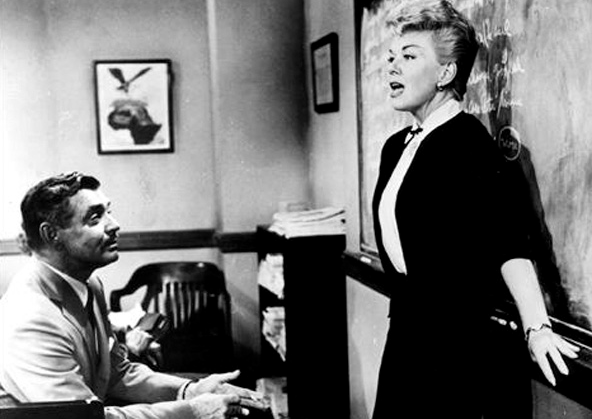
My “Portrayals of the Journalist” class eventually will watch the 1958 Clark Gable and Doris Day film “Teacher’s Pet,” in which a young journalism professor spars with a tough city editor who invades her class to expose what a waste of time journalism courses are. (He brags about learning on the job and not finishing high school himself.)
For another 1950s view of journalism education, here are two episodes of “Rogers of the Gazette,” in the first of which small-town editor Will Rogers Jr. finds his newsroom invaded by a student intern with big-city ideas about the watchdog press.
In both “Teacher’s Pet” and these two Rogers episodes, you’ll also find the common theme of the changing role of women in journalism. (In fact, “Teacher’s Pet” was co-written one of the authors of the Academy Award winning “Woman of the Year,” yet another variation on the theme.)
In this next episode, a speech by Rogers inspires enthusiastic twins from a high school journalism class, 531230_024_Investigative_Reporters — 6.9 MB
As usual, these MP3 files are from the Internet Archive, which has more:
While not exactly Mayberry, the series makes me imagine Andy Griffith’s Sheriff Andy rewritten as a small-town editor. It’s a whole other journalistic “myth/reality” than the big-city newsroom Hollywood movies and New York radio gave us most of the time. Students should do some background research on real-life Kansas editor William Allen White, a national legend when these fictional tales — including “Teacher’s Pet” were written. He is a clear model for the Doris Day character’s editor-father.
I’m working on a longer essay about Rogers of the Gazette; it will be password-protected for student use until it’s finished.
If an image or a video player appears beneath this line, it is an ad posted by the WordPress hosting service and not anything I have seen, much less approved. Ignore it.
The opening of this “Frontier Gentleman” radio drama from 1958 sounds appropriately like a lead sentence for a newspaper feature story:
“The great chief of the Sioux Indians is Sitting Bull. He’s a rather difficult chap to meet, especially when he’s preparing for war…”
When the series’ hero, London Times correspondent J.B. Kendall, arrived at the edge of Indian territory in the mid-1870s, he discovered a kindred spirit — an American newsman, Charlie Meeker of the Montana Telegraph-News. (Click his name to download a half-hour mp3 of the episode from archive.org) The journalistic camaraderie between the two fictional newsmen is immediate, despite their different backgrounds.
At least I’m assuming Meeker was as fictional as Kendall. Virginia City, the territorial capital, did have its first newspaper by then, but I’ve found no record of a real Virginia City Telegraph-News. Neither did Christine Kirkham, coordinator of the Montana Digital Newspaper Project, who graciously checked several databases for me. She discovered only one paper with the word “Telegraph” in its title: The Walkerville Telegraph, 1891-93.
Kendall was portrayed as a cool-headed adventurer, a veteran of the other “Indian wars” — in India, as a British cavalry officer. (His suggested cure for Meeker’s hangover involves tea, ginger and a cobra’s head.)
Despite the series title and Kendall’s cultivated accent, this mild-mannered reporter was no dandy. He was handy with a six gun, a knife and his fists, while spinning prose poems from Missouri to Montana. He was even a wordsmith when getting the drop on the bad guys. None of the “Drop yer gun, varmint!” from him. Instead, it was:
“You may very slowly and carefully unbuckle your gunbelt and let it drop to the floor. If you try to be foolish and brave, I shall be delighted to shoot you in the stomach.” — (from the episode “Remittance Man”)
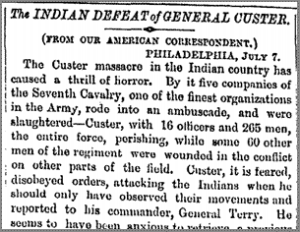
While the "American Correspondent" wasn't by-lined, The Times of London did have the biggest news out of Montana In July 1876, the same period as the fictional J.B. Kendall.
The script writer was a bit heavy-handed in naming the American “Meeker,” along with describing him as short, thin and round-shouldered, in a plot about the courage of the somewhat frail and alcoholic reporter.
Unlike Kendall, Meeker doesn’t carry a gun. But he agrees to help the Englishman try to get an interview with Chief Sitting Bull, and then — inspired by Kendall — insists on accompanying him on the assignment, rather than let the foreigner risk his life alone. The ending is foreshadowed, but well played, including a brotherhood-of-reporters theme not uncommon in popular culture portrayals of otherwise competitive correspondents.
In this and later episodes, Kendall relies on local journalists to direct him to colorful characters and stories that might interest his British readers, such as the old prospector named Short Horned Tom (in the episode “The Lost Mine”), who Kendall describes as “the most unwashed individual I’ve ever come across in my life.”
John Dehner starred in the weekly series “Frontier Gentleman,” a 1958 CBS adult Western. As J.B. Kendall, correspondent, he explored the American frontier of the 1870s for The Times of London. The show’s opening:
Herewith, an Englishman’s account of life and death in the West. As a reporter for the London Times, he writes his colorful and unusual stories. But as a man with a gun, he lives and becomes a part of the violent years in the new territories.
“Adult” westerns in the 1950s were not as “white-hat-good, black-hat-bad” as The Lone Ranger and other cereal-selling juvenile series. Characters could have a beer now and then, but they still couldn’t use expletives any stronger than “son of a gun!” The “Frontier Gentleman” writers clearly had fun with that in an episode titled “The Honky Tonkers,” where one character uses the phrase “son of a gun” a dozen times in the first three minutes. Adding whiskey and dance hall girls, and more son-of-a-gun foul language (with ladies present!) offends Kendal and eventually leads to a fight, a shooting, and an opportunity for Kendall to perform emergency surgery as learned on some distant battlefield. I suspect Richard Harding Davis would have been proud to have him as a colleague.
Historical figures were woven into many of the plots, including newsmakers Col. George Armstrong Custer (in “Kendall’s Last Stand,” a few episodes after the Charlie Meeker story), as well as Jesse James and Wild Bill Hickok. From the scripts and acting to the cinematic musical score, “Frontier Gentleman” was a state of the art example of radio dramatic production, just before radio drama disappeared in the glow of television.
Each story has narration by Kendall woven through the dialogue, as he interviews Indian scouts, gunslingers, homesteaders, gamblers, exotic women, a man who herds cats, and other colorful characters. It’s not hard to imagine his descriptive narratives being printed in London as newspaper features.
Thanks to the Library of Congress and university libraries’ access to digitized 19th century newspapers, students researching the series can have fun looking for accounts or actual incidents or individuals mentioned in the series — remembering that 1958 radio script writers had much more limited research resources. Here’s a Montana-newspapers search for “Sitting Bull” in the 1870s at Chronicling America.
While the introduction to each episode is comparable to a newspaper’s “lead” or a television broadcast’s opening “tease,” the endings sometime tell another angle that rings true — Kendall heading to the express office to see if his latest remittance check has caught up with him. Often, it hasn’t.
Note: As an experiment, I composed this item with the WordPress app on a 7-inch Pandigital Android tablet. Images were added and typographical errors were (or will be) fixed later from a real keyboard. Among other things, the tablet likes to change the word “an” to “Android” or transpose “of” and “or” when I’m not looking. Apologies if you struggled through the first draft.
Editor Randall: “We’re going to fry this story over again and fry it hot!” He asks new-hire Kitty Carmody, “You’re from Chicago, huh… They teach you to swipe pictures?” She replies, “Well, I’ve done everything.” Isapod (Boris Karloff) clearly hopes that’s true. Click to play the whole “And I thought I was cynical” scene…
For students watching the 1931 film “Five Star Final” with Edward G. Robinson as a guilt-ridden tabloid editor, and for anyone looking for an audio alternative to the old-movie experience, here is something close to a radio sequel to the story.
This premiere half-hour episode of the long-running series “Big Town,” is a melodramatic little tale titled “Pittsburgh Lil.” Robinson plays editor Steve Wilson of the Illustrated Press, a scandal-monger with a lot in common with editor Randall of the Evening Gazette in “Five Star Final.”
A recording of the Oct. 19, 1937, radio program is stored at MediaFire: Big Town: Pittsburgh Lil. (It’s a 26MB downloadable MP3 file.)
To better appreciate the rapid-fire dialogue, you can follow along with the script of “Pittsburgh Lil,” available from Generic Radio Workshop. The story manages to work the Alaska frontier, Ibsen’s “Doll House” and a Beethoven interlude into the plot; you’ll have to listen — or skim the script — to find out how.
The Illustrated Press is portrayed as an anything-for-circulation paper, about as bad as the Evening Gazette in “Five Star Final,” which was inspired by my favorite nutty tabloid of the 1920s, the Evening Graphic. The film was based on the 1930 play “Five Star Final” by Louis Weitzenkorn, who had served briefly as editor of the Graphic. (Both the movie script and a DVD of the film are available at McConnell Library for my Radford students.)
“Big Town” starred Robinson — better known for gangster roles like “Little Caesar” — as managing editor and the 27-year-old Claire Trevor as “Lorelei,” a sophisticated social worker turned society reporter. Her editor is her “reform” target in this first episode.
While plenty of later “Big Town” episodes are available online, they portray a more evolved Wilson — as the racket-busting editor of a crime-fighting paper. The transformation from scandal-sheet to civic pillar appears to have happened in the first few months of the series, but only the opening two episodes of that story are in the online audio collections.
In the missing episodes, Wilson apparently wrested the sleazy paper from its controlling owner and set out to change it, change himself, and change the city named “Big Town.” His inspiration came from his muse, Lorelei, and by Pittsburgh Lil, the subject of his scandal-mongering, who tries to kill him in this opening show.
Steve Wilson stayed in control of The Illustrated Press as a corruption- and racket-fighting editor for 15 years on radio, with Robinson in the part for the first five years and Edward J. Pawley for most of the run. (As “fighting managing editor” for most or those years, Wilson’s motto was the “Freedom or the Press is a flaming sword…” line now hinted at the top or this website.)
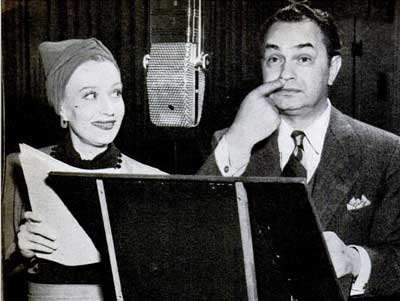
Ona Munson and Edward G. Robinson, indicating timing was “on the nose,” during a Big Town broadcast.
Trevor was replaced by Ona Munson in 1940, something of a tabloid reunion. Munson and Robinson had starred together in “Five Star Final,” where he played the guilt-ridden editor and she played Kitty Carmody, a conscience-free sob-sister from Chicago who teams up with creepy reporter Boris Karloff on the sensational story that convinces Robinson’s character to quit the paper.
Note: In spring 2012, the full film Five Star Final was posted at YouTube. I would have expected this to be a copyright violation that YouTube would block, but perhaps some loophole allows them to keep it online. Unless they do, here it is…
Clark and Lois get most of the attention at The Daily Planet, but their editor Perry White had his heroic moments too. One was when his editorials against a white-hooded gang of hatemongers resulted in a burning cross on his lawn, a close call with a bucket of tar and sack of feathers, and a brush with death at the hands of a Ku Klux Klan look-alike group.
The group — which the Superman scriptwriters called “a gang of hooded terrorists” way back in 1946 — was “The Clan of the Fiery Cross,” subject of a 16-episode story by that name. Behind the scenes was a real-life journalist and folklorist named Stetson Kennedy, who leaked Ku Klux Klan information to syndicated columnist Drew Pearson and to producers of the Superman radio serial, as noted in the Associated Press obituary for Kennedy, who died in August at 94. (He would have turned 95 Oct. 5, and memorial tributes are being posted at stetsonkennedy.com)
The full “Clan of the Fiery Cross” serial is part of the Internet Archive’s old time radio files, on page nine of its Superman collection, along with an earlier 1946 storyline “The Hate Mongers,” which had a similarly progressive theme. This time, Perry White was the target of a car bomb after he contributed $10,000 to an interfaith community group, while Superman joined forces with a rabbi, a Catholic priest and a Methodist minister to fight leftover Nazis in Metropolis.
For a taste of the action, Part 9 of the Clan of the Fiery Cross tale is a good example. In it, White confronts the “Grand Scorpion” of the “no foreigners” clan, mincing no words:
“You’re talking rot and you know it. The nation was founded by foreigners and built by foreigners. Everyone here either came from another country or is descended from folks who did. Don’t you ever read your history, you, you stupid bigot?…
I’ll fight you to the last breath, and so will every other American worth his salt. We’ll flush you and your hate-peddling goons out from behind your dirty sheets and clap you in jail where you belong.”
— Perry White
Meanwhile, Clark Kent and Lois Lane (not Superman) fight back with an extra edition and a page one editorial calling on an informer to reveal the identity of the clan leader and help The Daily Planet find its kidnapped editor.
The whole story is a fascinating portrayal of journalists as crusaders for American ideals of tolerance and brotherhood at the end of World War II. An American-born Chinese biochemist and his baseball-star son are the focal point of the clan’s race hatred, and Kent, White and Jimmy Olsen make numerous references to the just-defeated Nazis. (I don’t recall hearing any reference to Japan, or to the internment of Japanese-Americans during the war.)
The episode wasn’t Superman’s first battle with bigotry. Early that same year, he took on “The hate mongers organization” in a 25-episode adventure that brought together people of all faiths and races. This turn toward social-issue stories was well planned as an “Operation Intolerance,” for which the producers actively sought “writers who could combine cliff-hanging technique with crusades against intolerance, state a case and a solution in terms which children could understand, keep the character of Superman alive and combine exciting entertainment with a plain spoken message.” (From “Broadcasting” magazine, May 1946, quoting William B. Lewis of Superman, Inc., advertisng firm, Kenyon & Eckhardt; in Hayde, p 71)
Another newspaper reporter came to the rescue, Ben Peter Freeman, who had written for The New York Times before leaving daily journalism to freelance for magazines, then joining Robert Maxwell Associates, producers of the Superman radio and TV series. He continued with the company into the 1950s. As a result of “Operation Intolerance,” he received an award of merit in 1949 for promotion of civil rights in 1949 from Freedom House President Robert Patterson, the former Secretary of War. While Freeman’s Times experience is mentioned in most film and television indexes, a report of that presentation is the only mention of his name found in a search of The New York Times digital archive. [“Beware of Soviet, Patterson Urges”; New York Times, Jan 24, 1949. pg. 5 ; ProQuest Historical Newspapers]
Among other projects, Freeman had written sports-related fiction for magazines, and Jimmy Olsen’s local sports teams are the setting for Superman’s battles against intolerance.
Impatient listeners who want to download and listen to the whole story: Be aware the “15 minute” episodes are more like 10 minutes if you skip or fast-forward through the Kellogg’s Pep commercials and an “In yesterday’s episode…” and “On tomorrow…” summaries at the beginning and end.
Incidentally, according to the Superman historians at Wikia, the character of editor White was first created for the radio series in 1939, then migrated into Superman’s comic book, cartoons, television and feature film adaptations. Julian Noa played the role on the radio for the full dozen years of the program.
The “Clan of the Fiery Cross” story also reminded me of the real Pulitzer Prize winning editorials of two small North Carolina newspapers who fought the real-life Klan a little later. Editor Horace Carter spent three years editorializing against racism and bigotryin more than 130 articles — and Tabor City, N.C., was no Metropolis — with no Superman to protect the editor.
From the site:
“In May 1953 his efforts were recognized when his weekly paper, the Tabor City Tribune, received the Pulitzer Prize for Public Service, considered by many the most prestigious of the Pulitzers annually awarded for journalism. The Tribune became the first weekly paper to receive the esteemed award.
“Sharing the Public Service Pulitzer with Carter was a neighboring publication, the News Reporter of Whiteville, N. C., and its editor Willard Cole. Cole, like Carter, editorialized against the Klan, risking his safety and the newspaper’s welfare.”
Flights of Fantasy, by Michael J. Hayde, 2009, Albany, Ga., Bear Manor Media.
Superman versus the Ku Klux Klan : the true story of how the iconic superhero battled the men of hate; by Rick Bowers; Washington, D.C.: National Geographic, 2012.
Superman Versus the KKK in Metro, 1998, citing Weyn Craig Wade’s history of the Ku Klux Klan, The Fiery Cross, and a 1947 New Republic article about the show.
Updated Oct.2 with Stetson Kennedy information above.
This “shooting draft” is not exactly as spoken in the film His Girl Friday (1940) or the 1941 His Girl Friday radio version… so it might be fun for students to read along while they watch or listen, since all three versions are available here online.
When I wrote the original version of this page, I’d only heard this one 1949 episode of “Wendy Warren and the News,” but it captured the series’ unique style.
Wendy Warren was a fictional noontime newscaster who shared the opening moments of the broadcast with the network’s real news staff. (That particular day’s news was a slice of history, Alger Hiss espionage case, House Un-American Activities Committee and all.)
Actress Florence Freeman, in character as Wendy, introduced Douglas Edwards for those real-world news headlines, then delivered her own real-world “News reports from the women’s world” column, then did a reverse twist on what actors call “breaking the fourth wall.”
She pretended to end the broadcast, step away from the microphone, and go on with her life — for all the radio audience to hear. From there on it was “soap opera,” even if the sponsor was Maxwell House, not Lux.
(Douglas Edwards, meanwhile, disappeared from the day’s broadcast after that first batch of headlines, presumably to grab lunch, then prepare for his no-fiction-allowed role as CBS evening news anchor.)
I first heard of this program just a year or more ago in a phone conversation with J. David Goldin, “the man who saved radio,” who describes eight episodes in his RadioGoldIndex, now hosted at the University of Missouri, Kansas City.
That one online example of the program didn’t jump out at me — it was buried in a huge “Singles and Doubles” collection the Old Time Radio Researchers Group had uploaded to Archive.org. Even as compressed MP3 files, the collection would fill several DVDs, as noted on this Singles and Doubles Collection summary page, but there are separate Web pages, broken up alphabetically.
Later,two episodes of Wendy Warren and the News turned up in the Old Time Radio Researchers group Library.
The presence of Douglas Edwards on this show was the real surprise, but then radio reporters did shift roles at times, including covering historical events in dramatizations for CBS’s own “You Are There” series. In one of Edwards’ “You Are There” appearances, he interviewed actor Edwin Booth, asking him, among other things, “Do you have any idea why your brother killed President Lincoln?”
Although Walter Cronkite replaced him as CBS’s evening anchor, Edwards was among the leaders in the field, winning a Peabody award and making his way into the Radio Hall of Fame.
Edwards headlines were part of the Wendy Warren program for 11 years, 1947-58. I learned that at his biography at his archive site at St. Bonaventure University. Coincidence department: Thanks to Google, I later discovered that the reference to the program was added to that bio a few years ago at the suggestion of the Metro Washington Old Time Radio Club, which I joined earlier this summer!
More episodes:
Thanks to another old time radio collector, nicknamed “Nightkey5,” the Internet archive acquired three episodes of the Wendy Warren series, which the collector date-checked according to the real-world news reports. (Two from April, 1948, plus that 1949 broadcast opening with the Alger Hiss trial.)
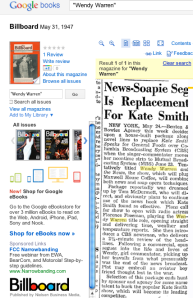
Sudsy daytime serials are easy targets for radio’s detractors. But soap operas go on & on because sponsors find them profitable. Last week, an outlandish new jumble of fact & fancy called Wendy Warren and the News (CBS, Mon.-Fri., 12 noon, E.D.T.) tried desperately to vary the formula.
The new twist: CBS Reporter Douglas Edwards leads off with a three-minute summary of the day’s headlines. A girl reporter named “Wendy Warren” (Actress Florence Freeman) follows him, shrills out 45 seconds of “women’s news,” promptly plunges into her tortured fictional love life. By the end of the first broadcast, the new heroine was in an old, all-too-familiar lather. “She turns deathly pale,” the announcer confided, “and, but for Gil Kendal’s ready arm, would fall.”
As you can see from Goldin’s eight-episode summary, Wendy’s listeners heard about more than her love life — spies and international intrigue were part of the plot. So was a newspaper reporter named Don, and (in the commercials) “a talking dog who actually barks, ‘America’s largest selling dog food!'”
Meanwhile, in the coincidence department: Of the many real people named “Wendy Warren,” at least one is in the news business. In fact, meet Wendy Warren, vice president and editor of Philly.com. I’ll drop her a line on Twitter to see if she’s ever heard the previous century’s Wendy Warren, and I’ll browse around Philly.com when I have a chance.
Update: Oh great… I send her a Tweet and five minutes later the Philadelphia mayor declares a state of emergency over Hurricane Irene! No time for casual mail with a real-world news person!

 Newspaper Heroes on the Air