I tried to answer that question on the “about” pages at the top of this blog, but getting an email from someone who has put even more creative energy into old time radio research inspired me to try again.
Here’s the interview at OTRBuffett… And, no, I haven’t been on the Internet quite as long as Jim suggests, although I did publish an article or two about it in Soundings magazine more than 20 years ago, back in the pre-Web “Usenet” days.
From the look of his many blogs, Jimbo Mason has been into old time radio much longer than I have. His clipping-index to radio show articles in Google’s scanned Billboard magazines and newspapers is amazing. I wrote to ask whether he was using some special software to compile those lists. Nope, just hundreds of hours of work, he said.
There isn’t much newspapering yet in this third Betty & Bob episode, but there is a hint of soap opera romance to come, as Chet meets Claire.
Claire is the young and “expecting” widow of The Trumpet’s star reporter, who apparently died in the line of duty around the same time that co-publisher Bob was almost crippled. (See the reference to the “miracle operation” in the first and second episodes of my Wednesday series.)
Unfortunately, the Internet Archive’s run of the Betty & Bob serial doesn’t include whatever weeks covered Claire’s reporter husband’s death, Bob’s injury, or Betty’s kidnapping — all of which were at some point in their radio past. So far, one of the most interesting things about this series is that “Betty and Bob” own and run their newspaper together. This is not (like “Front Page Farrell”) “the story of a reporter and his wife,” although a lot Betty’s role does seem to involve worrying about and cautioning the sometimes frail Bob.
But there’s still drama to come, including the brave smalltown school teacher Chet’s revelation that he has done some writing. How long before the Drakes recruit him for The Trumpet? Can he replace Claire’s late husband in more ways than one? Stay tuned.
It’s been a year since Seth Rogen’s “Green Hornet” movie did its violence to the legend of the old radio hero by that name, whose newspaperman secret identity might have been portrayed as more of a role model for journalism students.
At least the radio version of the Hornet showed some actual “journalism” going on at the hands of publisher Britt Reid (the Hornet) and the Daily Sentinel’s reporting staff. Today’s example, this episode from 1939 “Put It on Ice.”
I was reminded of the Hornet’s potential by Eric Alterman’s article over at the Columbia Journalism Review, “The Girl Who Loved Journalists,” singing the praises of another buzzing, stinging hero helping out journalists — a young woman nicknamed “Wasp.”
While the Green Hornet radio show had journalists tracking down bad guys — with help from their masked-vigilante publisher — Rogen turned the Hornet publisher into a drunken fratboy, and had leading lady Cameron Diaz play a journalism and criminology graduate looking for temp work as a secretary, then being duped by the fratboy into planning crimes for him. Not the greatest role models for journalism students.
Like Lisbeth Salander, the expert researcher and computer hacker who calls herself “Wasp” in The Girl with the Dragon Tattoo, the original Green Hornet was willing to break laws to get information — he’d steal or fabricate evidence at a crime scene, manipulate the police, and trick bad guys into confessing to their crimes.
But when it came to telling the story, the Sentinel’s publisher and reporters had a more conventional code of ethics. It’s not hard to imagine them debating some of the same issues Alterman raises in his discussion of media ethics in the Dragon Tattoo trilogy.
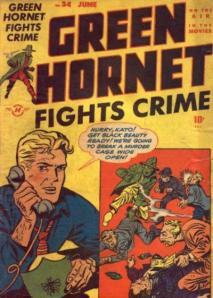
Britt Reid unmasked in 1948 Hornet comic book
Both the original Britt Reid, secret identity of the Hornet, and Stieg Larsson’s characters fight crime as journalists, not just as superheroes. They work as part of a team — Reid’s staff at The Sentinel newspaper and journalist Mikael Blomkvist’s crew at Millennium magazine, plus Salander. Journalists are shown as willing to risk death, injury or jail to get a story, especially when the story is one that would do some public good.
Back to “Put It on Ice” from 1939. Granted, it’s closer to comic-book quality than the sophistication of Larsson’s novels, but at least it has a reporter working on a public-interest investigative story. The Daily Sentinel’s Ed Lowery goes looking for business racketeers who are sabotaging a local meat-packing plant to force the owner to sell his company.
While not a 21st century evil on a par with serial-killing and international business fraud stories of “Dragon Tattoo,” it’s a story a real reporter might cover in 1939 — or today. The Sentinel takes an interest because of the danger to the safety of plant workers and to the public health.
In the opening scene, reporter Lowery is on the scene for a near-disaster at the packing plant, an ammonia leak in its cooling system. An aide tells the company president not to talk to reporters, but Lowery makes an effective pitch for getting the whole story. The full truth is better than the rumors the injured workers or the plant’s critics will spread, he says. The businessman agrees quickly, recognizing Lowery and his boss as “someone who won’t color the story.”
Later, publisher Reid mentions that city hospitals and public food centers are among the meat-processor’s customers, making the story one of even more concern to the newspaper. It may not take a vigilante like the Hornet to get to the truth, he says.
Reid: “When the public welfare is jeopardized the Daily Sentinel is interested, very interested. A reporter can find out a lot the police can’t…”
Lowery: “And believe me boss, when I start investigating, I investigate. Before I’m through, I’ll know this setup like the palm of my hand.”
The reporter sets out digging into company practices, inspecting the plant, and interviewing officials about business plans. But he’s frustrated by a lawyer with claims of privacy, and can’t find the company that’s trying to buy the business. But he runs into a middleman business broker blocking him with a stonewall involving a “perfectly legal” business name hiding the identity of the buyers.
It’s not until then that publisher Reid decides to have the Hornet do some undercover work to uncover the criminals. It’s not entirely unlike Mikael Blomkvist, at the end of Girl With the Dragon Tattoo, deciding to build a business-corruption expose based on some expert computer hacking by his friend Lisbeth, the Wasp.
A journalism ethics class could have a good time debating the difference between the Hornet and Wasp style of ethical violation — on a stories related to the public good — versus the controversy over British tabloids hacking into the voice mail of celebrities and crime victims.
A professional CD release of this Hornet episode is available in the Radio Spirits collection, “Green Hornet: The Biggest Game,” featuring 20 half-hour episodes from 1939.
As with the last episode, you can push past the opening two minutes of syrupy music to get to the 13 minutes of action in Neighbor Shoots Deputy Sheriff, the second installment in our continuing story from the 1930s radio soap opera “Betty & Bob.”
Audiences for the c. 1939 original or 1947 rerun tuned in daily, but for the duration of this semester, I’ve decided to post and podcast one episode a week, on Wednesdays. Give a listen!
Today, we catch up with newspaper publishers Betty and Bob Drake setting aside their rest-cure in the country to deal with what sounds like a lynch mob going after their neighbor.
“A man without reason makes trouble enough, but a mob without reason, there’s nothing worse or uglier.” — Bob Drake
In the process they find a local hero named Chet, a school teacher who, because he is principled and courageous, might make a good newspaper reporter when the Drakes head back to the city in a later episode.
Note: Some old-time radio collectors must be guitar-picking fans, because the filename titles of some archived episodes refer to the school teacher character as “Chet Atkins.” His name, clearly given here, is “Chet Andrews.”
My headline is about as strange as the introduction to this premier episode of “Bright Star,” which billed it as a genre-crossing “gay new exciting comedy adventure.”
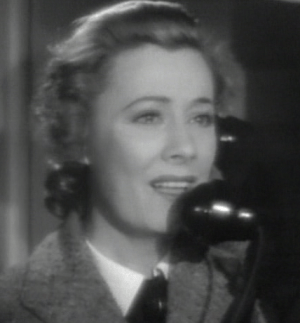
Irene Dunne
You should know this first episode, “The Oil Swindle,” was broadcast in 1952, when “gay” meant happy and carefree, and the other adjectives meant — whatever the writers wanted them to. The most important word in this series, however, was “Star” — both as the title of the newspaper in this weekly series and as its reason for existing.
Like a movie marquee with stars’ names at the top, “Bright Star” was introduced by the announcer as “The Irene Dunne, Fred MacMurray Show…” even before he gave the title. The top-billed Dunne made her stage debut in 1922 and had been one of Hollywood’s greatest leading ladies for two decades, as any quick IMDB or Google search on her name will assure you. She was nominated for “best actress” Academy Awards five times. If you prefer printed books, the title of Wes Gehring’s biography of her says it all, “Irene Dunne: First Lady of Hollywood.”
Fred MacMurray
On radio, Dunne recreated many of her movie roles, her speaking and singing voice barely aging over the decades. She could play the young bride Sabra Cravat— also a newspaper publisher — in 1931 in the movie “Cimarron” and play the same role in 1941 and 1948 radio adaptations.
While ages aren’t mentioned in “Bright Star,” the 54-year-old Dunne appears to be playing a character in her thirties — Susan Armstrong, an unmarried newspaper publisher carrying a torch for her paper’s star reporter.
This episodic radio series began the year that Dunne made her last major film. While she chose to wind-down her movie career, on radio she was able to continue appearing in whatever image her fans carried in their minds.
Here, Dunne is “lovely, attractive, headstrong Susan,” the editor and publisher who inherited the paper from her father.
MacMurray is George Harvey, the Star’s star — if not always starry bright — reporter. The actor, whose film and TV career kept going well into the 1970s, made his first movie appearances in 1929. He was born in 1908, but easily voiced the part of a relatively young and naive reporter for this radio series in 1952.
As for lessons in journalism practice or ethics, let’s just say “Bright Star” was a romantic situation comedy.
The intrepid reporter gets knocked out by a gangster in his first scene of the first episode, and is invited for a romantic evening by his publisher shortly thereafter. While waiting for her housekeeper to make dinner, “Susan” literally gets to sing a chorus of, “It’s so nice to have a man around the house…”
“George” seems more romantically involved with the idea of a free meal. As a reporter, he admits to a “nasty, suspicious mind” and is ready to write an expose without much in the way of facts. He’s not as suspicious of a “visiting heiress” who adds a jealously theme to the episode. The Hillsdale Morning Star office boy seems more mature and imaginative, when it comes to romantic advice.
By the second episode, Susan is running for mayor. In later episodes, the editor supports community service projects while the reporter complains that she is neglecting the paper, the reporter becomes the high school football coach on the side, and attractive women from the editor’s cousin to Miss America complicate the romantic-misadventure plots. A “Whistleblower” episode does have a bit of Cold War paranoia and investigative reporting, and a “New Homemaker Page Editor” episode would be great for a discussion of the media business, sexism, and 1950s roles for men and women. I’ll get back to them in future episodes of this blog.
None of this is very serious, but both Dunne and MacMurray let a little of their star-quality shine through in “Bright Star,” and it will be fun to hear what students in 2012 think of the silly innocence of 1952.
The Internet Archive copy of this “Judgement Day” episode of “Douglas of the World” spells “judgment” with the central “e,” British style, which is appropriately international.
The archive and the script itself identify this as the last show of the series — which was about the adventures of a Cold-War-Era foreign correspondent for The New York World.
The actual newspaper by that name had closed by the time the short-lived 1952-53 series began, but this episode starts at its city desk, with Brad Douglas home from a tour of 25 countries long enough to investigate why a Korean War veteran was threatening to jump off the brand-new United Nations building.
The series, you should know, was produced for the Armed Forces Radio Service (AFRS). I’d love to see some production notes or discussion by the script writers about the amount of foreign-policy (or propaganda) advice they received.
First impression: I couldn’t help noticing the mutual respect of the police and the newspaper reporters, none of that “sensational press mob” image that the past few decades of Hollywood movies make us expect. Or is it just that television news hadn’t taken over yet?
Other than that, I’m posting this episode here without discussion, hoping to let some Peace Studies and World Affairs faculty and students to share it without overwhelming the item with my inexpert interpretation. I’ll write about it more when I get to a tabbed “page” (rather than this date-stamped “post”) about the series.
I went a little overboard on research and speculation the last time I posted a Douglas episode on Douglas, terrorists and the Shah.
For more episodes, here are the Old Time Radio Researchers Group library uploads of “Douglas of the World” stored at the Internet Archive:
“Running a newspaper is our line of duty”
— Betty Drake, co-publisher of The Trumpet, pioneer soap opera heroine
“Betty and Bob,” one of radio’s first soap operas, eventually twisted its troubled-marriage plot around to journalism — not surprising, considering that the series’ creators and writer all had newspaper experience. (I’ll be expanding on that theme on my overview “Soaps and Romance” page.)
Betty, the heroine, is an equal partner in the couple’s newspaper-publishing enterprise. From references to earlier episodes, by this time she apparently had been kidnapped in the line of duty, rescued, and faced with the murder of the paper’s star reporter and the possibility that her husband, Bob, might be crippled for life.
Just for fun, I’m going try a bit of “serial drama” experience here at JHeroes, adding a continuing 15-minute episode of “Betty & Bob” every Wednesday, starting here: Betty and Bob arrive in the small town of Walton.
(Note: Each episode starts with a two-minute musical interlude over which a commercial would be inserted. Most MP3 players will let you fast-forward through the syrupy music.)
The exact date of the original broadcast isn’t clear — perhaps sometime in 1939 or earlier. In any case, toward the end of the series’ eight-year daily run, “Betty and Bob” introduced this “crusading newspaper” plot line.
By then, the rich-again, poor-again couple of the title apparently had made a fortune in oil, then used the money to buy a newspaper and take on corrupt city politicians and grafters. As the announcer puts it, they became owners of “that great fighting newspaper, The Trumpet.”
For this first episode in the archives, a recap of the recent past makes it clear that the Drakes had run the paper for some time, but their crusade had taken its toll — costing the life of a star reporter and almost proving fatal to Bob. In classic soap opera fashion, an announcer brought the audience up to date as follows:
On the train that is rapidly approaching the town of Walton we meet Betty and Bob Drake.
A few hours ago they left the city of Monroe where they ran and still own that great fighting newspaper, The Trumpet.
Upon the urgent advice of doctors, but against his will, Bob is going back to his country home to lead a quiet restful life until he has fully recovered from the miraculous operation which made it possible for him to walk again.
Yes, Betty had a difficult time persuading Bob that a return to the country and the simpler way of life was not only the best thing for him, but for their year old twin babies, for Bob’s mother, and for Claire Evans, the young widow of the star reporter, and for Betty herself.
The Internet Archive’s sampler includes 40 episodes with several breaks in the sequence. Today’s podcast is the first of a solid run of a dozen programs.
Despite the “quiet restful life” comment from the announcer, rest assured that the Drakes will be back in the thick of things pretty soon…
This “Rogers of the Gazette” episode from January 1954, titled “Something’s Going On,” has a terrible pun in the first line and a hint of “Invasion of the Body Snatchers” terror in the plot. (Of course, given that it’s “Rogers of the Gazette” the odds anything bad happening are terribly thin.)The friendly newspaper editor encounters an unfamiliar phrase: “No comment.” He hears it enough times to wind up asking a very un-Rogers question:
“What the devil is going on in Illyria all of a sudden?”
Pillar of his Mayberry-like town of Illyria that he is, editor Will Rogers Jr. is usually a tougher critic of the chief of police’s golf game than he is of any government activities. This story begins with the police chief and the editor on the golf course, something they apparently both have time for quite frequently.
Journalism students could have a good time discussing the proper relationships between newspaper editors and civic officials, whether the size of the community makes a difference, etc. In this case, even the police chief recognizes that taking time for a mid-day golf break might raise some eyebrows.
“A really smart newspaperman’d probably expose the whole soft setup. It’d be a big story, too, ’cause it’s the same way in the county. We’re just too blamed law-abiding around Illyria to need sheriffs and deputies and police chiefs and like that,” the chief says.
But that’s early in the story. Suddenly, the chief gets a phone call at the clubhouse. Next thing you know, the chief is not talking to the editor, other than to say “This is big.” Eventually he says he’s refusing to talk for “security reasons.”
The plot thickens with a mysterious stranger in a gray suit in town, and a secretary blocking access to the police chief.
“Most especially he is not seeing the press,” she says.
Even the town switchboard operator keeps telling the editor that all long-distance lines are busy every time he tries to call the wire services to find out if there’s a regional manhunt on or something. It’s amazing how isolated one town could seem in the 1950s, with only one national phone company and no Internet!
Suspense was not the most common element on Rogers of the Gazette, but this episode actually manages to create some, even if the friendly theme music assures you everything will be fine in the end, with some sort of O.Henry plot twist and a happy ending.
For a while, though, Illyria seems to have become a police state. The guy in the gray suit, a Mr. Adams, finally talks to Rogers, if enigmatically:
“Well I don’t mind telling you who I am, Mr. Rogers, but I get the impression that your chief of police and your sheriff would mind very much. Sorry, but any statements will have to come from them. And if I were you, I wouldn’t plan on any.”
He vaguely discusses “the public interest” and how it’s being served by keeping the local editor in the dark. He even hints that Will plays too much golf.
“It’s like the Martians or Venusians had taken over,” the Gazette’s assistant editor says.
This 1954 timeline mentions Eisenhower being accused of being soft on Communists, the CIA tunneling under Berlin, the first nuclear submarine being launched, Puerto Rican nationalists opening fire in House of Representatives, and Ed Murrow’s “Report on Senator McCarthy” coming up in a couple of months.
But that’s about all the suspense-building context I’ll risk here, to avoid spoiling the “Something’s Going On” story for anyone who wants to listen through to the thrilling conclusion. (Listeners in 1954 — and Americans over age 65 — may catch enough hints to guess the outcome. I’ve stowed away an extra one in the text links above.)
Note: Since writing this, I’ve been informed that Rogers of the Gazette scripts actually spell the town name “Illyria,” not “Elyria,” as I originally had it.
From Dec. 30, 1953, here’s what was regularly billed as “another heartwarming story of a country newspaper and its friendly editor.”
The series is “Rogers of the Gazette,” starring Will Rogers Jr. This episode starts with the editor giving a perhaps too-inspiring speech about journalism at the local high school:
“A newspaper does more than just print the news that’s turned into it. It has to go out and dig for stories and develop them. That’s why things like freedom of speech and responsibility to truth come to mean something to us.
“And we learn to fight for those principles. And in a way, that’s what journalism is, a fight. But it’s a good fight and a good profession and that’s why we love it.”
The Investigative_Reporters episode has more newspaper jargon, more suspense and more action than most “Rogers of the Press” episodes, along with lessons in reporting and newspaper economics.
The reporters mentioned in the title are high school students, twin sisters who start asking nosy questions around town, and telling people they are writing for Rogers’ paper. He complains to his assistant:
“Those kids have descended on this town like a plague of locusts. They managed to work their way into every nook and corner from the mayor’s office to the back room at Hogan’s Grill.
“You know what they asked Mayor Berkeley? How much graft he made on that West Side paving contract! He’s ready to run me out of town…”
Meanwhile, Rogers’ has spent his available cash on a new Linotype and is facing trouble meeting a payment on his building’s lease, and his landlord is one of the local residents the twins are “investigating.”
As a result, the editor also gets to deliver speeches on the right to privacy and the difference between big city newspapers and his community weekly. It turns out Rogers’ speech wasn’t the sisters’ only inspiration about being reporters:
“We’ve seen it in the movies,” the girls tell him, before turning their attention to crime reporting.
Rogers’ quiet town of Elyria has a lot in common with Andy Griffith’s Mayberry, if you take off sheriff Andy’s badge and replace it with an old-time editor’s green eyeshade and sleeve garters.
If you enjoy that New Year episode, feel free to back up a couple of weeks for two Christmas editions, also from 1953:
Footnote: In real-life Will Rogers Jr. actually was in the newspaper business, but not in the mythical town of Elyria. (There are communities by that name — in Ohio and Kansas, at least — but I suspect listeners were supposed to make an association between Rogers’ Elyria Gazette and legendary country-editor William Allen White’s Emporia Gazette.) Rogers, son of the even more famous humorist, studied journalism at Stanford University and was publisher of the Beverly Hills Citizen between his careers in acting and politics, and his World War II military service. Later, he was the host of “The CBS Morning News” from 1957 to 1958. See his obituary for details, but not until next year. Reading obits — even of good and happy lives — may not be the most upbeat way to spend New Year’s Eve.
Sticking with both “Crime Photographer” and my seasonal theme, the episode titled Hot New Year’s Party is really a “morning after” story — one that just happened to be broadcast on a New Year’s Day, Jan. 1, 1948.
The story opens at 9 a.m. in the Blue Note Cafe, with bartender Ethelbert delivering a hearty “Happy New Year” to a moaning “Flashgun” Casey and reporter Ann Williams, who both order coffee and aspirin.
That’s all a tease. Casey and Williams are suffering from smoke inhalation, not hangovers. They’re just back from covering an early-morning fire. But they do make New Year’s resolutions — about staying out of trouble in the coming year — before going out to cover a missing-person story. No rest for the working press.
As is sometimes the case in “Crime Photographer” episodes, Casey doesn’t do much reporting or picture-shooting. He does get to throw a few punches, and he gets a tip on the missing person case from a mob connection who owes him a favor.
Despite the stay-out-of-trouble pledge, it’s not long before Casey is sapped from behind, thrown unconscious into a ditch, and apparently about to be cured of hangovers for good — by a man with a gun.
If there’s a “journalism ethics” issue involved, it has to do with the perils of becoming too identified with the forces of law and order, which was often the case for radio’s version of newspaper reporters. Casey is always helping the authorities solve crimes, whether they like it or not, but this episode makes it clear that the adversarial aspect of his relationship with the police may not be obvious to the crooks.
Here’s what happens when he looks up a confidential source at a bar frequented by mob characters.
“You still runnin’ with the cops, Casey?” the mob’s favorite bartender asks him. Casey’s reply is, “I don’t know what you mean. I’m a newspaper guy.”
However, the bartender puts in a call to a gang boss, who slips in and eavesdrops on Casey’s interview with his source. As a result, both Casey and his source land in that ditch with bumps on their heads and a gun aimed at them. (To find out what happens next, you’ll just have to listen to the program, linked above thanks to the Internet Archive and the Old Time Radio Researchers Group.)
An intriguing bit of journalism-education background from this episode: When a secret code turns out to involve Greek characters, it’s Ann Williams who recognizes the alphabet.
“Ann knows — she’s been to college,” Casey tells the police.
Is that supposed to imply that Casey got his photojournalism training on the job (or the street), while women journalists might be more likely to take a collegiate route into the racket? Was Ann supposed to be special, or a typical case? I can’t be sure.
The movie “Here’s Flash Casey” starts with our hero having used his camera to work his way through college, but I don’t know whether the two-fisted radio version or his pulp-magazine first incarnation ever admitted to earning a degree. I’ll keep my ears open while I listen to more episodes.
It’s been a couple of years since I read the book Flashgun Casey, Crime Photographer: From the Pulps to Radio And Beyond, but I’ll go back and see if it reveals anything about Casey’s or Ann’s education before I declare my Crime Photographer page finished.

 Newspaper Heroes on the Air