Welles’ dramatic technique of imitating radio news alerts, simulating interruption of a routine broadcast, and having a “live” announcer cut short by a Martian death-ray, were all enough to convince many listeners that a real attack was in progress — especially if they switched to the program after the beginning announcement. Those scenes still have impact, but it’s worth remembering that the original listening audience had yet to experience the 1940s use of radio to cover the horrors of war.
This full page of Welles’ Mercury Theater programs has a somewhat scratchy 17Mb version of “War of the Worlds,” but it provides more history about the radio series itself, which — speaking of Halloween — started with a dramatization of “Dracula.”
The final contribution of “War of the Worlds” to the portrayal of journalists in popular culture was an indirect one — the controversy over audience reaction to the program helped boost Orson Welles’ reputation to the point that Hollywood offered him the opportunity to make his first film, the legendary “Citizen Kane.”
A 65th anniversary Prologue magazine essay at the U.S. National Archives reported that 1,770 people wrote letters to the main CBS station in New York, and 1,450 to the Mercury Theatre, while more than 600 contacted the new Federal Communications Commission (FCC). Of course, those may have been as much in response to newspaper headlines and editorials as to the program itself.
As Sokolow wrote in 2008, “So what accounts for the legend? First — and perhaps most important — the news media loved the story, and Welles loved the news media.” He and a colleague have a full book on
This week’s “The Big Story” episode is a “journalism procedural” about a Richmond News Leader reporter who takes up the case of a man convicted of murder six years earlier. Exactly when the original news stories appeared and the real names of people involved were never mentioned in this series, but I suspect this one goes back to the 1930s or earlier. Unfortunately, the News Leader is no more, and the two Virginia universities near me don’t have it on microfilm.
It was common practice for Big Story cast members to voice more than one role in an episode, as in this case.
Like the reporter in the based-on-a-true-story movie “Call Northside 777,” Julian C. Houseman, real-life reporter and star of this episode stubbornly tracks down witnesses, interviews people on both sides of the case, and convinces the prisoner — called “Jamie Goodwin” in the script — that his freedom is worth fighting for.
His original defense attorney is not a character in the play — in fact, the reporter appears to be the man’s sole advocate. As in other “Big Story” scripts, that may be a simplification to add to the drama and fit the time limit, but it also might serve to enhance the audience’s esteem for the power of the press.
The state’s attorney believes the testimony of the murdered woman’s mother and a friend, both adamant that the prisoner is the man who married and then killed the victim.
Broadcast as a “The Big Story” episode June 8, 1949 and presumably actually taking place much earlier, the case pre-dates DNA testing, ubiquitous photo-IDs, computerized records and CSI techniques we’ve come to expect in crime dramas, and in real-life.
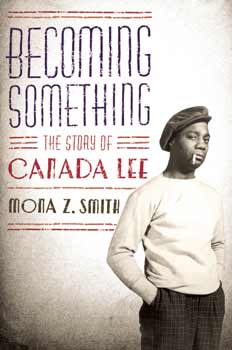
John Sylvester played the part of Houseman, while Canada Lee was the convict. In the television version of the episode, broadcast Nov. 25, 1949, the convict was played by Frank Silvera, according to the TV.com episode guide. (I wonder if Canada Lee was blacklisted on TV between the two performances.)
Even the prisoner’s father admits that the man looks like his son. Neither race nor racial profiling is ever mentioned, although the actors’ accents show that medium that gave us “Amos and Andy” was hardly color-blind. As J. Fred MacDonald notes (in Don’t Touch That Dial), African-American actors found few serious dramatic roles on radio. This episode of “The Big Story” is one case where they did.
While some of radio’s regional, ethnic and racial accents were parodies and terrible stereotypes, the cast members of this episode play it straight, serious and well — despite scripted attempts at dialect that might have gone badly with less talented actors.
Mister, go won away. Who cares ef a backwoods boy like me live or die? Go won away — leave me be. — Jamie Goodwin, from the archived script
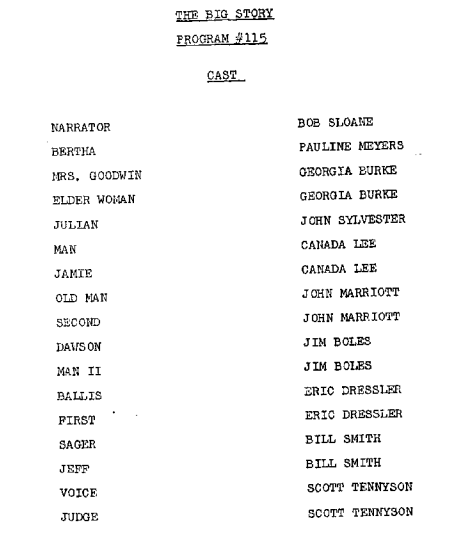
The episode script is available in PDF photo images of the broadcast scripts at the Old Time Radio Researchers, where this is Big Story program number 115.
Among the cast members identified in the script is one who appeared in another 1930s series I’ve discussed here. Broadway and film actress Georgia Burke, who voiced two roles in this episode, played a more stereotyped role in the long-running soap opera “Betty and Bob,” Magnolia, the newspaper-owning couple’s maid.
The “Big Story” script says the murdered woman’s friend, “Bertha,” was played by “Pauline Meyers,” a variant spelling for Paulene Myers, a black actress whose stage, film, radio and TV career spanned 54 years. (While she wasn’t a regular in any journalist radio series, she did make an appearance in an episode of TV’s Kolchak, facing another kind of investigative reporter.)
While the script does not say race was an issue in the “Goodwin” trial, it’s clear from the start the program is affirming the fact that a black man can get a fair trial in America — at least with help from a crusading newspaper reporter. The program opens to music and voices a Harlem dance club, a scene followed by the announcer’s voice-over that Houseman is receiving his Pall Mall Award, “for his contribution not only in writing a great story, but in reaffirming a great truth, that every person on Earth is a human being and has a right to human dignity.”
In the close of the program, Houseman’s telegram accepting the $500 “award” for the story, as given in the broadcast script, said:
“Day after trial Goodwin visited the paper and said, ‘I just wanted to come to the people who got me out of this jam… I needed assistance and it’s the News-Leader that I owe my freedom.'”
Note: I still hope to track down the original newspaper stories — about the murder, the retrial and, if there were any Virginia stories about it, this broadcast — and add to this essay in the future. Tips and suggestions? Add a comment or write to me.
More research on the Richmond reporter’s career might prove interesting. First step in identifying him: Getting his name right! Was it Julian Hauseman, Houseman, or Housman? I’ve seen all three spellings in old-time-radio articles about the Big Story episode. “Houseman” is the spelling in the episode script as republished at the Generic Radio Workshop Script Library.
“Give me a chance, just give me a chance, and I’ll be the best male Jane Arden in the racket.”
— Jerry Delaney, the newspaper’s cub reporter
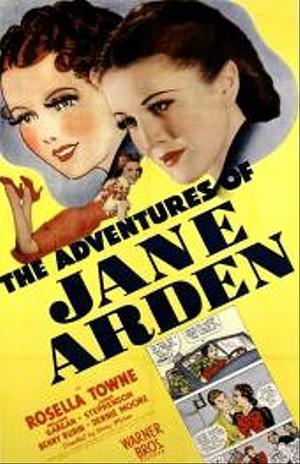
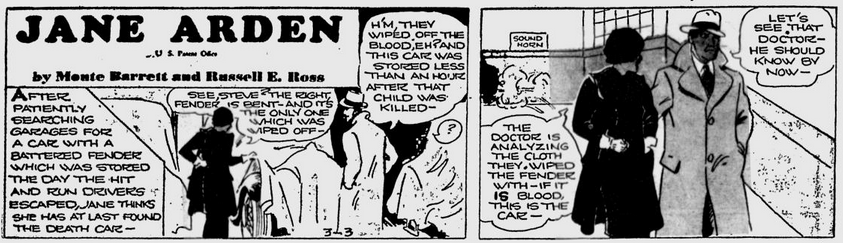
Clearly, she was inspiring! Jane Arden was a long-running comic strip about an adventurous “girl reporter,” pre-dating Lois Lane and Brenda Starr, and gracing daily and Sunday comics pages for more than 40 years. Her radio and film spin-offs weren’t as popular, but still illustrate themes in the portrayal of journalist characters in popular culture.
The radio announcer’s introduction:
The Adventures of Jane Arden, a thrilling drama of a fearless girl reporter, the most beautiful woman in the newspaper world. Jane Arden, star reporter for The Bulletin, important newspaper of a big American city.
As the story in our example begins, the announcer provides the details of The Bulletin’s big 10th floor newsroom, full of “men in shirtsleeves, cuffs rolled up, green shades over their eyes…
“Far back in the room is the slot, the double-row of table-like desks over which the rewrite men finally shape the stories as they will appear in The Bulletin. And guardian of the slot, commander of the news staff, Eddie Dunn. city editor, sits, the final arbiter in the news of the day.”
The strip was created by newspaperman Monte Barrett in 1927 and kept running in syndication until 1968. (See the Monte Barrett bio at the Des Moines Register.) His comic was aimed at women readers, and the radio serial that followed a decade later was broadcast in the morning, prime time for soap operas and other programs aimed at women listeners. Jane Arden was promoted in newspaper display ads as “the most beautiful girl in comics,” which became “the most beautiful girl in the newspaper world” to radio listeners.
The one easy-to-find episode was pretty exciting, starting with a murder in the newspaper building’s elevator, and Jane giving orders to the coroner, the police and her boss! Without Further Adventures, we will never know whether Jane solved the murder… or the additional mystery of conflicting episode descriptions and dates suggesting that collectors might have merge two references to two different series.
John Dunning’s 1998 edition of “On the Air, the Encyclopedia of Old-Time Radio” lists the series title as simply “Jane Arden,” without “The Adventures of…” and says it was broadcast from September 26, 1938, to June 23, 1939, as a Blue Network soap opera, weekday mornings at 10:15. A quick check of 1938-39 Chicago Tribune radio listings confirms the program was on at 9:15 a.m. on WLS in the Central time zone, and that the last broadcast was Friday, June 23, with a music program taking over the time slot the following Monday. Sorry, Jane.
Radio historian and collector Jerry Haendiges confirms the “1939” episode in the archives is really the September 1938 debut, which he has in his own collection at otrsite and once shared at VintageRadioPrograms.com.
Alas, since the program was a brief 15-minute daily serial, having just one or two episodes will leave you hanging, but you do get quick introductions to the characters and their relationships.
Eddie Dunn, the editor, wants Jane to investigate another company in the newspaper’s building, but she can be sidetracked by breaking news: Conveniently, someone is stabbed to the death in the crowded elevator while Jane and Jerry, the cub reporter, are headed out for coffee.
Even with just two episodes to go by, there are features familiar to other portrayals of journalists in radio, film and fiction. For example, Jane and the editor engage in some of the “show some respect for your editor” banter familiar in most appearances of Hollywood’s Torchy Blane or comicdom’s Lois Lane.
“No other woman on the staff calls me ‘Eddie.'” — Jane’s editor
Similarly, a “police-journalist cooperation” theme I’ve noticed in other crime radio series also shows up in the first “Jane Arden” episode. Not only is Jane on a first-name basis with Mike, the Irish cop in her newspaper building and knows his badge number when she calls the morgue and police headquarters — where she doesn’t have to explain who she is.
Editor Dunn sounds a bit grumpy about her calling the morgue and the police before telling him all the details of the murder. Actually, he asks her a good set of questions for the story — and she provides descriptive details for the elevator murder.
Jane, billed as “star reporter,” sounds experienced at hard-news crime reporting; the body in the elevator apparently isn’t the first fresh corpse she’s seen. She says the dead man was good-looking, then adds:
“Death has a way of painting a mask over a face,” — Jane Arden.
Both Jane and the cub reporter demonstrate good reporting skills — remembering details like the killer’s brown tweed suit, brown hat and limp.
Eddie Dunn sounds like more of a mentor than some fictional editors when Jane asks him to give Jerry, the cub reporter, a break.
“I am giving him a break — I’m breaking him in” — editor Dunn on his treatment of a cub reporter.
In a soap opera format of daily continuing episodes, there is no telling how many days or weeks it took to resolve the murder in the elevator story, or where Jane’s adventures went next. Dunning mention story lines including reporter competition and a newspaper merger that are not featured in the first two episodes.
While the radio series was in progress, “Jane Arden” newspaper comic strip fans voted on the selection of the actress Rosella Towne to play the leading role in “The Adventures of Jane Arden” movie, which was intended to be the first in a series. “More than 120,000 readers of 79 newspapers throughout the country joined Warner Brothers casting department in choosing the actress,” the St. Petersburg Evening Independent reported (Nov. 4, 1938).
While the planned series of films and the radio show both ended, the Jane Arden comic strip kept going through the War years and beyond. The comic’s journalistic focus was a natural — its creator, Monte Barrett, was managing editor of a San Antonio, Texas, newspaper. Barrett felt the comics page was lacking both a women’s angle and a continuity strip, rather than the “gag-a-day” comics popular at the time, he told the Associated Press in 1946. As for Jane’s “look,” Barrett said his inspirations (in 1928) had been actresses Corinne Griffith and Billie Dove. Barrett wrote the scripts and sent them on to collaborating artists, including for many years Russell Ross of the Des Moines Register. (“Many Famed Comic Strips Are Created by Texans,” by Jack Rutledge, Associated Press, Apr. 11, 1946, Victoria Advocate, p. 10, via Google News Archive )
Even before the U.S. entered World War II, Jane was overseas getting involved with foreign intrigue in “Anderia.” In 1939, newspapers ran display ads that said “Jane Arden to Cover WAR!” (Pittsburgh Press, Sept. 12, 1939)
While its radio episode collection is thin, the Internet Archive also has collections of comics that reprinted Jane Arden newspaper comic strips, with titles including Crack Comics and Feature Funnies, and Google’s newspaper archives have numerous papers that carried the daily and Sunday comic.
The comic strip continued until 1968, with Walt Graham taking over as writer in 1952, but unlike her contemporary radio journalist heroes Clark Kent, Lois Lane, and the crew of the Green Hornet’s Daily Sentinel, Jane Arden did not move on to television and color films.
As a former reporter for The Hartford Courant, I was intrigued to find a Courant story from long ago among episodes of the radio series “The Big Story,” and just had to track down the original criminal investigation. The broadcast drama turned out to be based on a 30-year-old serial killer case from 1916 and, more surprisingly, was at least part of the inspiration for one of the most famous “screwball comedy” movies.
The other serial hazard to the health here is the program’s tobacco company sponsor. Unlike some Big Story episodes in online archives, this one has its Pall Mall commercials intact. And when a distraught woman arrives in the newsroom, the first thing the reporter does is offer her a cigarette.
Broadcast as “The Case of the Final Curtain” in 1947, the murder story was a piece of Connecticut criminal history, a murder case that ran through two trials and helped inspire the hit play and film “Arsenic and Old Lace.” That very funny movie has little to do with the serious tale you will hear on this radio program. In the film, the nephew of the murderesses (reality only needed one) is a theater critic for a newspaper, but getting the story is not his focus as much as getting his dear aunties into a comfortable asylum.
The Big Story episode, although crammed into a half hour, sticks closer to the facts than the Broadway play did — at least after a melodramatically imagined opening scene about a daughter sending her elderly Shakespearean actor father to the nursing home, with much hamming it up on his way to becoming one of the victims. Perhaps that was a tip of the radio writer’s theatrical hat to the Broadway critic in “Arsenic and Old Lace.”
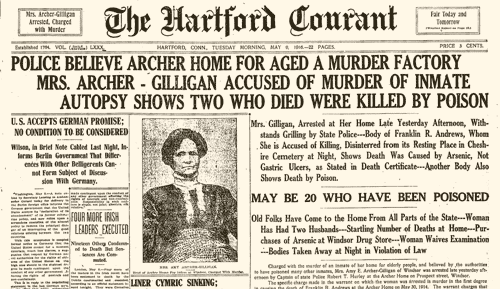
In the radioplay, the rest home operator took an original approach to “managed care,” especially for clients who unsuspectingly paid for lifetime care in advance. If an old actor was among her original victims, that fact isn’t mentioned in the most recent book about the case. In any case, there was nothing humorous about the original story — as is clear from its Courant “Murder Factory” May 9, 1916, front page headline.
(The Courant is part of the Proquest Historical Newspapers project, which makes full-text scanned copies of the newspaper available through libraries’ Proquest subscriptions.) The original 1916 story filled more than four eight-column pages of the 22-page paper. It profiled the police investigator who had worked on the case for 13 months, at one point saying he “used as the groundwork of his official investigation the material that had been secured by ‘The Courant.'” Elsewhere, the story says that the police investigation actually had started the previous year with a complaint to the state’s attorney, but “received a new impetus” from evidence gathered by The Courant.
The Big Story episode is presented in the name of Aubrey Maddock, at the time an assistant city editor at The Hartford Courant, but later a prominent Hartford businessman. By not giving the date of 1916, the radio series may have left listeners wondering about the competence of both the Connecticut police and medical profession.
As with many “Big Story” episodes, the broadcast drama amplified the role of the “Pall Mall Award” winning reporter. In the radio script, the doggedly persistent Maddock is the only one who gets suspicious about the amount of arsenic it takes to kill the rats at a nursing home, as well as the unorthodox removal of bodies after midnight.
He’s a confident and aggressive interviewer and seems to have had the story all to himself. Columnist Colin McEnroe revisited the original story for The Courant in 2000 under the headline, A Page From History: We Were There. “Just how much The Courant had to do with driving this case forward is a matter of some confusion,” he concluded.
If I someone wants to pursue this further, it would be fun to check the Hartford Times on microfilm and maybe the Springfield (Mass.) Republican for their coverage of the story back in 1916, to see whether the region’s other two large papers gave contemporary credit to The Courant. The New York Times story the next day did make reference to The Courant’s having obtained and printed affidavits on some aspects of the case.
A year after this JHeroes post, former Courant reporter, Ron Robillard looked back at the case in a column (not at the Internet Archive), focusing on the roles of an editor and reporter in the investigation and reporting, particularly their use of death certificates as public records, noting that the poisoning case was aided by then-public death certificates and a poison-register that druggists were required to keep.
“The true story of America’s deadliest female serial killer …”
The Devil’s Rooming House
For those interested in pursuing the case, the story was told one more time as The Devil’s Rooming House: the true story of America’s deadliest female serial killer by M. William Phelps, Guilford Press, 2010.
Worldcat Synopsis: “A silent, simmering killer terrorized New England in 1911. As a terrible heat wave killed more than 2,000 people, another silent killer began her own murderous spree. ‘Sister Amy’ Archer-Gilligan, who’d opened the Archer Home for Elderly People and Chronic Invalids four years earlier, would be accused of murdering both of her husbands and up to sixty-six of her patients with cocktails of lemonade and arsenic; her story inspired the Broadway hit Arsenic and Old Lace.”
“Here, take the gun; cover me…” — detective to journalist
That’s not a sentence most newspaper reporters ever hear from a police officer, but it’s part of the dialogue from the thrilling conclusion of this week’s episode of “The Big Story,” the true-journalism and true-crime radio series from the 1940s and 1950s that I wrote about last time.
The script writers did “improve” on reality at times, at least removing the names of the people in the stories, updating them a bit (some of the true stories dated back to horse-and-buggy days), and improvising characters and scenes to make the news story work as a radio drama. On that level — well-acted dialogue and a plot that moves along through several flashbacks — I’d call this episode a success.
As a textbook on journalistic practice or police practice, it certainly doesn’t describe a world most reporters would recognize. Maybe there have been times and places where newspapermen and local police were on such friendly terms, but I suspect some of the camaraderie was created by the script writer as a way to tell the murder-investigation story through radio dialogue.
The episode starts with a corpse at the dump, then flashes back to a scene of domestic conflict that sounds a lot like an episode of TV’s “The Honeymooners” gone terribly wrong. Coincidentally, actor Art Carney — the upstairs neighbor in that TV series — is the star of this Big Story episode, playing newspaper reporter Rolf K. Mills of Minneapolis, and doubling as the city grain inspector who finds the corpse.
Mills is quite the newspaperman, turning out several versions of the evolving story late at night and into the early morning, hence the episode title “The Deadline Murder.” This may sound like an update-schedule for the Internet age, but remember that a half-century or more ago, larger papers did keep the presses rolling with multiple editions and a “rewite” staff taking story updates over the phone. Unfortunately, Mills’ Minneapolis Morning Tribune does not appear to have been digitized by any of the state library or other online sources for the years from which The Big Story usually drew its plots, so we can’t easily go back and read his original stories.
In any case, Mills’ conversations with his editor and his shoe-leather reporting stamina — from the crime scene at a city dump to the morgue, a series of barroom interviews, and a final knock at the murderer’s door — all make a great example for today’s desk-bound and time-strapped reporters.
Mills also has a tough interview with a reluctant source — a landlord named Lopez, who insists on counting questions and giving sound-bite-brief answers.
Here’s the announcer’s summary at the half-way point:
“A fine thing. Covering police headquarters for the Minneapolis Morning Tribune, you, Rolf K. Mills have a blonde corpse turn up in time for the first edition — a person unknown murdered by person or persons unknown — and the city desk hopes for the who and the BY whom for the final edition. And you have just followed a false trail to the bitter end…”
The writer of the script turns a good phrase now and then, too, including some sharp dialogue in the radio-noir imagined scenes between the murder victim and her estranged husband, as well the conversations between the reporter and his editor:
Editor: So backtrack. Everybody makes mistakes. Mills: Yeah, I know. That’s why they put erasers on lead pencils. And tonight my pencil is all eraser.
That last bit of dialogue should sound more familiar to reporters than the one about the policeman handing over his gun.
Technical note: It sounds to me like this Internet Archive mp3 recording was made from an old audio tape that had stretched, or a transcription disc played at slightly the wrong speed, making speakers’ voices a little lower than normal. (It also has had the Pall Mall cigarette commercials removed, possibly for non-commercial Armed Forces Radio broadcast.) If I find a better copy, I’ll replace it.
For old-time-radio fans, the archived script indicates that Joan Alexander played “the blonde,” the eventual murder victim who is described in the (not broadcast) director’s notes as “a nag and a bitch.” She was tough but a bit more pleasant in another “newspaper heroes” radio role — playing reporter Lois Lane in hundreds of Adventures of Superman radio episodes and 1940s cartoons. Finally, if you think the unpleasant blonde in this story has an authentic Minnesota accent, it may be because Alexander was born in St. Paul, according to her IMDB.com biography.
As mentioned previously, The Big Story scripts were preserved as part of the tobacco industry claims settlement, and are available at several archives online, including one by the Old Time Radio Researchers Group. “The Deadline Murder” is script 60.
After a rather long preamble, you’ll find an episode below from “The Big Story,” a radio series that sometimes sounded like a “reporter-cop buddy movie.” (Actually, I don’t think such a genre ever existed on film, except when the reporter was “Torchy Blane” or another attractive female with her eye on a good-looking detective.)
The strange twist in “The Big Story” is that the news stories were real. Was the close cooperation between the reporters and their police friends a narrative device invented by the radio writers, or was it a real part of the reporters’ experiences?
The dramatized adventures of newspaper reporters often blur the boundaries between journalism and police work, usually by turning a fictional reporter into a crime-solver who “helps” the police, whether they like it or not. This was especially true back in the years when radio brought crime dramas like Big Town, The Green Hornet and Casey, Crime Photographer into American living rooms — before radio fiction faded out in the 1960s.
Coincidentally, the 1960s also may be a decade that added some professional distance to police-press relations: a series of prominent trials raised “Free Press vs. Fair Trial” concerns, several Supreme Court cases underscored defendants’ Sixth Amendment rights, both the Civil Rights and anti-war movements put police on the spot during civil-disobedience demonstrations, and a formal Freedom of Information Act codified rights and put a new bureaucracy in place.
Perhaps when “The Big Story” was a radio hit — 1947 to 1955 — newspaper reporters and police were easier to cast as heroes fighting crime together, or maybe they simply did work that way. Did social forces make both the police and the press established members of the post-war “establishment,” at least for a decade or so?
In any case, the weekly “Big Story” dramatized a real reporter’s “how I got the story” experience — and was so successful that the series made the transition from radio to television. When broadcast, the crimes weren’t news anymore; they were often a decade old, sometimes more. That didn’t matter to the sponsors, who gave each week’s featured reporter a $500 award for his or her contribution to journalism, or at least to the kind of crime-drama tales that made for good radio.
While assuring listeners the stories were based on “true and authentic cases,” the scripts are full of situations that seem unlikely today.
For one thing, as former police reporter David Simon pointed out a few years ago in his essay, “In Baltimore, No One Left to Press the Police,” today there just aren’t as many veteran police reporters as there used to be. Simon also details an adversarial relationship between reporters and police spokesmen when he was on the beat in the 1980s.
That adversarial tone may have increased in the last third of the 20th century, but perhaps it was always there. Maybe it simply didn’t fit into a half-hour radio script the way it did into a modern TV series like Simon’s “The Wire.”
(There are certainly old-time movies where reporters and the police are adversaries, including the classic “The Front Page,” where even the best journalists are on shaky ethical grounds, but the police are even worse. For audio versions of “The Front Page” and its remake, “His Girl Friday,” see my separate JHeroes page, Hildy Johnson & Walter Burns on the air.)
Perhaps the adversarial nature of police-press relations lessened under some post-war feeling of everyone being on the same team. Listen to episodes of The Big Story and you will hear young police officers deferring to older newspapermen for investigative tips, detectives calling journalists at home to alert them to breaking crime news, reporters tipping off police before they print a story, and investigators bringing the press along to active crime scenes. There’s no sense of one exploiting the other — they are all apparently just doing their jobs.
In this episode, “Murder and a Frustrated Father,” United Press reporter Sam Melnick and a Kansas City, Mo., policeman approach a house. The murderer may be inside.
Melnick: “I’m going in with you…”
Policeman: “Look, you don’t have to, Sam. You’re a reporter, but I’m a police officer. I’ve got to go in. It’s my duty.”
Melnick: “But it’s my story…”
Policeman: “It might be dangerous”
Melnick: “All right. I’ll keep my fingers crossed.”
Policeman: “OK. Oh, before we go in, you got a gun?”
Melnick: “Uh, no.”
Policeman: “All right. I’ll keep my gun ready. You carry this flashlight.”
Incidentally, that flashlight comes in handy. The policeman eventually credits Melnick with saving his life by flashing the light in the gunman’s eyes at just the right moment. Perhaps that was a detail the script writers’ added for dramatic effect, along with some comic relief involving Melnick’s mother’s home cooking — which presumably did not make the United Press wire.
The 1950 episode was based on a story Melnick had reported five years earlier in Kansas City, Mo.
As with all Big Story episodes, the radio drama’s producers admitted they took liberties, at least changing all names but those of the reporters. They also obviously invented dialogue to create dramatic scenes the journalist either didn’t report or couldn’t have witnessed — such as the domestic arguments in this tale that led to the deranged father shooting his daughter.
In another example of aggressive reporting, Melnick interviews the murder suspect’s sister while police are still searching for him — but the journalist shares his biggest hunch with the police before going off on his own. He theorizes that the murderer has — cliche or not — returned to his home, the scene of the crime. (Remember, this is back in the days before yellow plastic “Crime Scene” tape.)
Melnick: “I’m going to have a look. Care to come along, John?”
Policeman: “Maybe I’d better. If your hunch turned out right and I wasn’t there, I’d never forgive myself. And neither would the police commissioner.”
The facts of the 1950 dramatization did not stray far from Melnick’s 1945 United Press reports, although the radio play left out a few details and altered others. The program compressed the action into one night, while 48 hours actually elapsed, according to Melnick’s May 31 and June 1, 1945, wire stories, found online in the Piqua, Ohio, Daily Call. The story also said both the head of the homicide squad and a second detective, as well as the United Press reporter, went to the house looking for the killer “on a hunch.”
Here’s a 354-page volume of scripts downloadable from The Big Story at the Old Time Radio Researchers Group, with the Melnick story first in the collection. Pall Mall sponsored scripts were once downloadable individually from a “tobaccodocuments dot org” website created during the tobacco industry lawsuit settlement, but that site was abandoned a couple years after the first posting of my blog article and has been taken over by a French-language quit-smoking site) But thanks to the tobacco lawsuit, scripts of The Big Story are available in several databases, including https://www.industrydocuments.ucsf.edu/tobacco/.
Big Story episodes usually obscured the dates of the actual cases, which may be why Melnick’s broadcast left out the fact that back in 1945 the dead woman’s 23-year-old boyfriend was a decorated World War II veteran, just home from nearly three years overseas.
For more Big Story episodes — including one in which 1930s police invite a young woman reporter to infiltrate a terrorist group — see my JHeroes “The Big Story” article, still a work-in-progress.
In the movies of All the King’s Men, starring Broderick Crawford (1949) or Sean Penn (2006), charismatic Southern politician Willie Stark is obviously the main character.
But for the only radio adaptation I’ve found of Robert Penn Warren’s novel — as in the novel itself — the burden is literally on the teller of the tale, former journalist Jack Burden.
NBC University Theater adapted the story for the air before the first film version was released. Following its university-of-the-air format, it added scholarly discussion of the book at the half-way point by critic Granville Hicks. Wayne Morris played Burden, with Paul Frees as Stark. Clarence A. Ross wrote the script. While the one-hour broadcast includes major “spoilers” for readers or movie-viewers, both the Pulitzer-winning book and Academy Award winning film will survive the loss of suspense.
For the broadcast edition, Burden isn’t a journalist at first. He opens the story in flashback, already working for Governor Stark’s staff as in-house researcher and right-hand man.
Eight minutes into the story, Burden explains how they met when he was covering Stark’s first campaign, trimming his fingernails during the speeches — until the key “a hick like you” speech that showed Stark’s promise as a populist leader, not unlike Louisiana’s real-life Huey Long, who met a similar end.
Burden doesn’t reflect on his shift in role from journalist to partisan hack putting his research skills to work on tasks that come close to blackmail. But students of politics, ethics and the media can read a lot between the lines of the hour-long broadcast.
In the end, Burden is almost a reporter again, lining up facts, asking the key question, “How do you know? How do you know? How do you know?” Historian or journalism student, it’s a good question to keep asking.
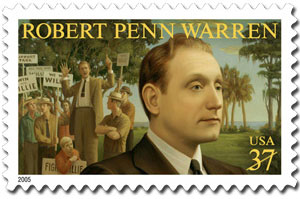
As students of writing, listeners would do well to crack open the book itself — Warren was poet laureate of the United States as well as novelist, and focusing on the printed page can be more instructive than letting compressed dialogue flow by over the radio or MP3 player.
As New York Times reviewer Orville Prescott put it when the book was new, “Jack may be morally as blind as Willie Stark, the Boss, but Mr. Warren has endowed him with his own exuberant skill with words.”
As a political novel and exploration of power, responsibility, idealism, cynicism, moral character and the meaning of life, Warren’s book won the Pulitzer Prize for best novel of 1946. The 1949 movie won a Best Picture Oscar, among others. (The 2006 re-make didn’t do so well.)
Here’s one more clip from the Broderick Crawford film, as long as someone has posted it to YouTube. John Ireland plays Jack Burden, mostly as a face in the crowd, while Stark cranks up his “Nobody ever helped a hick but a hick” speech.
(When you see the reporter listening to a speech blurt out “He’s wonderful, wonderful,” that’s Jack — and you can tell he’s about to go over to the dark side.)
Journalism’s a shrew and a scold. I like her.
She makes you sick, she makes you old. I like her.
She’s daily trouble, storm and strife.
She’s love and hate, and death and life.
She ain’t no lady. She’s my wife.
I like her. — F.P.A.
As the radio narrator notes, F.P.A.’s poem about journalism was written to mark the 1931 demise of the New York World, “a newspaper that newspapermen admired above all others.”
While not a “dramatization,” the 1956 radio program “Biographies in Sound” captured a bit of Franklin Pierce Adams’ style and character, as did his column itself — both examples of how the 20th century listening and reading audience formed its impressions of what journalists were and did.
While some journalists focused on crime, politics and life’s little human dramas, Adams connected journalism to the elite literary and celebrity life of New York, from the Algonquin Hotel roundtable, to Broadway, tennis courts and croquet lawns. As the friends and colleagues on the radio documentary make clear, it was a different world.
Before there were blogs, there were newspaper columns… and some were more than print pulpits for political pundits. Franklin Pierce Adams’ daily (yes, daily) “Conning Tower” column of witty notes and poetry entertained readers of various New York newspapers through most of the first half of the century. Think “Huffington Post,” but on dead trees.
While his initials “F.P.A.” were the column’s brand-name, he hosted what the radio narrator refers to as a “Who’s Who in the literary history of the past generation,” introducing Dorothy Parker, James Thurber and other writers who went on to the New Yorker, newspapers, magazines, books and Broadway.
Adams (1881 to 1960) wrote columns for the Evening Mail, the Tribune, Stars and Stripes, the New York World, Herald Tribune and New York Post.
Biographies in Sound, running from 1954 through 1958, was a radio documentary series whose subjects included living or recently deceased celebrities, some of whom were journalists and former journalists.
“Well, it made a pretty good yarn, I guess. Y’know — ‘Mother slaves to save $5,000, offers it to clear her son.’ I told myself it was all in a day’s work…” — Reporter Mac McNeal
It all starts with a classified ad in the newspaper, a scrub-woman, and a reporter’s search for the truth — and proof.
Based on a real newspaper investigation that led to the freeing of a convict, the film starred Jimmy Stewart as an at-first-reluctant reporter who gradually becomes an advocate for a man whose mother scrubbed floors to offer a reward for new evidence in his case.
Decades before “All the President’s Men,” this story is another realistic “newspaper reporter procedural,” with Stewart’s character skeptical at first, then building the story gradually, chasing down leads, employing shoe-leather, compassion and insight.
The almost-documentary film’s conclusion uses a photographic clue to solve the case — not the easiest way to make a point in the later radio broadcast. The use of wirephoto and a dramatically enlarged image were not really “high tech” for the 1948 film, but may have seemed so to a non-technical audience.
The extra bonus, when it comes to radio drama’s record of the importance of newspapers in American life, is in how the reporter spots the key piece of evidence — a bundle of papers under a newsboy’s arm in a newspaper photograph: Newspapers-in-a-newspaper-photo-in-a-newspaper-drama!
The radio version is by Screen Guild Theater, one of radio’s “anthology” series that specialized in radio adaptations of hit films. James Stewart and Richard Conte re-create their film roles as the reporter and the prisoner. Pat O’Brien (the original film Hildy Johnson in 1931’s “The Front Page”) is added to the cast as Stewart’s editor, a part played by Lee J. Cobb in the film. O’Brien puts a great touch of Irish blarney into his speech convincing the reporter to dig deeper.
Compressing the film into a 25-minute radio drama meant cutting details, and corners. Is it still effective? Give a listen.
No, this isn’t about Pulitzer’s World campaigning to build a pedestal for the Statue of Liberty. It’s about a reporter for the competing New York Herald who, at least according to this radio drama, fell in love with a lady who was outstanding in another harbor.
The woman is the real subject of the drama — lightkeeper Ida Lewis of Newport, R.I., “The Woman on Lime Rock” of the episode’s title. In fact, “Lime Rock” itself was officially renamed “Ida Lewis Rock” in 1924. Today, it is home to a yacht club, also named after the turn-of-the-century heroine. But I’m getting ahead of the story.
“It’s late afternoon in the year 1911 in a hotel room in Newport, R.I., Will Carver, an elderly journalist, stands at the window looking across the harbor at Lime Rock Lighthouse…”
Carver, of the New York Herald, narrates the story, dramatized in flashbacks as he dictates Ida’s obituary. The actor is Les Tremayne, one of the best-known voices in radio. Actress Shirley Booth plays Ida, rowing through storm-tossed waters, tending the harbor beacon lit and keeping the fog horn sounding for 54 years — all compressed into a 25 minute program.
When I have a chance I’ll check the archives to see if there actually was a published obit under Carver’s byline. (My available online archives don’t include the Herald.) In the drama, Carver admits that Ida was his childhood sweetheart, and that he first proposed to her when she was 15. But she wanted to be a school teacher, and was just starting on that path when her father’s illness left her in charge of tending the oil-lamp harbor beacon.
When Carver comes to interview her at the lighthouse years later — after she’s a national celebrity — her crippled father mentions that stories of her heroism have brought hundreds of letters proposing marriage. “Know about them? I wrote them,” Carver replies. The journalist, in this portrayal, does nothing more heroic than being a life-long friend, with a self-deprecating sense of humor. Good for him.
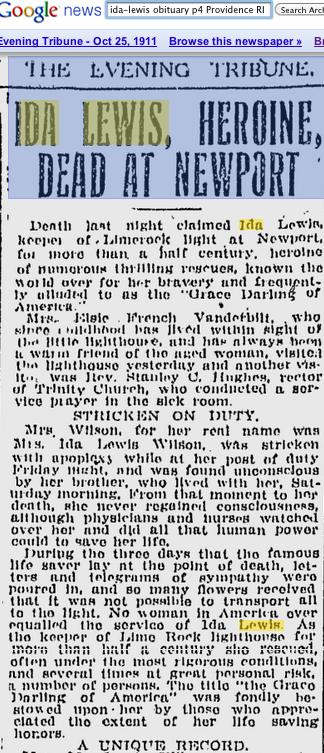
“Ida Lewis, Heroine, Dead at Newport”; Providence Evening Tribune, Oct. 25, 1911, page 4
Ida Lewis really was a hero and subject of numerous news stories in national newspapers and magazines. From the age of 18 she made headlines for her rescue work. Eventually, she received gold and silver medals, and President Grant paid her a visit. Ambrose Everett Burnside, a Civil War general who became Rhode Island’s governor, may have lost at Fredericksburg, but he won the battle to get Ida named the official keeper in the U.S. Lighthouse Service, one of the predecessors of the U.S. Coast Guard. (She and her mother already had been tending the light for years.)
At her death, obituaries said that she had saved the lives of 18 people, including soldiers and sailors making their way across the harbor in small boats or on weak ice.
As is the case with Hollywood’s film docu-dramas, the radio stories on “Cavalcade of America” aren’t marvels of historic detail. They prefer to tell simple half-hour-long stories of Americans demonstrating noble virtues. In this case, Ida’s mother and brother are left out of the story, her brief marriage to a Connecticut man is omitted, and the Rhode Island general’s name is shifted to a more familiar one of the same era, “General Sheridan.”
While the lingering affections of the romantic newsman provide a useful narrative frame for the story, perhaps his presence also reminded Cavalcade listeners of newspaper reporters as observers and storytellers, and hinted that they — like lighthouse keepers — sometimes made sacrifices for their careers.
“That’s how it was with Ida Lewis and me. I brought her news of the world she’d left behind so long ago, and we talked and laughed together. I never noticed it happening, but somehow we’d both grown old…”
The star of this “Cavalcade of America” episode, Shirley Booth, was an accomplished actress, and had a few journalist roles in her career, even if they weren’t her most celebrated. A few years after this broadcast won a Tony and an Oscar in “Come Back Little Sheba.” On television, she won Emmy awards for her 1960s series, “Hazel.” Her Broadway career, however, gave her opportunities to be a news photographer in “The Philadelphia Story” (1939), a writer in “My Sister Eileen” (1940), and a columnist in “Hollywood Pinafore” (1945).


 Newspaper Heroes on the Air