As a former reporter for The Hartford Courant, I was intrigued to find a Courant story from long ago among episodes of the radio series “The Big Story,” and just had to track down the original criminal investigation. The broadcast drama turned out to be based on a 30-year-old serial killer case from 1916 and, more surprisingly, was at least part of the inspiration for one of the most famous “screwball comedy” movies.
The other serial hazard to the health here is the program’s tobacco company sponsor. Unlike some Big Story episodes in online archives, this one has its Pall Mall commercials intact.
And when a distraught woman arrives in the newsroom, the first thing the reporter does is offer her a cigarette.
Broadcast as “The Case of the Final Curtain” in 1947, the murder story was a piece of Connecticut criminal history, a murder case that ran through two trials and helped inspire the hit play and film “Arsenic and Old Lace.” That very funny movie has little to do with the serious tale you will hear on this radio program. In the film, the nephew of the two murderesses (reality only needed one) is a theater critic for a newspaper, but “getting the story” is not his focus as much as getting his dear aunties into a comfortable asylum.
The 1947 Big Story episode compressed the 1916 arrest story into a half hour, but stuck much closer to the facts than the Broadway play did — at least after a melodramatic opening scene about a daughter sending her elderly Shakespearean actor father to the nursing home, with much hamming it up on his way to becoming one of the victims. Perhaps that was a tip of the radio writer’s theatrical hat to the Broadway critic in “Arsenic and Old Lace.”
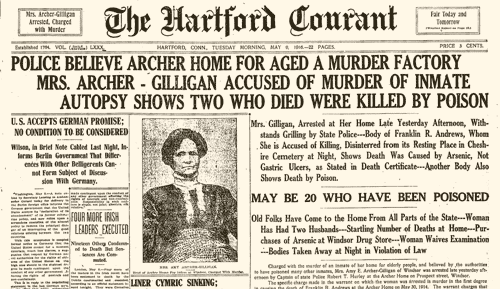
In the radioplay, the rest home operator took an original approach to “managed care,” especially for clients who unsuspectingly paid for lifetime care in advance. If an old actor was among her original victims, that fact isn’t mentioned in the most recent book about the case. There was nothing humorous about the original story — as is clear from its Courant “Murder Factory” May 9, 1916, front page headline.
(The Courant is part of the Proquest Historical Newspapers project and Newspapers.com, which both have made full-text scanned copies of the newspaper available through libraries or individual subscriptions.)
The 1916 arrest story filled more than four eight-column pages of the 22-page paper. It profiled a police investigator who had worked on the case for 13 months, at one point saying he “used as the groundwork of his official investigation the material that had been secured by ‘The Courant.'” Elsewhere, the story says that the police investigation actually had started the previous year with a complaint to the state’s attorney, but “received a new impetus” from evidence gathered by The Courant.
A book-length account of the case reveals that the “home” in question had raised suspicions for years. Among other things, the paper’s part-time town “stringer,” Carlan Goslee, noticed he had been writing a lot of obituaries, and found records of the home’s arsenic purchases. His editor, Clifton Sherman, told him to keep digging, and assigned additional reporters to the project, building stories that were ready to go when the state was ready to prosecute. Goslee eventually became a grand juror signing the warrant for the 1916 arrest, at which point he was sworn to secrecy. However, the Courant had been promised a break on the story, according to details of the investigations, arrest and trial compiled in the 2010 book The Devil’s Rooming House, by M. William Phelps.
The 1947 Big Story “Pall Mall Award” was presented to Sherman’s third reporter, Aubrey Maddock, an assistant city editor at the Courant, and later a prominent Hartford businessman. For his substantial contribution to the “Murder Factory” story package, he had tracked down and interviewed a former resident of the “home,” a woman who was committed to a mental hospital by the home’s owner after making complaints about her treatment that neighbors relayed to the state’s attorney.
As may have been the case with many “Big Story” episodes, the broadcast drama amplified the role of its “Pall Mall Award”-winning reporter. In the radio script, the doggedly persistent Maddock (not Goslee) is the one who gets suspicious about the amount of arsenic it takes to kill the rats at a nursing home, and the unorthodox removal of bodies from the home after midnight. He is portrayed as a confident and aggressive interviewer who seems to have had the story all to himself. Courant columnist Colin McEnroe revisited the original story in 2000 under the headline, A Page From History: We Were There. “Just how much The Courant had to do with driving this case forward is a matter of some confusion,” he concluded.
If anyone wants to pursue this further, it would be fun to check The Hartford Times on microfilm and maybe the Springfield (Mass.) Republican for their coverage of the story back in 1916, to see whether the region’s other two large papers gave contemporary credit to the Courant. The New York Times story the next day did make reference to The Courant’s having obtained and printed affidavits on some aspects of the case. Coincidentally, Goslee later became a part-time correspondent for the Courant’s longtime competition, The Hartford Times.
A year the first version of this JHeroes post, former Courant reporter, Ron Robillard looked back at the case in a column focusing on the roles of then-public documents, death certificates and a poison-register that druggists were required to keep.
“The true story of America’s deadliest female serial killer …”
The Devil’s Rooming House
For those interested in pursuing the case, the story was told one more time as The Devil’s Rooming House: the true story of America’s deadliest female serial killer by M. William Phelps, Guilford Press, 2010.
Worldcat Synopsis:
“A silent, simmering killer terrorized New England in 1911. As a terrible heat wave killed more than 2,000 people, another silent killer began her own murderous spree. ‘Sister Amy’ Archer-Gilligan, who’d opened the Archer Home for Elderly People and Chronic Invalids four years earlier, would be accused of murdering both of her husbands and up to sixty-six of her patients with cocktails of lemonade and arsenic; her story inspired the Broadway hit Arsenic and Old Lace.”


