The historical radio series DuPont Cavalcade of America celebrated the first century of the Associated Press in 1948 by dramatizing scenes in the news cooperative’s past — from its first big error (signal flags were involved) through an effort of literally Biblical proportions to monopolize a telegraph line and relay European news from Halifax (did the Queen really ban the waltz?), to more significant news from Gettysburg, Little Big Horn, and the Johnstown Flood — over 2,000 dead, with the AP reporter filing his story despite a broken leg.
The compressed story takes the AP from its start as a cost-cutting cooperative effort by the six most important New York newspapers of 1848 into the new century, then jumps to its 1948 status as a million-words-a-day wire service with a membership of 4,000 subscribers.
The radioplay even manages to get in a few chuckles on the way, particularly when an AP agent has a telegraph operator transmit Bible passages to keep control of the wire for several hours.
(I thought I’d posted an essay about this episode long ago, but I don’t see it here. Perhaps it’s lurking on the backup disk from my old office computer. At least this blog post will remind me to do a more thorough write-up the next time I update my Cavalcade of America page.)
I’ve written in the past about the Shadow having his partner Margo Lane impersonate a reporter from time to time, but now I have found a Shadow episode in which Margo actually does take on a writing assignment.
It’s not hardcore news reporting of the Lois Lane variety, but a feature story for a women’s magazine, at least at first.
But when the society family Margo is about to profile turns out to have nasty secrets, the tale becomes what the chroniclers of The Shadow call “The Dragon’s Tongue Murders,” broadcast in 1941 and stored away as an MP3 file in the library of the Old Time Radio Researchers group, OTRR.org. (Click on the episode title to download the MP3 if the player icon below does not work properly.)
A fan also has posted the episode to YouTube, under the name of one of the pulp-magazine Shadow’s secret identities…
Back to Margo as reporter… In fact, I’ve read somewhere that the creators of the Superman comic strip took the name of Lois Lane from both Margo Lane and Lola Lane, one of the actresses who played the fiesty reporter Torchy Blane on a series of B-movies in the 1930s.
In a way, this Shadow episode is like the early Superman adventures on radio. The “reporting assignment” is what gets Margo Lane and Lamont Cranston to the peculiar family’s estate, before any crime has occurred. Then they get caught up in the mystery, and Cranston has to shift into his superhero role, at least briefly. That is reminiscent of some of the Superman radio serials, where Clark Kent and Lois Lane — as reporters — were the center of the plot for days of 15-minute episodes before Kent had to do anything superhuman.
Perhaps to get Shadow fans interested, the broadcast begins with a preamble about the family’s dark secrets, with the voice of the Shadow in a role I haven’t heard before — as an omniscient narrator. Then we jump to Margo and Lamont on their way to the estate. (In the car, Lamont, whom we and Margot know as the Shadow, has no knowledge of the events in that spoken preamble.)
As for Margo’s story, it certainly doesn’t turn out the way she planned. But despite the multiple murders mentioned in the title, our freelance writer heroine does have her own somewhat happier surprise ending.
I recall reading that the Shadow was originally a mysterious sounding narrator who did not actually appear in the stories. That was before he evolved into a crime fighter with the ability to cloud men’s minds etc. I wonder if that opening scene with the shadowy voice over this was an homage to the early days, or an early transitional script being reused.
Now that I have listened to the and written this much about it, I’m going to dust off my copy of Martin Grams’ book about the Shadow, as well as a couple of other radio reference books to to refresh my memory about Shadow history and see if they shed any light on this particular episode.
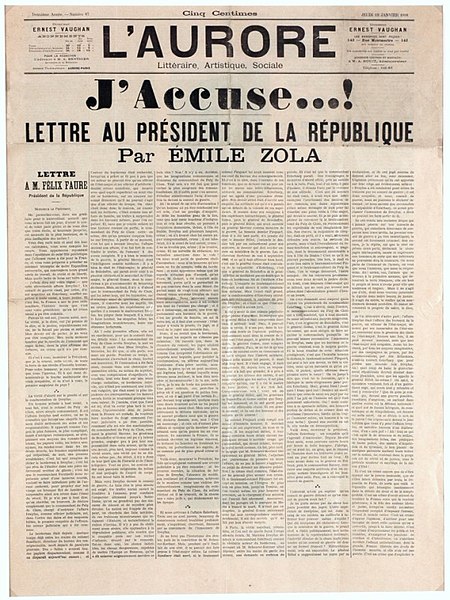
Today was the birthday of Émile Édouard Charles Antoine Zola (1840-1902), and the birthday of a former editor of mine, a coincidence that reminded me that I have never gotten around to posting about the 1898 Dreyfus case and Zola here.
I am posting these links now to take advantage of the birthday coincidence, and will get back to writing about them sometime in the future. I accuse myself of procrastination.
The Whistler episode Conspiracy. from Sept. 29, 1948, opens with a reporter reading a newspaper murder story in a diner, and speculating about the motivation of killers.
Then he gets a call from his editor, sending him out into the driving rain to a Mississippi River town whose levee is about to break. It’s the town where Marilyn lives, his ex-wife, the one person he might want to kill… and the rising river would cover for him… almost like a Conspirator, hence the title of the episode.
The cool, confident reporter is played by Frank Lovejoy, his voice easily recognized from his leading-man role as the Chicago columnist in the series Night Beat from 1949 to 1950. I wonder whether the heroic part of his performance here — star reporter faces deadly storm — helped him land that starring role a year later. Maybe a search of some archived trade magazines or “Night Beat” history sites will answer that question, in which case I’ll update this page.
Lovejoy was featured in a variety of non-journalist roles in at least 20 Whistler episodes, and is credited as writer of one of them. (He was also radio superhero The Blue Beetle early in his career, but his secret identity a young policeman, not a “mild mannered reporter” like Clark Kent.)
The CBS network’s “The Whistler” was a special sort of half-hour mystery series — not a simple “whodunit,” because it revealed the killer and his or her motivation early on. Instead, its suspenseful plots led to a twist at the end, keeping listeners’ attention until after the last commercial… pretty far from routine “inverted pyramid” newspaper stories, which open with the conclusion, then fill in details, with no last-paragraph surprises.
More than 500 episodes of the 1942-1955 Whistler series are offered at the Internet Archive by the Old Time Radio Researchers Group, which has broadcasting-history documents and a database at the Old Time Radio Researchers Website (www.otrr.org).
Series synopses and cast lists, which I am skimming for journalist plots, are offered by J. David Goldin at his Radiogoldindex.com website (now university-library based as https://radiogoldin.library.umkc.edu/). This story is one of ten or more where a newspaper reporter or editor is criminal, suspect, or victim… or just doing his or her job.
In my search for radio portrayals of journalists, “The Final Page” was the most promising title in a collection of New Adventures of Nero Wolfe episodes. Unfortunately, the page mentioned in the title is from a novel, not a news publication.
However, there is a public relations or publicity person in the story, working for the book publisher… and the detective makes use of some deceptive public relations — giving a false story to the press — to bring the tale to a conclusion. For a moment, even Archie, Wolfe’s assistant and legman, is taken in by the fake article. I guess that’s enough justification to include the program here, since it might warn readers to be alert to fake news… in this case, back in 1951.
I will keep listening to Nero Wolfe, hoping that he encounters a reporter and some real news reporting in another episode.
For today, a very short blog post with a link to some newsroom banter between Lois, Clark and editor Perry White when Lois has a brainstorm about — silly idea — Kent being Superman’s secret identity.
“Oh stop this nonsense, Lois, we’ve got a paper to get out.” — Perry White
It does suggest that a good-natured, argumentative and teasing relationship exists between a newspaper editor and his reporters. It may not be the greatest testimony to women being taken seriously in newsrooms. Still, Lois does come off as being assertive and tough, if not sufficiently sure of her evidence to stand by her intuition about Clark. After all, that was always part of the fun of the Superman comic books and radio series. Had I been old enough to listen to this program when it came out in 1947, I might have grown up thinking a newsroom was a place I wouldn’t mind working. I wonder if the same was true for girl listeners?
The conversation actually refers back to the conclusion of the previous storyline, a transitional recap before starting a new story. Of course, Lois’s suspicions are quickly set aside, after Clark and Perry explain the logic of why Superman showed up to rescue Lois and Clark while they were both unconscious.
Most episodes of the story (complete with commercials and premium giveaway promotions) are at the Internet Archive as downloadable or streaming mp3 files:
“Behind the Mic,” a radio series whose message was to demystify the medium itself, devoted its June 29, 1941, episode to the Associated Press, the newspaper co-op that had gradually come around to the idea of radio news.
The program includes mini-dramas of scenes from AP history, including the 1848 meeting of usually rival New York editors that formed the association to get some leverage over another “new media,” the telegraph companies.
The 19th century hazards of journalism portrayed on the program range from misreading semaphore signals to getting the assignment to cover General Custer at the Little Big Horn — and dying at his side.
We hear another AP man advising Pancho Villa to delay an attack until after the baseball World Series if he wanted to get on the front page of American newspapers. He did.
The anecdotes, dramatized from a history of the Associated Press, are delivered in rapid-fire, but provide no discussion of how the newspaper based service came around to the idea of providing news to radio stations.
Kent Cooper, general manager of the AP is interviewed on issues like the size of the association (1,400 American newspapers, 7,500 correspondents), arrangements for war coverage, and the latest news technology, one that it goes without saying would not be much use on radio — the AP wirephoto.
The program closes with an NBC announcer reading the latest AP war news, to the accompaniment of clattering teletypes, and the newscast ends with an important phrase: “For further details, see your local newspaper,” a clear sign that by World War II the newspapers, their wire services, and the New Medium of radio had found ways to co-exist.
The witty — if a bit prone to puns and quotations — college president on “Halls of Ivy” had more than one anxious moment over campus news media, but supported the freedom of the press in good spirits, which must have been acceptable to the program’s Schlitz Beer sponsor.
The second episode of the series, starring Ronald Colman and Benita Hume Colman as President & Mrs. Hall of Ivy College, featured a student newspaper editorial that offended his nemesis, the chairman of the board of governors, so much that he wanted the editor expelled.
Student Editorial, Jan. 13, 1950.
“A millenium is at hand, someone has finally read an editorial in an American newspaper!” — the student editor.
A year later, the same trustee went after the anthropology department as well as a student anthropologist author. President Hall disagreed with the article… a critique of campus life… but supported it on free speech principles, quoting Sinclair Lewis. The trustee was more concerned with the article’s impact on a football star who had taken the article to heart and was questioning his dedication to the sport.
Student Editorial in the Ivy Bull, Oct. 10, 1951.
“We can discuss the article in The Bull and the possible bull in the article…” — President Hall, inviting student author to dinner.
From the intellectual ramparts of anthropology, the Halls moved on in 1952 to investigate a campus gossip column of the air. It’s not a spoiler to reveal that the trustee chairman is in the middle again, but the Halls survive nicely. And, as Hall points out, the young woman reporter does stick to her facts. He quotes Sheridan about that, but also manages to mention one of my favorite oldtime newspaper columnists.
Voice of the Ivy Vine, Feb. 20, 1952.
“What the late Don Marquis called ‘stroking a cliche until it purrs like an epigram.'” — Hall quoting the creator of “Archie & Mehitabel.”
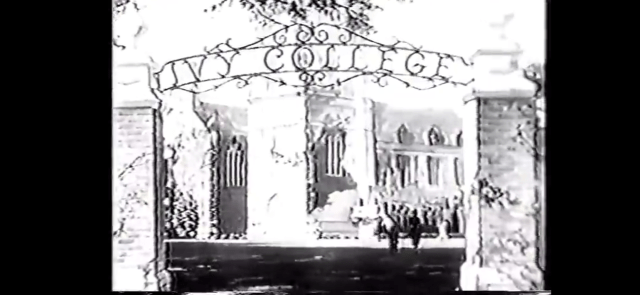
In addition to the Peabody Award winning 1950-52 radio series, more than 100 episodes, the Colmans also brought the series to television in 1954-55, which provided the college gate image at the top of this page as well as this brief clip at YouTube.
While he never went to college himself, Don Quinn, creator of the campus-based radio program, gave a revealing interview about it while on vacation in Hawaii, which has been archived at YouTube. Listen for a tip-of-the-hat to his wife, a Northwestern University journalism school grad. Here it is:
“What a story! Boy this is great!” — reporter Jimmy Gifford
Here’s a mystery from 1932, the days when radio drama was relatively new, when flying the air mail was still an adventure, and so was newspaper reporting.
The broadcast presentation on these original syndication company transcription discs includes no opening title or theme music, just the buzz of an airmail plane and some filler music that presumably could be covered by a local announcer introducing the program. The cast and crew are never identified.
The plot: Irene DelRoy, “clever girl operative of the Department of Justice,” arrives to investigate three mysterious crashes of a private contractor’s airplanes carrying mail and government securities.
Reporter Jimmy Gifford of The Star, who we learn has a romantic history with agent DelRoy, is introduced in the second episode “Andrews Accused,” making a good showing as an investigator himself. Irene and Jimmy’s cop-and-reporter buddy-romance is a mirror image of the”Torchy Blane” reporter-and-cop movie serials, but not played for cuteness and laughs. In a later episode, Jimmy even carries a gun, and at one point Irene tells him to be prepared to shoot-to-kill.
Later in the Air Mail Mystery, Irene mentions that she and Jimmy have worked together before, and tells others that unlike some other reporters, he can be trusted. That kind of camaraderie might be closer than most editors would like to hear about, but it makes me wonder if there were plans for more Irene-and-Jimmy stories. So far I have found no information about whether this one 13-episode serial, which could have run daily for two weeks or so, was part of plans for a continuing series back in 1932.
Here is Jimmy, making his appearance in episode 2…
The third episode, “At the Crash,” finds newshawk Gifford asking more solid questions and unmasking an undercover federal agent working for Irene. (Later, I think he’s the one who produces a whiskey flask right when needed to help revive a tear-gas victim. Some reporter stereotypes are forever, I guess.)
Before the end of the tale, Gifford is being a daredevil, first in a gunfight, then risking his life flying after a mysterious plane on his own…
(It’s interesting that in 1930s fiction, newspaper reporters were sometimes able to fly their own planes. In one of the first Superman radio adventures, Clark Kent piloted a plane on a flying rescue when he was still keeping the existence of Superman a secret. And I remember Lois Lane donning a leather flying helmet and taking off on a solo flight to track down the bad guy in one of the early Superman cartoons.)
Back to the Air Mail Mystery, even with just 12 episodes, the story is very listenable, well-acted and reasonably mysterious. The summaries at the beginnings of the episodes make it easy enough to follow the tale if you weren’t paying close attention, or without the missing chapter seven.
I’ve already updated this post once, and will do it again if I find more information about this intriguing series.
Many thanks to the Old Time Radio Researchers group and Jerry Haendiges of otrsite.com, who digitized transcription discs of the series and provided them to the group for uploading to the Internet Archive by the group’s Web coordinator Paul Kornman.
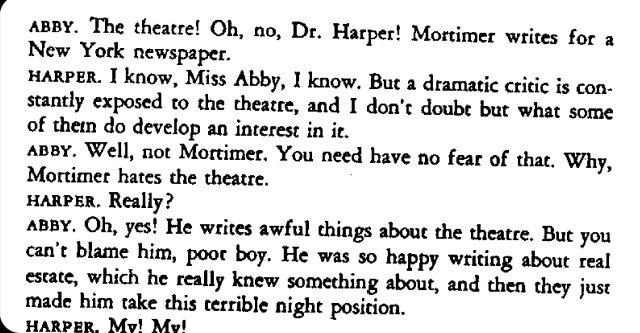
“I can save time if I write my review on the way to the theater.” –Mortimer Brewster
Arsenic and Old Lace(IMDB), a hit play and Capra film, was done by several radio anthology series.
Here it is by “Best Plays,” from July 1952. (If an audio player is not visible above, click on the series name to download an MP3 file.)
This radio adaptation has Donald Cook as theater critic Mortimer Brewster and Boris Karloff, from the original Broadway cast, as family psychopath Jonathan Brewster. Capra had Cary Grant as Mortimer and Raymond Massey as Jonathan, but kept the original play’s line saying Jonathan “looked like Boris Karloff.”
Are theater critics “journalists”? They certainly were on the minds of playwrights and film-makers, as I’ve discussed here before. And if they worked for a newspapers, they shared the newsroom culture that often included a shifting from beat to beat. Walter Winchell rather famously went from theater critic and Broadway columnist to newspaper and radio columnist full of information and opinions on everything from gangland to Hitler’s Germany.
While not as interested in “hard news,” Mortimer Brewster says he is off to “cover a play,” as a reporter might say he was off to cover a court hearing or council meeting. One of his aunts mentions that he actually hates the theater and was happier writing about real estate before being forced into the night job, which may be reflected in his decidedly critical approach to criticism.
Whatever his dedication to his craft, it is understandably tested when he discovers that his aunties have a cadaver in the window seat. In an attempt to deal with this crisis, he calls the office to find a last-minute substitute to review that night’s play.
His suggested candidates include an office-boy and one of the printers at the newspaper… with a joke that his substitute might turn into “another John Chapman” — the New York Daily News critic who was the host of “Best Plays.”