Nellie Bly on the radio

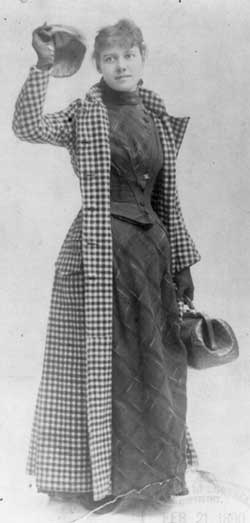
Nellie Bly, from Library of Congress

Nellie Bly

“1885… Women are coming out of the kitchen and invading fields hitherto considered sacred to the male of the species. One of these fields is the newspaper, and the spearhead of this invasion is a girl with big soulful gray eyes, a manner determined, and the energy of a wildcat, Nellie Bly… Nellie has journalism by the throat and shakes until it cries for mercy.”

A bit violent, but that’s how Cavalcade of America opened its 1945 radio profile of Nellie Bly, star reporter of Pulitzer’s World, and star of her own famous trip around the world. Listen to the full program here…
Nellie was a lady (Click the title to download or play on iPod if you don’t see a player icon.)

Turner Bullock’s script, titled “Nellie Was a Lady,” has some wildcat energy of its own.

The half-hour drama manages to include Nellie’s race with Jules Verne’s fictional “Around the World in 80 Days,” a brief meeting with Verne, and her exposes of a madhouse, a prison, mashers in Central Park and lobbyists in Albany — all to the cheers of crowds and whines of a disappointed suitor.

The reporter’s real name, Elizabeth Jane Cochrane, is never mentioned, but we do get a barbershop chorus of the Stephen Foster song, “Nellie Bly,” that inspired her pseudonym.

The program clearly is more entertainment-drama than serious history. As author Brooke Kroeger notes, until the publication of her 1994 book, Nellie Bly: Daredevil, Reporter, Feminist, “anyone interested in knowing more about her had to rely on a number of juvenile biographies, all partly fictionalized, which have done as much to distort the record as they have to perpetuate Bly’s memory.”

Cavalcade’s Nellie was played by Agnes Moorehead, one of radio’s greatest actresses — listen to her singing and shrieking her way through a bit of Ophelia’s madness scene to get herself committed to that asylum. Her other radio roles ranged from Margot Lane on “The Shadow” to memorable episodes of “Suspense,” and frequent appearances as a radio member of Orson Welles’ Mercury Players. (As far as I know, “Margot” was her only Lane — she never played Lois.)

In another Welles connection, Moorehead’s film career had a major close-encounter with journalism several years earler: She played publisher Charles Foster Kane’s mother, Mary, in the opening scene of the 1941 film, “Citizen Kane.”

A year earlier, she played the mother of an even more famous fictional journalist in another opening scene: The baby Kal El’s doomed mother, Lara, on the first radio Superman episode, “The Baby from Krypton.” (For the second episode, where Kal El takes the name “Clark Kent,” see jheroes.com’s first episode, Getting off the ground at The Daily Planet.)


Notes:

The audio file is streamed from the Calvacade collection uploaded to archive.org by the Old Time Radio Research Group.

The less-known Six Months in Mexico, along with Around the World in 72 Days and Ten Days in a Madhouse have been adapted for the Web at the University of Pennsylvania. The latter book includes “Miscellaneous Sketches: Trying to be a Servant” and “Nellie Bly as a White Slave.” The two best-known books are also available read aloud in several audio formats from Project Gutenberg: Ten Days, Around the World.

For an excellent biography, as mentioned above, see Nellie Bly — Daredevil, Reporter, Feminist by Brooke Kroeger, 1994. (By the same author, “Nellie Bly, She Did It All,” a 1996 article from the Quarterly of the National Archives.)

For the more cinematically inclined, see the PBS American Experience documentary based on Kroeger’s book, Around the World in 72 Days.

For a substantial Web resource page, see Nellie Bly Online.

Among other honors, Nellie Bly was featured in a 2002 set of United States postage stamps of women journalists, and she is the namesake of the New York Press Club Nellie Bly Cub Reporter award.

Finally, students of “the portrayal of the journalist in popular culture” might be amused to search the Internet Movie Database for movies, TV serials and episodes featuring Nellie, and rumors of a 2012 film in the works. In print, via Worldcat or book review databases, you’ll find many “juvenile” biographies, and even a fictionalized Nellie rubbing shoulders with Sherlock Holmes in four of former journalist Carole Nelson Douglas‘s Sherlock-Holmes-inspired mystery novels, starting with Chapel Noir and most recently Spider Dance.

Posted in 19th century, cavalcade, foreign correspondents, historical figures, journalism, newspapers, reporters, women | Leave a comment

Women’s History: Sarah Josepha Hale on the Radio

Editor of Godey’s Lady’s Book

Sarah Hale portraitDupont Cavalcade of America featured historical and biographical programs, many of famous and less well-known reporters, writers and editors of the past, including Sarah Josepha Hale (1788-1879), author, magazine editor and advocate of education for women.

Hale’s best-known work may be a children’s poem about a young woman doing something against the rules — “Mary Had  a Little Lamb” — but her long and productive life was an example of more subtle re-writing of 19th century rules.

This recording of the radio biographical drama is from the Calvacade collection at archive.org, by the Old Time Radio Research Group. In honor of Women’s History Month I’ll add links to other women journalists on Cavalcade of America and other series over the coming weeks. (OK, so I jumped the gun with Hildy Johnson.)


Sara Josepha Hale, editor of Godey’s Lady’s Book.

The original 1937 Cavalcade broadcast came six years after the publication of Ruth E. Finley’s The Lady of Godey’s: Sarah Josepha Hale, a possible source of inspiration. (In keeping with the era and feminine theme of the program, the Cavalcade Orchestra opens the program with the 1889 hit — and perennial wedding song — “Oh Promise Me.”)

A young widow, Hale became a writer and editor to support herself and five children, soon editing the 19th century’s leading magazine for women, Godey’s Lady’s Book. She did not campaign for woman suffrage. But, as a dialogue in the radio biography puts it, she convinced her publisher that their magazine could work for reform “without antagonizing men” and become “a force for the advancement of American women.”

Before her retirement in 1877 — after 40 years as editor — she had campaigned successfully for women’s education and the employment of women as teachers, nurses and doctors. She also advocated labor-saving devices like washing machines and sewing machines, as well as pushing civic projects including the completion of the Bunker Hill Monument, preservation of Mount Vernon, and the creation of the national Thanksgiving holiday.

The Cavalcade episode, in fact, was originally broadcast on Thanksgiving Eve.

I can’t help wondering how women listening to this in 1937 (or today?) felt about Ms. Hale — a pioneer, an inspiration, or quaintly old-fashioned? The opening scene with her friend aghast to think that she actually was reading books seemed ancient — Dickensian, even. Then it dawned on me that this lady was 24 years older than DIckens.


Additional sources:

Here’s a biography page and a link to a more recent documentary film about her and Godey’s Lady’s Book.

Some features from the magazine have been turned into an online edition, godeysladysbook.com.

Joyce W. Warren. “Hale, Sarah Josepha Buell”; American National Biography Online Feb. 2000.

Stephen L. Vaughn

Encyclopedia of American journalism, p. 597-598

An appreciation by Vicki Rumble in Homespun: Godey’s Lady’s Book

Posted in 19th century, historical figures, j-heroes, magazines, women | Leave a comment

Rescuing the Tabloid Competition in Big Town

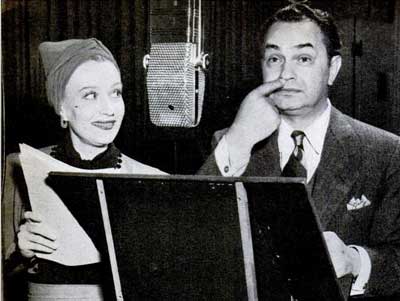
EGR touches his nose to indicate coming within 5 seconds of allotted time.

Not only were newspaper reporters and editors cast as heroic characters in old-time radio dramas, they sometimes made heroic attempts to help the competition, no matter how bitter the rivalry.

Perhaps that’s because they recognized newspaper journalism as a higher calling than profit-making. And perhaps their attitude was summed up most eloquently by crusading journalist Steve Wilson — originally played by Edward G. Robinson — during the opening of Big Town:

“The power and the freedom of the press is a flaming sword. That it may be a faithful servant to all the people, use it justly, hold it high, guard it well!”

(I don’t know how many future journalists were inspired by that line, but it did inspire the heading of this blog.)

Episode: “The Lost and the Found,” December, 1948. (Click to download if no media player is visible.)

In this radio-noir episode from 1948, Wilson (then played by Edward J. Pawley) and his colleagues from the Illustrated Press set out to find a rival newspaper’s missing crime reporter. The newshawk has been kidnapped by the mob while on an undercover assignment. He’s roughed up by a gun moll — while tied to a love seat with her nylons — amid very pulp-magazine dialogue.

The bantering conversation between newspaper editors and a few other scenes are fun, but be prepared for some over-written dialogue, sexist comments (appropriate to the era?), and the repeated “B.O.” warnings of the era’s Lifebuoy commercials.

(My player streams an audio file from the Archive.org collection of old-time radio. See other selections from Big Town linked to my backgrounder page on the series.)

In future episodes of this blog I’ll discuss more examples of dramatic radio’s newspapermen setting out to rescue — or avenge — competing reporters.

Footnote: The Illustrated Press’s competition in “The Lost and the Found” is called The Graphic, possibly modeled after the New York Evening Graphic of the 1920s, a sensational tabloid that I’ve written about elsewhere, and will be writing about again.

In fact, Big Town’s first episodes, when it starred Edward G. Robinson, were reminiscent of the actor’s hit film Five Star Final which also starred Robinson and was based on a play by an editor at the Graphic.


Note: By popular demand (a friend named Phil Meyer), I’ve added to that Big Town page and posted this repeat of one of the trial podcast posts from last year at my Other Journalism blog.

Posted in competition, crime, ethics, j-heroes, movies, newspapers, reporters, sensationalism | 1 Comment

Clark Kent vs. Horace Greeley: Heroic deeds on radio

As mentioned in a separate episode or two, the 1940 radio introduction of Lois Lane had her greeting Clark Kent with a sarcastic remark comparing him to Horace Greeley (1811-1872), one of the previous century’s journalistic superheroes.

New York Times remembers Tribune's Greeley

A 1930 New York Times remembers Tribune’s Greeley

A 1930 New York Times remembers Tribune's Greeley

That got me wondering: Would the radio audience for a juvenile adventure show like “Superman” have known Greeley’s name? His New York Tribune, by then merged with the Herald, marked its centennial in 1941, which may have raised his position in the schoolbooks of the 1940s.

I did a quick search in the Proquest Historical Newspapers database. At least Greeley was often quoted or misquoted as telling young men to “Go West.” Decades after his death, he had been called “the best-known man in America.” His statue occupied a prominent spot in New York’s City Hall Park, where it was given a cleaning and a new base in 1940 in conjunction with the opening of a new subway station.

His name was even mentioned when a Herald-Tribune reporter competed in a 1930 national spelling bee on the radio, according to Robert D. Heinl’s “Off the Antenna” column in The Washington Post (Apr 6, 1930; pg.A5).

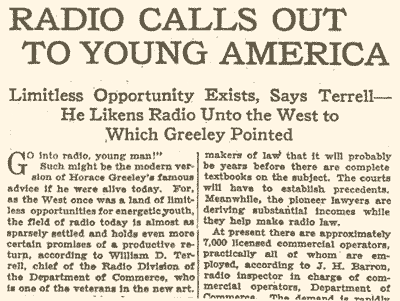
Coincidentally — since this blog is about radio — Greeley’s 19th century call to young men to look to the western frontier was used in a 1930 New York Times in the headline for a federal official’s career advice: “Radio Calls Out to Young America: Limitless Opportunity Exists, says Terrell — He Likens Radio Unto the West to Which Greeley Pointed.” (Jan. 26, 1930; pg.123)

Meanwhile, dramatized and fictionalized versions of Greeley made it onto the air, telling the radio audience considerably more than the fact that he encouraged Western migration, even if “Go West, young man,” was not his original phrase.

The Dupont series “Cavalcade of America,” which specialized in uplifting profiles of famous Americans, featured Greeley at least four times — in a multi-part 1936 episode titled “American Journalism,” in a 1941 profile of Margaret Fuller, in his own half-hour episode in 1951, “Greeley of the Tribune,” and again in 1952’s One Nation Indivisible, an episode about Greeley’s role in setting Jefferson Davis free after the Civil War. (Click the episode name to download or play the MP3 audio files from the Old Time Radio Researchers Group collection at archive.org, if the audio-player icon is not visible below.)

Cavalcade: American Journalism

Cavalcade: The Heart and the Fountain (Margaret Fuller)

Cavalcade: Greeley of the Tribune

Cavalcade: One Nation Indivisible

The first episode introduced Greeley and his Tribune, James Gordon Bennett and his Herald, and Henry Stanley’s search for Dr. Livingston on behalf of the Herald. The Margaret Fuller episode has Greeley hiring his first woman writer, initially as a literary critic, but eventually as American journalism’s first a foreign correspondent. (She jokes about expecting him to say “Go East, young woman,” as she leaves for Europe.)

The “Greeley of the Tribune” episode portrayed the editor as innovative and eccentric. Buttermilk and graham crackers hint at his vegetarianism, and his innovation consists of getting the news first by having type set at sea on a voyage from Boston to New York — with an alcoholic compositor’s Yankee aunt along to keep the man at work. Other scenes emphasize his interest in explaining America and educating the immigrant masses.

The final Cavalcade episode highlights a later day in Greeley’s career, when his paper called for Jefferson Davis’s release after the Civil War.

Intriguingly, none of the Cavalcade episodes I’ve listened to so far emphasize the most cliche history-book line about Greeley, the “Go West, young man,” quote, regardless of its provenance.

However, my last discovery of Horace Greeley in the old-time radio archives puts a new twist on the “Go west…” theme. In real-life, Greeley did go to the West — reporting back on what he saw there. The same Archive.org that I use for most of my radio program links can serve you numerous biographies and collections of his writings, including his Letters from Texas.

A century later, young radio listeners learned of his travels with a twist — a radio storyline that saw him robbed of his research notes on the way back to New York. And who could come to his aid? A former Texas ranger… (Cue the William Tell Overture…)

Mr. Greeley Goes West

Yes, in 1952, The Lone Ranger radio series had Tonto and the masked hero find Greeley by the side of a Western road, victim of a stagecoach hold-up. (From one of several Lone Ranger pages at the Internet Archive, which gives the episode’s date as June 25, 1952.)
Greeley wrote about his real western journey, including an interview with Brigham Young, in “An Overland Journey from New York to San Francisco in the Summer of 1859.”

For a more recent historical portrait of Greeley, see Horace Greeley by Robert C. Williams (New York University Press, 2006), reviewed in The New Yorker with this summary:

Horace Greeley was America’s most famous editor and, with his Tribune, a defining voice in mid-nineteenth-century politics. He was an early promoter of Thoreau, lent money to Poe, and employed as foreign correspondents both Mark Twain and Karl Marx (who described Greeley to Engels as a “jackass with the face of an angel”).

Bottom line: Horace Greeley, “America’s most famous editor,” got plenty of airtime — even though he died a half-century before live radio — and even if that upstart Kent was the one who got the thrice-weekly series and Lois Lane as a girlfriend.


Background research: The prolific historian of old-time radio Martin Grams Jr. has an 480-page book about The Cavalcade of America on both radio and television, complete with detailed episode guides — even if you just want to know all the members of the 150-voice choir for a Christmas broadcast.

Posted in 19th century, cavalcade, Clark Kent, historical figures, Horace Greeley, newspapers, publishers, reporters | Leave a comment

‘Hildy Johnson used to be a man’ – Cecil B. DeMille

After their success as Hollywood movies, both “His Girl Friday” and the hit Ben Hecht and Charles MacArthur play that inspired it, “The Front Page,” were adapted for radio — and more than once. A few of the productions are available as MP3 files, so I’ve attached a sampling here.

Cary Grant & Rosalind Russell in His Girl Friday

Walter & Hildy in His Girl Friday

As someone who saw both films several times before hearing the radio versions, I wonder how first-time listeners would react if they didn’t have the visual memory of the films. Maybe some of my students will try them in that order.

Whether he’s Hildebrand (in “The Front Page”) or she’s Hildegarde (in “His Girl Friday”), do Hildy’s City Hall poker-playing pressroom cronies give newspapermen the same unflattering image on radio that they do in the films? Does voice alone give a strong enough impression of Walter’s charisma — or whatever it is? Can Fred MacMurray compete with Cary Grant or Adolphe Menjou in that role?

The Front Page — Lux Radio Theater 1937 (Click the series name to download or to play the file on an iPad or other device that doesn’t show a player icon.)
Like the original film, “The Front Page” radio edition made it into the world a few years before its Hildy-is-a-lady reincarnation. This hour-long version is memorable for having a real newspaperman playing Hildy, if not for his acting. Walter Winchell of the New York Daily Mirror already had brought his tabloid Broadway column to his own radio program, memorable for his staccato “Good evening Mr. and Mrs. America and all the ships at sea…” intro over a clicking telegraph key. James Gleason, as Walter, gets third billing after the actress who plays Hildy’s fiancee.

It might be interesting to compare some of the dialogue with the original. Was it Winchell or a scriptwriter who made Hildy’s critique of journalism refer to readers as “a million nitwits and their wives” instead of the gentler, “a million hired girls and motormen’s wives” that I remember from “His Girl Friday”? (Winchell’s critique of journalism is about 12 minutes into the program.)

Historical note: That June 28, 1937, broadcast opens with an announcer mentioning that pilot Amelia Earhart, scheduled to be on the show, had “not yet completed” her round-the-world flight, but was expected to be on the program the next week. Her last verified radio transmission was July 6, after which she had officially disappeared.

The original stars of the 1931 film, Pat O’Brien as Hildy and Adolphe Menjou as Walter Burns, the role that brought him an Oscar nomination, did a half-hour Academy Award Theater adaptation on radio in 1946, an impressive compression of the original three-act play. (Lee Tracy, who played Hildy on Broadway, also played the role in a radio version, but so far I haven’t found an online source for that performance.)

The Front Page — Academy Award Theater 1946

The other “original cast,” Rosalind Russell and Cary Grant, present a compressed version of their already fast-moving “His Girl Friday” in this 30-minute 1941 adaptation of the 1940 film.

His Girl Friday — Screen Guild Theater 1941
But that wasn’t the first radio version. The film came out in January 1940; that September, Lux Radio Theater already had it on the air with a different cast.

His Girl Friday — Lux Radio Theater 1940
Not Rosalind Russell and Cary Grant, this version has Claudette Colbert and Fred MacMurray, and a tongue in cheek opening address from the famous producer and director, Cecil B. DeMille. He sets the scene and reminds the audience of the main difference between the two plays: “Hildy Johnson used to be a man.”


All of these MP3 files are from the Old Time Radio collection at archive.org. The films “The Front Page” and “His Girl Friday” are also at archive.org as streaming or downloadable video files. If the dialogue is too fast for you, a His Girl Friday script is online at The Internet Movie Script Database (IMSDb).

Posted in Hildy Johnson, j-heroes, movies, newspapers, reporters, women | Leave a comment

Publisher dares to report

Britt Reid didn’t follow a traditional publisher’s job description, and I’m not just talking about his moonlighting as a masked crime fighter for more than 1,000 radio episodes in the 1930s, ’40s and ’50s, each one with a newsboy shouting “Sentinel Extra!” to sum things up at the end (“… Hornet still at large”), and in later years to sell the sponsor’s product, Orange Crush.

Back in the radio days, the “daring young publisher,” as each Green Hornet episode introduced him,   Reid sometimes acted like an editor-in-chief, or took the more hands-on approach of a managing editor. Sometimes he wrote or dictated editorials. In some episodes, he even went out to gather the facts himself — and wound up in great danger as a result. (See JHeroes Hornet overview page.)

Younger listeners should not confuse radio’s Britt Reid with 2011’s Seth Rogen Green Hornet movie, hitting on his secretary or calling her a “hottie.” Radio’s Hornet, written for a juvenile audience, showed no more interest in women than the average Saturday-matinee cowboy hero, which Rogen turned into a running “not gay” joke.
Rogen’s Reid also admits to being a dope about newspapers, and seemed unlikely to have a “second edition” Hollywood sequel. Not so the radio version, whose Britt Reid grew into the job after being given the newspaper by his father. The series had run for a decade when the elder Reid returned to the storyline in the late 1940s, proud of his son’s dual-identity accomplishments. (He also revealed his own secret — that as a lad he had ridden with another masked crime-fighter, his uncle the Lone Ranger, a fun plot link between the two similar adventure series produced at Detroit’s WXYZ.)

For the original Britt Reid, lines also blurred between the publisher and Gunnigan, who was Daily Sentinel city editor in name, but more managing editor in practice. I think Gunnigan was the only other titled Sentinel executive mentioned in the couple of hundred episodes I’ve heard, watched or read. (Newspaper job descriptions are a bit vague in other radio dramatic series, too.)

Sometimes Reid gave reporters news tips or explicit assignments, or gave direct orders to the city editor. At other times he dictated editorials to his secretary. And sometimes he just seemed bored with the place, giving the impression he was simply a playboy who slept late after nights on the town.

Radio fans knew that on his nights out, Reid was more inclined to jump in his supercharged car and fight crime with something punchier than an editorial. Of course that was the underlying theme of the entire series: That Reid had become a vigilante out of frustration with racketeers slipping through loopholes in the legal system.

As the Green Hornet, he pretended to be a crook himself, but used guile, trickery, blackmail, threats or coercion to get the real bad guys to incriminate themselves, while eluding the police himself… and, Robin Hood like, donating bad guys’ loot to charity.

Here’s an example, complete with some of Reid’s reflections on journalism. In this Murder Ring Racket episode, Reid and city editor Gunnigan debate the ethics of their sensation-minded competition, The Clarion, which is hiding an informant to get exclusive stories:

“The Clarion ought to think more of the public and less of yellow journalism,” Reid says. “What they’re doing is against the public interest.”

Later, Reid is on the phone with the Clarion’s publisher, trying to convince him to put the witness in police custody, even offering to give the Clarion an exclusive on the story — another sign that the Sentinel puts human rights and civic duty above the headlines

Reid’s secretary Lenore Case is in the act too — confronted by a hoodlum who mistakes her for someone from the other paper, which has hidden away a witness to get exclusive stories out of him. “The Clarion is a block further down,” she says, and slugs him with her purse, mentioning that she wishes it had a brick in it.

She also winds up helping Sentinel city editor Gunnigan track down a piece of the story when all the reporters are out of the office, and she spots a clue (footprints in the coal dust on a fire escape!) before the editor or the police.

(In the later years of the long-running radio show, the efficient Miss Case not only dabbled in reporting, but also became the Hornet’s confidante, a role that continued into the 1966-67 TV series and 2011 movie… which also made her a 21st century journalism school graduate, sadly settling for a secretarial job.)


The episode is also available at archive.org and RadioSpirits. In the broadcast, The Hornet introduces the story with the phrase “Murder Ring Racket,” and the episode is listed as “Crandall and the Murder Ring” with a 1939 date in some MP3 collections. However, the exhaustive 2010 book The Green Hornet by Martin Grams Jr. and Terry Salomonson lists the story under the copyright-registration script title, “Murder Seeks Its Victim,” with a June 5, 1940, broadcast date.

Posted in competition, ethics, GreenHornet, j-heroes, newspapers, publishers, radio, sensationalism, women | Leave a comment

Superhero ethics versus reporter ethics

Landing that first journalism job can be a challenge. It’s certainly true today, but the 1940s were no picnic either.

So, when a young man identifying himself as Clark Kent appeared at The Daily Planet, “a greenhorn” as the editor put it, he was prepared to use more than a resume and portfolio of news clips to get a job.

  • He had no clips.
  • He had no experience.
  • He didn’t have a decent suit of clothes.
  • It’s not even clear where he learned English.

What did he have?

There may have been a recommendation from a college professor. That’s who suggested he get a job on a great metropolitan daily in the first place, to fulfill his career goal of observing and studying human beings, “to know which to help, and when help is needed.”

As the professor put it, “To mingle with people, to see men at the highest and lowest, if that’s what you want… How about a newspaper? A great metropolitan daily… Join their staff. Be a reporter.” (The professor’s son, Jimmy, suggests getting a new suit and calling himself “Clark Kent.”)

But Clark didn’t mention the professor to editor Perry White in that job interview. Instead, he just gave the boss what he wanted — a promise of a hard-to-get story about threatened railroad sabotage.

Getting that story idea is where is the ethical fog rolls in. (Michael Keaton had a similar problem in the movie “The Paper” many years later — in a scene where he swiped a story idea of the desk of the editor interviewing him for a job at a bigger paper. He didn’t get the job; he did get the story.)

In Clark’s case, some super-hearing apparently let him in on all the details of editor White’s last telephone conversation before the job interview. “You’re either clairvoyant or the luckiest guesser alive,” White said later. “Either way I can use you.”

Was that fair? White’s secretary didn’t think so: “You’re pretty lucky, I’ll say. A hundred good newspapermen walking the streets and you step right into a job.”

You be the judge of whether he delivered the goods as a reporter in “Keno’s Landslide,” the next episode from the original three-day-a-week Superman radio serial. Actually, Clark underestimated the power of the press at one point — just saying he’s a reporter kept a conductor from putting him off of a high-speed passenger train for not having a ticket. “You’re liable to write up a story about getting kicked off our train…” Ironically, Kent wanted to get off the train, but you can hear what happened for yourself in the middle of this episode, “Keno’s Landslide”…

You also can pick up more of that story in the Superman collection at Archive.org if the audio player doesn’t work for you, or if you want to follow more of the series.

Clark, meet Lois

For discussion of Clark as journalist, I’m going to skip to episode 7, “The Atomic Beam Machine,” which literally makes The Daily Planet the center of the plot: A villain has threatened to blow up the newspaper.

Half-way through the episode, Clark meets Lois Lane for the first time. She’s not impressed.
She calls him “the boy wonder” and “the white-haired boy” and “mister star reporter.”

“They tell me you talked yourself into a job went out west and came back with the biggest story of the month, all in less than a week,” she says. “You’ve got the old man hypnotized. He thinks you’re Horace Greeley.”

Lois even suggests that Kent made up the threat to blow up The Daily Planet, which he is investigating, and she’s not very impressed by her own new assignment, to interview an atomic scientist. Even editor Perry White suggests that it’s a soft story.

As before, you can get all of the story in the Superman collection at Archive.org.

In episode number nine, the thrilling conclusion, Clark Kent reveals a skill no one expected: He knows how to fly — not as Superman, but by taking the controls of an airplane in an emergency attempt to rescue Lois.

As that episode ends, reports of a fire and a woman trapped on a 20th floor comes into the newsroom, and Kent is begging White for the assignment, “maybe I can do something.” This newspaper job certainly seems to be everything the professor predicted.

Posted in Clark Kent, j-heroes, journalism, Lois Lane, movies, newspapers, podcast, reporters, Superman | 2 Comments

Getting off the ground at The Daily Planet

This is the first in what I hope will be a once or twice a week podcast of oldtime radio programs featuring fictional (or dramatized) newspaper reporters and editors.

As a logical place to start, I’m sure the first fictional journalists I ever encountered were Clark Kent and Lois Lane, probably before I knew of any non-fictional reporters. I seem to remember a Superman comic book following me home from the drugstore after church one Sunday, even before we had a television.

I don’t remember the Superman radio serial, which finished its run when I was very small. But I was surprised to learn that the Superman story on the radio was quite different from the comic book, TV and movie versions.

For one thing, the original radio Superman did not grow up in Smallville. He grew up in that rocket flying to Earth and arrived fully grown and, somehow (super-scientifically or super-genetically), already educated about where he was from.

But he didn’t know Earth. He didn’t know human beings. And he didn’t know where his great powers were needed.
He did — somehow — know a runaway trolley car when he saw one. Listen to this, the second 15 minute episode in the Adventures of Superman series, from Feb. 14, 1940, with the questions “What is journalism for?” and “Why be a reporter?” in mind.

If you’re a student in one of my journalism classes, add a comment answering those questions, or comparing about today’s news media. Would today’s version of “the professor” in the story give different advice?

(If your browser doesn’t show you an audio player on this page, you can subscribe to this podcast with iTunes or download the episode here.

For more of the Superman radio series:

Podcast address: https://jheroes.com/feed/

Posted in 1940s, j-heroes, newspapers, radio, Superman | Leave a comment

The Hornet’s nest was a newspaper

Britt Reid, daring young publisher…

Long before Seth Rogen put on a green mask for his 2011 film, “The Green Hornet” was one of the 1930s-1950s radio series that inspired me to start paying attention to how newspaper reporters and editors were treated in radio dramas, including the frequent pop-culture suggestion that reporting the news at a paper like The Daily Sentinel was a fine career for adventurous young women — not unlike Lois Lane in a certain other radio serial.

In fact, the Hornet arrived on the radio before the Superman comic book was born, and the Superman radio serial came after that. The Hornet was from the creators of the popular western series “The Lone Ranger,” but aimed at older teenagers and young adults about to become voters. For that reason, many of its stories were about government corruption and racketeers.

A Humphrey-Camardella “Super Heroes Podcast” may have been the first place I heard the Hornet episode “Bid and Asked,” one that demonstrates how much of a role the newspaper played in the series. Here it is from an archive.org Green Hornet collection:

The story opens with newspaper publisher Britt Reid’s secretary, Lenore Case (not to be confused with the 2011 Cameron Diaz version), confessing that she’s been daydreaming over a job offer from a competing paper.

Reid: “The Clarion? Miss Case! That scandal sheet? Why be a secretary there when you can be a secretary here?”

Case: “This wasn’t a secretarial job. The Clarion wants me as a reporter. Oh, good grief, Mr. Reid, I’d give my new summer dress to be a reporter.”

Reid: “Oh, I see. Well, perhaps you will be a reporter, Miss Case, but if you are you will work for the Sentinel. Now get Ed Lowery and have him follow up this phone call. Here give him this note. Well, get moving. All I said was ‘perhaps.'”

Case: “Gosh I… Mr. Reid, I could kiss you!”

Reid: “Hey!”
[Theme: Flight of the Bumblebee]


If the audio player is not visible, click here to download the MP3 from archive.org or use the podcast subscription address for iTunes: https://jheroes.com/feed/

Collections of original Green Hornet radio episodes are sold on CD and online by RadioSpirits.com. The 820-page encyclopedia of Hornet lore is The Green Hornet by Martin Grams and Terry Salomonson.

For my students: More of my thoughts on the Hornet  …

Posted in GreenHornet, j-heroes, journalism, movies, newspapers, podcast, radio, women | Leave a comment

Stay tuned!

Journalism today needs heroes.
For inspiration — or at least food for thought about what might make a journalist “a hero” — this site explores radio’s portrayals of “ladies and gentlemen of the press” starting back in the 1930s, when broadcasting was going from hot “new media” idea to prime-time living room entertainment.
“Newspaper Heroes on the Air” — jheroes.com for short — will be a blog and podcast about 30 or 40 years of radio’s depiction of journalists, from fictional characters like Clark Kent and Lois Lane to real-life legends like Horace Greeley, Joseph Pulitzer and other old-time editors, reporters, printers and publishers.
Along with their radio-broadcast versions, from time to time you will find references here to fictional and real journalists in films, novels, comic books, songs, and other manifestations of popular culture. See my “At the Movies” page for some of the connections.
If you can’t wait for me to blog about a topic, see the Image of the Journalist in Popular Culture project for related materials. I’ve also outlined a proposed course that I may get to teach next year.
Testing of this podcast idea began at my main blog in December. Regular postings will begin here in January 2011, after I come up with an appropriate collage/logo for the top of the page — and around the time I start teaching a related course.
Meanwhile, I’ll be compulsively editing and rewriting this start-up post, then moving its semi-finished contents to the “about” page.

Update Note: I wound up not having time for the usual “podcast” idea mentioned above. That would have involved including my commentary along with sound bites or full broadcast of old radio shows, but I think some podcast reader software might be able to subscribe to the RSS feed of this WordPress site and acquire only the MP3 files of the radio shows that I have embedded in JHeroes posts.

Posted in j-heroes, journalism, movies, newspapers, podcast, radio, teaching | Leave a comment