The 1948-49 series Box 13 featured a former newspaper reporter, Dan Holiday, now a novelist. He had become a detective/adventurer, advertising for tips sent to his classified-ad box, to dig up plots for his works of fiction. The newspaper’s main role is carrying his classsified ad, but he stays in touch.
In a November 1948 episode titled “Suicide or Murder” in the Old Time Radio Researchers Internet Archive collection (although there is no hint of suicide in the actual story), writer Holiday finds a note in Box 13 from the mother of a recently deceased Evening Record reporter. He was a war veteran and Nuremburg Trials observer with a Distinguished Service Cross whose death was attributed to a drunken bar fight. The mother doesn’t believe it and neither does Holiday, played by Alan Ladd.
He finds out from the dead reporter’s editor that he was working on a “big story,” but had been secretive about it. Holiday and the editor, an old friend, search through the dead guy’s desk and begin to unravel the story. The young reporter, less than six months on the job, had been sent off to a Carribean island on a “Latin American neighbors” feature assignment. (Some budget that Evening Record had in 1948! But Holiday and the editor treat that much as routine. A waterfront bartender also is impressed by Holiday’s expensive suit and tie, so maybe journalist and novelists we’re making good money back then. Or at least radio script writers led the audience to believe such a thing.)
Eventually, after another murder, Holiday finds a war-criminals-escape-to-Caribbean clue in the reporter’s notebook and sets off on a search for missing film and the murderers… and the film turns up, quickly followed by a mysterious character with an accent and $10,000 to spend for negatives. The police and a happy ending can’t be far behind.
“Hurry up, newsman, get on with the fight,
Or Johnny dies with me before daylight.”
That’s the unmistakable voice of blues singer Josh White, added to the cast of “Big Town,” the adventures of fighting editor Steve Wilson, for this one prison tale.
In the 1949 episode, Wilson is out to free an innocent man from Death Row, and White provides the blues equivalent of a Greek chorus, urging the editor along from another cell.
Listen to “The Prisoner’s Song” episode of “Big Town.” (Click on the title to download the mp3 file from the Old Time Radio Researchers Library (OTRRLibrary.org) if a working audio player does not appear below. The long program filename seems to cause a page-coding problem that I will try to repair after the holidays.)
Josh sings an original blues that parallels the story of the radio play; to be part of the scene, he plays a prisoner on death row.
“He’s going to the chair…” the guy in the next cell says.
“They let him have his guitar. He wanted it instead of his supper.”
As was often the case, Wilson resorts to non-journalistic techniques to free the condemned man, this time browbeating the real guilty man, facing down the armed killer — until a last bit of subterfuge gets a confession, followed by a last verse from the bluesman.
Wilson, played by Edward Pawley, also delivers the episode’s final Lifebuoy commercial, and the announcer plugs an upcoming Josh White concert in New York.
Incidentally, Josh White’s song here is not the more famous “The Prisoner’s Song,” although it also might suit the “Big Town” episode by that title.
The earlier “The Prisoner’s Song” was a huge heart-breaking hit in the early days of recorded music, for country star Vernon Dalhart a Number 1 hit for 12 weeks in 1925-26.
Since then it has been re-recorded many times. I even remember my mother singing it, sometimes just the line, “If I had the wings of an angel…” when she needed a quick escape from whatever was getting her down.
(Sections of this post appeared several years ago in my music related blog. I just realized that a version of it I thought I had published here never got past the draft stage. A reprieve, of sorts.)
In the continuing story “Pennies for Plunder,” the Daily Planet and Superman waged a month-long battle against a punchboard lottery racket, throughout December 1947, in the era when Superman was a daily 15 minute cliffhanger radio serial (and seller of Kellogg’s cereals and Superman premiums).
Here’s the second episode (starting Nov. 28), in which cub reporter Jimmy Olsen reports back to Clark Kent on the extensive legwork he has put into investigating an attempt to defraud youngsters with phony punchboard sales in candy stores.
“I talked to about 100 kids and it’s just like we thought,” Olsen says, “70 of the 100 play the punchboards. I told them they didn’t stand a chance and most of them said I was crazy…
“Some of the storekeepers feed them cock-and-bull stories about guys who won bicycles and things… I checked up on a couple of them and of course they’re phony.”
The Daily Planet was frequently portrayed as a crusading newspaper, not just an objective one content to report on events, but an active force for reform, fighting rackets, government corruption and bigotry, or in this one attacking the punchboard business as a gateway to gambling and juvenile crime. The earlier radio series often focused on Planet reporters (and Superman) solving mysteries, not just fighting the super-villains more common in later Superman movies. This social-reform theme took off after World War II. This 1947 story, for example, was a year and a half after the “Clan of the Fiery Cross” story and others that had the Planet and Superman campaigning against bigotry in America.
In “Pennies for Plunder,” the primary villain is a gambling boss with an offshore yacht and a voice a lot like Peter Lorre, who attempts to blackmail a key government official, as well trying to murder Lois Lane and Perry White.
Unfortunately, the Old Time Radio Researchers’ library and its Internet Archive version where I listen and download these programs includes only 18 episodes of the “Pennies” serial, through Monday, Dec. 22, four days short of the end of the story.
By that time, the story was out of the hands of the newspaper. In 1947, Clark Kent wasn’t the only Daily Planet staff member with a dual identity — reform-minded editor Perry White had managed to get elected mayor. And in the later episodes of “Pennies for Plunder,” White takes his newspaper’s crusade against the punchcard gaming to the state legislature, trying to ban all such activities, not just the fraudulent ones run by the story’s gangster villain.
We can safely assume his bill passed, despite a last minute attempt to derail it by the gambling syndicate boss. By New Year’s Eve, Kent and the Daily Planet crew were digging into a new mystery involving recent immigrants and food aid for hungry children in Europe.
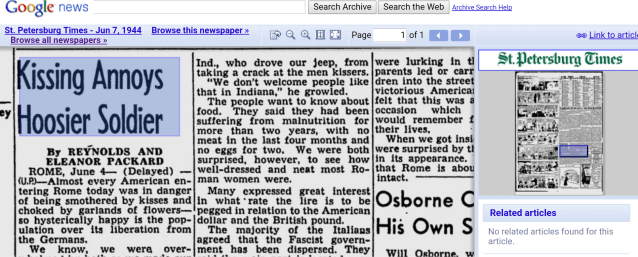
Alas, the liberation story shown in this Google newspaper archive clip never made it to the radio, as far as I know, but it hints at the first-person style of husband-and-wife United Press correspondents Reynolds and Eleanor Packard.
The “Soldiers of the Press” broadcast you can listen to below is an earlier item, the story of a news-feature almost too good to check, by one of World War II’s best-known reporters.
It is not an eyewitness account by Reynolds Packard, but his as-told-to Italian-front yarn worthy of Hollywood, with the title “Battle Boomerang,” and the password-of-the-day “Strawberry Shortcake.”
When veteran foreign correspondent Packard died in 1976, his New York Times obituary contained a passage with a hint of another flavor… sour grapes…
During his reporting career, Mr. Packand was often an irritant of fellow correspondents, who charged that some of his reports were less than authentic. They frequently made such charges in explaining to their editors back home why they had been scooped.
Mr. Packard once gave this pithy definition of his reporting:
“If you’ve got a good story, the important thing is to get it out fast. You can worry about details later. And if you have to send a correction, that will probably make another good story.”
“What I want to do,” he said at later time, “is to let my readers participate in my experiences in collecting news, whether it’s real or phony.”
There are certainly plenty of details in the “Battle Boomerang” story, from the rank of the injured soldier to that password… and the recipe involving battlefield biscuits. Were they improvisations by the radio scriptwriter, interview details from Packard’s notebook, or embellishments to help tell the tale? So far, I haven’t found a published version of Packard’s U.P. dispatch for comparison, the way I have with some of the radio series’ bigger stories, such as the D-Day invasion.
“Soldiers of the Press” dramatizations, usually based on one or more wire stories sent to subscribing newspapers, were reworked extensively by radio script writers, then recorded by actors in a studio, complete with sound effects like the clacking typewriters, gunfire and other battle noise in the background of this episode. The series helped promote the scrappy and competitive United Press wire service — never as big as the Associated Press —as well as informing and entertaining the homefront audience.
I wonder if Reynolds and Eleanor Packard ever heard or commented on the broadcasts, like fellow U.P. reporter Walter Cronkite, who lived to write about the strange experience of hearing a radio actor playing him in a Soldiers of the Press episode, saying “This is Walter Cronkite” decades before American TV audiences learned the sound of his voice. (Did United Press correspondents ever tell their own stories on Soldiers of the Press? I don’t know, but the recordings clearly have the production values of New York studio work and were broadcast while the reporters were presumably still overseas in the war zones. I’ve found precious little written about the series at the time, primarily trade-magazine advertisements using the program to promote U.P. itself to radio stations. The broadcasts themselves included no credits for cast or crew.)
The Packards wrote several books, which I haven’t read. If you have, and have seen references to their appearances on “Soldiers of the Press,” please add a comment below!
Packard’s obituary doesn’t mention his books, but WorldCat can find them for you, from “Rome Was My Beat” and “Balcony Empire: Fascist Italy at War” to “The Kansas City Milkman.”
(Note: This episode of [jheroes.com] Newspaper Heroes on the Air was written and links inserted entirely with the WordPress app on an Android phone. I will probably edit it later using a more substantial computer to fix any oddities in the fonts, formatting, spelling or linkage.)
For the “Suspense” March 23, 1953, production of Charles Dickens’ “The Signal-Man,” one of radio’s leading ladies, Agnes Moorehead, narrates a supernatural story, some 16 years before she played the witch Endora on TV’s “Bewitched.”
Her character is a returned resident of an English village, back after 20 years, encountering the veteran railroad signal-man at his tunnel-entrance shack. But it’s not just a nostalgic visit, she is also a journalist: “I’m a writer,” she says. “I wanted to interview you…”
This was not the first radio production of “The Signal-Man,” and both it and the “Lights Out” version I reported on last depart from Dickens’ tale by explicitly making the narrator a journalist. Since Dickens’ original (now available online) was first published in a magazine, perhaps the narrator’s role as writer went without saying, although the words “reporter,” “journalist” and “writer” never appear in the story. In this version the woman works for a magazine. The troubled railroad-tunnel signal operator of the title confesses to being a reader who is familiar with her unnamed magazine column. In the “Lights Out” version of the story, the narrator is from The London Times.
In Dickens’ story, the narrator merely describes himself as “… a man who had been shut up within narrow limits all his life, and who, being at last set free, had a newly-awakened interest in these great works.” (The “great works” presumably being the railroad and its tunnel, similar to one involved in the 1861 Clayton Tunnel rail crash, five years before Dickens published his tale.)
The signal-man’s shack holds a shelf of classic books — including Gibbon and Darwin — part of what makes him interest the reporter as an unusual feature. He appears more educated and sophisticated than his job requires… and his education implies that he should not be troubled by ghostly apparitions.
As an interviewee, he asks good questions. Why does a reporter choose a particular story?
The reporter’s childhood fear of trains is part of her motivation, an angle added to the Dickens story by the radio script writer. Moorehead gasps in terror at the whistle-scream and engine-roar of each one entering the nearby tunnel.
The gender change for the reporter causes the signal-man to awkwardly use “it” instead of a male pronoun to describe a figure he has seen, forshadowing what is a powerful variation on the original ending.
Irving Reis is credited with the adaptation and Elliot Lewis as producer. Joseph Kerns plays the title character. Sound effects are excellent. “Suspense” was a top-notch series, and its producers loved the Reis adaptation enough to use it two more times — in 1956 and 1959.
Reis also produced what was probably the first adaptation of the story, for the Columbia Workshop in 1937, which made the signal-man’s visitor a journalist for an unidentified publication. He’s a thorough and compassionate, but skeptical, interviewer.
Moorehead also plays a fine reporter, insisting it will take several visits to complete her story, later providing a strong voice of reason arguing with the man about the things he has seen and heard. But this is “Suspense,” and nothing is certain but the Auto-Lite sparkplug commercials.
Wikipedia’s page about Dickens’ story reports various broadcast adaptations:
“In the United States, the story was adapted for radio for the Columbia Workshop (23 January 1937), The Weird Circle (as “The Thing in the Tunnel”, 1945), Lights Out (24 August 1946), Hall of Fantasy (10 July 1950), Suspense (4 November 1956) and Beyond Midnight (as “The Signalman”, 1970) radio shows. The Canadian Broadcasting Corporation also adapted the story for their CBC Radio drama programme Nightfall (17 December 1982).”
J. David Goldin’s Radiogoldindex was the first to alert me to the fact that Suspense returned to the in 1956 and 1959.
Update, Dec. 26, 2018…
Here’s the Columbia Workshop’s pioneer adaptation from 1937, via the OldTime Radio Researchers group library. The series was directed by Reis, but writing credit for “The Signal Man” was given to Charles Tazewell in a 1948 anthology, “Plays from Radio,” Abraham Harold Lass, ed.
Unlike later productions, the opening and ending have additional characters to set the scene, establish the main characters, and resolve the story… a resolution Reis apparently decided wasn’t needed in his shift to a smaller cast and female reporter for Suspense.
I wonder if any of the radio columnists or fan magazines interviewed him about that in 1953 — or was the new-fangled television all they wanted to write about?
For more discussion of the story, fans of radio and Dickens (rather than journalism) might enjoy annual presentations of versions of the story by the Mysterious Radio Listening Society podcast.
Sorting out a stack of CDs of podcasts I downloaded more than a decade ago, I discovered this reporter-centric episode of “Lights Out,” a suspenseful 1940s series.
This copy is playable or downloadable from the Old Time Radio Researchers Group’s OTRRLibrary.org. (It opens with almost a minute of static, disk or tape noise, but gradually becomes listenable.)
The plot: A new London Times reporter is assigned a story on “little-known occupations” and comes upon a railroad tunnel and its veteran signal operator.
“This is a world here different from other men’s worlds,” he says. And we’re off. The new reporter asks good questions, and gradually gets some very strange answers
The story “The Signal-Man” is much older than this 1946 broadcast. The author is Charles Dickens, more famous for his novels and his “Christmas Carol” ghost story. Although there is no holiday theme, this one also was first published in a Christmas season magazine, in 1866, in keeping with an even older tradition of telling ghost stories at Christmas.
According to Wikipedia, the Dickens story was adapted for broadcast in England, Canada and the U.S.
American versions included the Columbia Workshop in 1937, The Weird Circle (“The Thing in the Tunnel,” 1945), this Lights Out production, Hall of Fantasy in 1950, Suspense in 1953, 1956 and 1959, and Beyond Midnight (as “The Signalman”) in 1970. I’m off to track down recordings of the others, and the original Dickens, to see if the inquiring reporter is the storyteller in all versions, then add it to one of my overview pages. (Note: this post is partly an experiment in creating a WordPress item from my new cell phone. It worked!)
This unusual 70-year-old episode of The Green Hornet begins with a heroic (or foolhardy?) journalist defying death threats — but he’s a radio columnist, not one of the series’ usual newspaper reporters. In the 1940s, radio news reports had grown in importance to a nation following developments in World War II, but the broadcast journalist was still not as common a character in radio dramatic series as the newspaper reporter.
The Green Hornet, a costumed-hero adventure series aimed at a teen or young-adult audience, had plenty of journalists. The Hornet was a young newspaper publisher, frustrated by racketeers and corrupt politicians who stayed out of the reach of the law. By pretending to be a masked criminal himself, he could bring them to justice in other ways.
Like Superman’s Daily Planet, the Hornet’s Daily Sentinel was the perfect place to learn about the life of the city. Its reporters, photographers, editors, and the publisher’s secretary, appeared regularly in Hornet stories — for the most part unaware their boss was the man behind the mask and the Hornet’s non-lethal gas gun.
In this episode there are newsroom scenes and some banter between newspaper publisher Britt Reid and reporter Michael Axford, about radio-newspaper competition.
Axford is not the Sentinel’s sharpest reporter; he’s a former cop appointed to his position by Reid’s father, owner of the paper, to double as Reid’s bodyguard. In the Hornet stories he also doubled as comic-relief, a stereotypical ethnic caricature — the “dumb Irish flatfoot” who never figured out the Hornet’s identity.
Of course, Reid ends up going after murderous racketeers as the Green Hornet, with the help of Kato, his valet (and brilliant inventor, and driver), and their super-fast Black Beauty getaway car.
The criminal enterprise in question is a postwar anomaly, a black-market in meat. Was this really an issue in 1946? Or was this script originally developed when wartime rationing and shortages were common? At first I suspected the latter, but a little online research in newspaper archives and history sites shows that meat shortages were, indeed, making headlines in 1946.
Incidentally, the “Man of Many Words” of the episode title is not the radio commentator or anyone on the Sentinel staff, but the racket boss — a corpulent sesquipidelian with echoes of Sydney Greenstreet’s character in the 1941 movie “The Maltese Falcon.” (It may be just a coincidence, but a similarly Greenstreet-like criminal mastermind was featured in the “Adventures of Superman” radio series story “Atom Man in Metropolis” the previous year.)
The Internet Archive provided the MP3 file. Hornet episodes are also available on high-quality CDs from Radio Spirits.
(Technical note: This post was begun with the Chrome browser on an Android phone, then updated with a new version of the WordPress Android app. In addition to getting a new episode onto the site before a classroom discussion next week, I was testing the coding of MP3 streaming and download links, and determining whether repeated edits were saved properly. The App was much more reliable than the phone-browser rendition of the website editor, in both HTML and visual-editing modes.)
The long-running Jewish Theological Seminary radio series “The Eternal Light” usually drew from an older text, but it did feature a crusading newspaper in at least one episode, “The Rabbi with Ink-Stained Hands,” which the inspirational-drama program broadcast more than once.
The 1960 broadcast of “The Rabbi with Ink-stained Hands”:
The broadcast dramatizes the life of Rabbi David Einhorn, an anti-slavery crusader in 1850s Baltimore before being forced to flee to Philadelphia when a mob destroyed his newspaper, Sinai.
The murder of Presbyterian minister and abolitionist publisher Elijah Lovejoy is also mentioned in the story.
The Old-Time Radio Researchers Library has versions of the program from 1956 and 1960. I am browsing the long running series (1944-1962) for other episodes featuring journalists.
So far, I haven’t found references to prominent publishers of Jewish ancestry Adolph Ochs (The New York Times) or Joseph Pulitzer (The New York World), but the program dealt with moral ideals, not just Jewish ancestry. As for newspaper-related episodes, there is one involving the non-Jewish Ben Franklin (played by Ralph Bellamy), waxing nostalgic about his printing appenticeship and first “Silence Dogood” columns. And there’s another ecumenical item about Gandhi, although not focused on his newspapering.
The 1956 broadcast of “The Rabbi with Ink-stained Hands”:
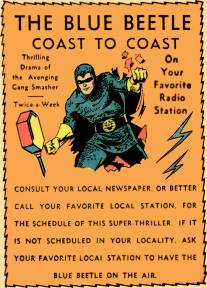
Radio and movie star Frank Lovejoy would have been 104 today. Better known as the leading man reporter on Night Beat, Lovejoy also took a turn as The Blue Beetle, a radio and comic book superhero who appeared to borrow heavily from Superman and The Green Hornet.
Unlike those two, the Beetle’s day job wasn’t at a newspaper. Instead, he was a rookie police patrolman. However, his girlfriend in the comic books was a Lois Lane style reporter, Joan Mason, who even appeared as the title character in some comic stories. And on the radio, he also shared the stage with newspaperman Charlie Stone, “ace reporter of the York City Sun,” friend of police officer Dan Garret (the Blue Beetle) and his partner.
The comic, launched in 1939, evolved into a radio serial in 1940 that ran for less than a year. Frank Lovejoy, the actor who played the Beetle, was to have more success a decade later playing a newspaper columnist in the mystery/drama series “Night Beat.”
Radio episodes of The Blue Beetle are available at archive.org, including Drug Ring (May 15, 1940), which includes reporter Charlie Stone. (Click the episode title to download or stream an MP3 if an audio player icon is not visible.) Not only does the character don his blue chain mail to fight reefer-dealers and opium dens, he begins taking a mysterious drug himself — a secret “vitamin 2X,” which gave him the ability to recover from bullet wounds and increased his strength and speed and mental abilities.
The reporter doesn’t have a big part in the episode, although he is observant enough to get the license number of a gunman’s car. When Garret’s partner sends him to call for an ambulance for the hero, shot down on the street, he mentions that he’ll call his paper at the same time. “Boy, what a story!” he says, on his way to the phone.
Alas, the shows are juvenile, punctuated by organ arpeggios and overwrought dialogue, which may explain why the series had such a short run on radio, although the comic book has had several incarnations under several publishing companies over the years. Here’s an early sample Blue Beetle comic at the Internet Archive, an April 1943 World War II era episode, complete with both Irish and Asian cultural stereotypes.
In 1940, Superman didn’t need a world-threatening super villain or a city-destroying duel with another “hero” to be an entertaining role model. In this early “Adventures of Superman” radio tale, Clark Kent’s reportorial curiosity gets the better of him — so much that he passes up a scheduled boat ride home from a previous adventure in the Caribbean.
After resolving the previous tale, the opening episode of “The Curse of Dead Man’s Island” starts with Daily Planet copyboy Jimmy Olsen catching a turtle to take home — only to discover a call for help scratched into its shell. That’s enough to inspire reporter Kent to investigate. As he says,
“There may be a swell story behind this plea for help. Someone is evidently in trouble!”
His instincts are right — the story eventually involves a mostly deserted island, a castaway, a beautiful woman, a secluded castle with a mysterious dynamo and, of course, a dungeon.
See the JHeroes overview page for the Superman radio show, which began in February, 1940, serializing its stories as 12-minute daily episodes. This particular story ran from Sept. 23 to Oct. 4, shorter than most of the adventures. The six individual episodes are downloadable from the chronological Internet Archive collection of the series, or as a combined 70-minute recording. (Unlike some full-story recordings, this one is before the repetitious Kellogg’s cereal commercials that came with the successful series’ full sponsorship later.)
There are no major explorations of journalism ethics in this juvenile adventure, although Clark does fib to the captain of their homeward-bound vessel to explain why he and Jimmy are staying in the islands, and he does show somewhat questionable judgment including Jimmy in the adventure — but having a companion to talk to makes for much better radio than relying on a narrator to fill in the gaps.
As usual for these early stories, the mystery plot is on a human scale, with Kent’s superhuman powers only coming into play when necessary — often to save Jimmy or Lois Lane (who is absent from this story), while Kent pursues a news story that turns into an adventure. Kent’s being a reporter “frames” the tale more than his being Superman. In the process he shows the usual journalistic skills with nautical charts and small engines, as well as a certain amount of luck, not all of it good.
At the end of this six-parter, there’s no mention of the story Clark plans to file about the adventure. After the mystery is solved (no spoilers here; listen for yourself), Kent and Jimmy don’t even fly home. They head back to Metropolis by boat, where they find a message waiting from Perry White to return home because they are needed for another big story.
It’s the life of a reporter — or so young listeners were taught in 1940.

 Newspaper Heroes on the Air