Kent’s approach isn’t super; Lois Lane steps in

Smart, clever or super-powered, newspaper reporters are still fallible and can be fooled, according to the adventures of Lois Lane and Clark Kent in 1940s Superman radio episodes.

In this September 1941 sequence, Lois Lane tries to get through to a half-mad witness who won’t talk to Kent or the police. Like a story by real-life reporter Dorothy Kilgallen in another radio drama, it at first seems a “woman’s touch” is all that is needed.

However, by the end of the episode (ninth in this 15-part story), the strange woman has turned the tables and put Lois in her all-too-frequent role of “damsel in distress.” Actually, almost half of the 12-minute episode is given over to summarizing the story so far, then Lois gets into the act and brings about an apparent transformation in the woman.

Episode 9: Lois interviews witness Episode 10: Madwoman captures Lois.
Episode 11: Central American drugs! Episode 12: Crisis in the jungle

From a crazed scientist and his mad sister in the first half of the adventure, the villains shift in episode 11 and 12 to a conniving white trader and a tribe of jungle dwellers with poison darts and hints of human sacrifice — a plot displaying all the racial and cultural sensitivity of 1930s jungle-adventure movies, as Superman faces “100 black pygmies who are shadows in the darkness.”


This is the third JHeroes installment for the story, “Metropolis Football Team Poisoned,” each including four “Adventures of Superman” daily episodes from the 1941 serial.

First installment: Clark Kent, unethical sports reporter

Second installment: Clark Kent, burglar or bungler?

Posted in 1940s | Leave a comment

Newspaper Editors Face Evil in Black & White

“So the forces of good and evil join battle in Monroe, as they are joining in battle through the whole world. There is only one way to enter the battle — unafraid, as do Betty and Bob.” — announcer Milton Cross

Two episodes:

Margaret Jameson Has Hit a Girl Betty Visits Ellsworth Jameson

Here are the last two in a 16-episode run of the soap opera adventures of newspaper publishers “Betty & Bob” from a storyline  first broadcast sometime in the 1930s or early 1940s. I do wish the dating was more definite and that the files were more complete. These 16 from the Internet Archive collection are followed by a 12-week gap during which a considerable number of plot developments took place.

The program was serialized using re-issued transcription disks, which probably explains why these episodes, dated in the summer of 1947, include speeches like the one above, presumably written in the early days of World War II.

War-years stress and anxiety might explain why newspaper publishers Betty and Bob Drake even sound a bit paranoid in these two episodes.

The plot: Convinced that a new city manager has been brought to town by corrupt politicians, the Drakes have set their new investigative reporter to work investigating the City Council, while they have taken it on themselves to get to know the manager, Ellsworth Jameson, and his troubled daughter, Margaret.

This may be a soap opera, but the Drakes face relatively realistic media-ethics problems along with the intrigues of investigating political corruption. A half-dozen episodes ago, the Drakes suppressed a story when Margaret Jameson was charged with drunken driving. Bob argued that not playing up the bad news would give the new manager a fair start in the city. Now there is worse news: Margaret’s car has struck a 10-year-old girl, who will be hospitalized for weeks.

While the announcer quoted above — and the Drakes — seem to see the story in black and white, the script suggests some shades of gray. Margaret insists she did nothing wrong, and that she hadn’t been drinking this time. The Drakes, meanwhile, seem to have a very unenlightened (or 1930s) view of mental illness, despite the prevalence of such troubles in soap operas — including earlier episodes of “Betty & Bob.”

The councilman who brought the new city manager to town comes to ask the Drakes to suppress the story about Margaret’s accident, but there are no threats, just a vague suggestion of quid-pro-quo.

“Why crucify the old man on account of his daughter?” councilman Martin Anderson says.

Bob: “Margaret Jameson has to be taught a lesson; maybe a jail sentence will set her straight.”

Anderson: “You’re sort of blood-thirsty, aren’t you, Drake?”

Bob: “No. I just hate to see blood being shed needlessly… It would be right for anyone else to go to jail for doing what she did.”

Earlier, talking about the case with Betty, Bob seemed to be acting out of guilt over suppressing the earlier drunken driving story. This time, he orders the managing editor to run the story, displaying it prominently in the edition about to go to press.

Bob: “Betty we made a terrible mistake suppressing the story the last time when Margaret Jameson was picked up for drunken driving. If we hadn’t this mightn’t have happened. If that little girl is seriously hurt, we’re partly to blame for it.”

Betty: “Margaret Jameson is a sick girl, mentally.”

Bob: “All the less reason for her to be running around loose in an automobile. A jungle lion in a children’s playground would be less of a menace…. a wild unbalanced girl who ought to be in a sanatorium somewhere.”

In any case, Anderson shows his true colors before leaving the Drakes’ office — he is ambitious in ways that suggest little regard for ethics. He predicts the girl will be let off with a stiff fine. He also predicts that Drake will someday want to get involved in politics, and will need friends and favors.

Anderson: “I know that you’d only go into politics to do even greater good than you’re doing now, but you can’t do that until you get to the top.”

Bob: “So getting to the top is the all important thing?”

Anderson: “Yes. And how you get there is of secondary importance.”

Bob: “That’s a philosophy that’s sort of popular these days, isn’t it… Yes, it makes for wars and the slaughter of innocents.”

Anderson: “Now, now, now, now Drake, let’s not take the whole world into this little picture.”

Bob asks Betty whether they should run the story. She agrees immediately, and Anderson goes away, mad.

Betty: “And that’s Martin Anderson… His ruthlessness and ambition show in every pore…”

Bob: “He’s a full-fledged enemy.”

Betty: “The kind of man you want for an enemy, because he’s probably the enemy of all good and decent people.”

Bob: “He’ll be out to get us, Betty.”

Betty: “We’re out to get him.”

Bob: “Who will win?”

Betty: “There’s no doubt in your mind about that, is there.”

Bob: “No Betty, none.”

… and that gets us to the announcer’s line that started this page.

At this point, there’s a three-month gap in the daily-episode archive, after which the storyline has changed quite a bit. New characters have been added and new complications include financial problems and the birth of a son to the widow of a murdered reporter.

But the Drakes are still in control of their newspaper, and Martin Anderson has become more obviously their enemy — suspected in both a bombing and a burglary at the paper. All-in-all, there are enough developments to come back to the Internet Archive Betty & Bob collection and discuss the Drakes and their newspaper again sometime.

Here are the past items in this 16-episode sequence, and my general page about radio’s soap-opera journalists.


Note: The Internet Archive copies of “Betty & Bob” episodes spell the city manager’s name “Jamerson,” but the audio sounds like “Jameson” to me. And the same titles spell his daughter’s name “Margeret.” If I find an archived script somewhere with a written version of the names, I’ll be happier.

Posted in 1930s, newspaper crusades, newspapers, political corruption, publishers, soap opera | Leave a comment

Stanley, meet Livingstone; America, meet modern journalism

“This isn’t the other papers… I’m going to teach everybody in the cities, on the farms, on the frontiers to like important news. This country’s growing up… It doesn’t want any more colonial gazettes with local gossip, but big newspapers with news of the world.” — Horace Greeley

While “hyperlocal” online news is the industry buzzword of this decade, journalism’s role in delivering enlightenment and international news was featured in this 1936 tribute to the high ideals of American newspapers.

It was among the celebrations of American history and values presented in the first year of the DuPont Cavalcade of America series, itself a landmark in public-service broadcasting as corporate image-making, which ran until 1953 on radio and for another five years on television. [audio
http://archive.org/download/OTRR_Cavalcade_of_America_Singles/CALV_360701_038_American_Journalism.mp3%5D
Cavalcade Episode: American Journalism (The dramatic presentation is preceded by five minutes of light classical music, which was Cavalcade’s format at the time. Skip ahead to the 5:20 marker if you want.)

While the announcer notes that America had printers from colonial days, he points to the revolutions in journalism in the 19th century to introduce three scenes. The first is the 1831 arrival of the industrious and Bible-reading Horace Greeley on a New York printer’s doorstep at 5 a.m., then skips a decade or two to illustrate his goals as publisher of the Tribune.

Greeley’s campaigns to both fight political corruption and enlighten the general public are dramatized by a confrontation between the publisher and his business manager, who argues for the style of the more sensational crime-filled penny papers of the day as a way to reach the immigrant masses.

But Greeley says enlightening the masses is a more important goal than mass-circulation. The dispute is resolved when an Irish cleaning woman comes in — clearly part of the masses — and refuses to part with her copy of the Tribune until the whole family has read about the political corruption in their ward.

As noted elsewhere on this site, Cavalcade — and other radio series — often featured Greeley as a model for American journalists.

Along with Greeley’s Tribune, this “American Journalism” Cavalcade episode presents the rise of modern newspapers with The New York Herald, telling the story of reporter Henry M. Stanley’s African safari in search of Dr. David Livingstone, ending not only with Stanley’s famous line, “Dr. Livingstone, I presume?” but with Livingstone’s response to the reporter’s request for an interview: “First, tell me the news of the world.”

In short, Cavalcade was not subtle about making its point:

“In America many modern newspapers have imitated the energy and enthusiasm of such journals as the Herald and the enlightened tone of such papers as the Tribune, so that American journalism holds the respect of the world.” — Cavalcade of America


Almost 20 years of episodes are available online in the Old Time Radio Researchers Group Cavalcade of America collection at the Internet Archive.

Posted in 1930s, 19th century, cavalcade, editors, foreign correspondents, historical figures, Horace Greeley, journalism, newspapers, publishers | Leave a comment

Clark Kent, super burglar or stupid bungler?

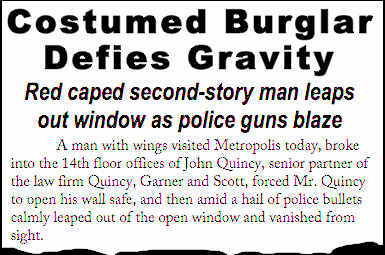
Costumed Burglar Defies Gravity -- Red caped second-story man leaps out window as police guns blaze

One Daily Planet story Clark Kent did NOT write, and an example of poor reporting. The unnamed author leaped to the conclusion that a flying man must have wings.

Being on the side of truth and justice appears to have justified some “might means right” tactics in Clark Kent’s early reporting repertoire, including burglary, threats, assault and kidnapping.

For example, in this sequence from the second year of the “Adventures of Superman” radio series, Kent’s alter-ego breaks into an elderly lawyer’s office to find out the beneficiaries named in a will that the lawyer refused to make public. The lawyer pulls a gun, which Superman smashes. Then he forces the man to open his safe and reveal the confidential information:

“Now look Mr. Quincy, I’m not fooling. You recall how I got rid of your gun? I can get rid of you just as simply.”

When Quincy signals the police, the costumed character defies both their orders and their bullets, as indicated in the simulated Daily Planet “clipping” above on the right. (At this point in the second year of Superman’s decade-long radio career, the newspaper was not convinced of the flying man’s existence, which he was still keeping secret from all but a few selected criminals and the people he had rescued from them.)

Back in his Kent clothes, the reporter joins copyboy Jimmy Olsen in what amounts to a getaway car, breathes a sigh of relief, and says “That neighborhood wasn’t very healthy.” He tells the boy the lawyer “gave me the information I wanted.” He later tells Editor Perry White, “I talked him into it.” Neither puts two and two together when The Daily Planet carries the headline, “Costumed Burglar Defies Gravity… Red caped second-story man leaps out window as police guns blaze…”

That’s the fifth in the 15-episode radio story titled “Metropolis Football Team Poisoned,” which we began discussing last week, a catalog of ethical missteps. In the episode after the burglary, Jimmy sees a cook adding something to the football team’s milk pitchers and tells Kent. Even before the milk is analyzed, Kent chases the cook to another town, knocks him out and (as Superman) flies him back to Metropolis, intending to get him to confess to poisoning the team. The reporter doesn’t even switch to his super-suit to knock the man unconscious.

It’s as if someone edited the “Superman” introduction to read, “Leaps to conclusions faster than a speeding bullet.”

Episode 5: Superman burglar! Episode 6: Kent kidnaps cook.
Episode 7:”Everything went to pieces.” Episode 8: Capture, escape & pursuit

Later in episode six, when the cook is shown to be innocent and the reporter is told he “bungled stupidly,” Kent admits his mistake and says he will find some way to make it up to the man. He is doubly embarrassed to learn that the man’s son has infantile paralysis — the disease Metropolis University doctors are trying to cure. The whole reason Kent is breaking so many ethical rules, in “the end justifies the means” mode, is to help the football team win enough games to get a promised $3 million bequest for medical research to fight the disease.

The script writers don’t show Kent acting on his brief statement of remorse, not even going back and apologizing — much less being punished for breaking the law. The same is true in the case of Superman terrorizing the lawyer, whose only offenses were having an annoying tone of voice, protecting his client’s privacy, and pulling a gun on the “red-caped burglar.”

Comic readers and radio listeners probably had no problem with Superman’s frequent tactic of flying a criminal into the air to scare him into confessing, but I wonder if they noticed that in this story the cook and the lawyer were not criminals in any way.

By the end of the decade, “The Adventures of Superman” was much more prone to teach and preach — against America’s World War II foes and against racial and religious prejudice.

In episode seven of this footall story, before joining Kent on his next assignment, editor Perry White confronts the reporter with the “Costumed Burglar” story:

“A man with wings visited Metropolis today, broke into the 14th floor offices of John Quincy, senior partner of the law firm Quincy, Garner and Scott, forced Mr. Quincy to open his wall safe, and then amid a hail of police bullets calmly leaped out of the open window and vanished from sight.”

“That sounds like a fairy story,” Kent replies. Not exactly a lie. He doesn’t even point out that no one has said the flying man literally has wings. White doesn’t say who wrote the story, which was presumably based on a sketchy police report.

In any case, Kent admits “everything went to pieces” when he leapt to the wrong conclusion about the football team cook, then he and White head off to confront the real poisoner — and wind up falling into a trap that it will take all of  episode eight to escape from, followed by a dangerous high-speed car chase with Kent in full vigilante-mode, dragging a woman into the car and telling her, “There’s nothing we can’t do… You’re going to dislike a lot of things before we are through.”

I haven’t made a careful analysis of the hundreds of archived “Adventures of Superman” stories on radio — the program was broadcast for 11 years, initially as a daily 12-minute serial, later in a one-half-hour-story format. However, I wonder how often Superman’s Green-Hornet-like law-breaking approach to gathering information appeared — and whether it diminished after the U.S. entered World War II. This football team plot was broadcast three months before the Japanese attack on Pearl Harbor put America in the war.

After December 1941, did Superman script writers — and Americans in general — come to see “might makes right” as having Nazi or Fascist overtones, especially when combined with Friedrich Nietzsche’s concept of the “übermensch”? That might be a good master’s thesis investigation for someone!

Posted in 1940s, adventure, Clark Kent, ethics, Jimmy Olsen, Perry White, reporting, Superman | Leave a comment

Former police chief becomes investigative reporter

“Here’s the dope, Bob…” — former Chief Henderson.

A few episodes ago Betty and Bob Drake convinced their corrupt city’s former police chief to become an investigative reporter on their paper, The Trumpet.

In this episode, he lets them know what he’s found out about the new city manager and the politicians who put him in power: Henderson Has News About City Corruption.

The chief’s report is more “private eye” than news reporter — personal dirt about council members’ personal weaknesses (debt, ambition, women), not anything that will become a story very soon. Apparently with its star reporter murdered and Bob Drake hospitalized for some weeks, The Trumpet was left without a reporter who could dig into the ouster of the old city manager and installation of a new one.

After hearing from former Chief Henderson, Bob Drake, newspaper publisher, admits that he hasn’t given the City Council the attention it deserves. Finally, there’s news about another accident involving the new city manager’s reckless daughter. Will the Drakes agree to suppress the story, the way they did an earlier one? Will they get to talk to the real power-broker on the City Council? Tune in here next week!

The announcer wraps up:

“Well! Betty and Bob are beginning to uncover the ways of a corrupt political machine in taking over a city. Bribe your way in, threaten your way in, and promise your way in. Find ever man’s weakness and play up to it. But how can these forces of corruption be joined in battle and defeated? That’s what Betty and Bob have got to find out.”


Unfortunately, this recording has a few skips in the audio that make this rather poor listening — two minutes actually repeat around the 11-minute mark.

A full and accurately dated collection of “Betty and Bob,” one of radio’s first soap operas, does not appear to be available, but the Internet Archive includes 40 scattered episodes including two steady sequential runs. This is the fourteenth in a series of 16 dated June and July 1947, but probably first broadcast a decade earlier. (The transcription discs were reissued in syndication.)

As I mentioned last week, the radio soap opera’s focus on the publishers is quite different from the tales of crime-busting reporters and editors of other programs, from Big Town and Crime Photographer to The Green Hornet.


Earlier JHeroes posts on Betty & Bob and radio soap operas in general.

This storyline is a June-July 1947 sequence from the Archive.org collection of 40 Betty & Bob episodes.

Posted in 1930s, 1940s, journalism, political corruption, publishers, soap opera | Leave a comment

Clark Kent, unethical sports reporter?

“You’re a reporter, not a detective,” Perry White to Clark Kent.

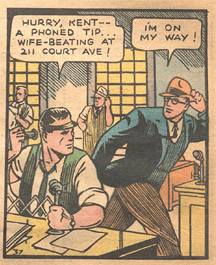
Cartoon image of Clark Kent and editor

From his first appearance in Action comics in 1938, Clark Kent was a general-assignment reporter. In this 1941 radio episode, the Daily Planet sports desk has a job for the mild-mannered reporter.

The month of March madness seems an odd season to be writing about football, but here goes — with a tale that demonstrates that there were sometimes shades of gray in the heroism of radio’s newspaper heroes.

Before it’s over, the world’s favorite mild-mannered reporter has assaulted two innocent men, kidnapped one of them, burglarized a safe, and run from police.

Maybe the authors of this September and October 1941 storyline hadn’t refined their book of superhero ethics yet — or absorbed the finer points of impartial journalism.

The 15-episode story “Metropolis Football Team Poisoned” starts with Clark Kent announcing to Lois Lane that he’ll be covering a Metropolis U vs. State U game. He mentions that he doesn’t think State has a chance, but bases that on the Metropolis’ team’s perfect record.

That sounds OK from a journalism ethics point of view, but it’s still a bad move for Clark: The scrappy Lois turns out to be a State grad, a true believer in her alma mater’s ability to pull an upset and more cheerleader than reporter when they get to the game. (Perhaps the “Adventures of Superman” script writers can be forgiven for breaking the “no cheering in the pressbox” rule in the interest of making the audio-only story more exciting.) Lois also teases Clark mercilessly, claiming that she knows more about football than he does.

“I bet you don’t even know the difference between a T-formation and a double-wingback,” Lois says, producing a rulebook before agreeing to go to the game with Clark. “You’ll need it… Remember, I’m not going to tell you what the game’s all about.”

As it turns out, Kent’s reporting does leave a lot to be desired, but for a different reason: He ducks out before the dramatic final play to investigate a bigger story, leaving Lois to take his notes back to the paper, which does not please editor White one bit.

Next, to save the team’s reputation he agrees to suppress the bigger story — the possibility that something dastardly is going on, as suggested by the story title, “Metropolis Football Team Poisoned.”

An ethics class could have fun with Kent’s reasoning. The team members all were near collapse before the end of the game for mysterious reasons. The coach insists the team needs to win for a bigger reason than getting to a bowl game: Continuing the no-loss record is essential to winning a bequest for the university medical school, one that could fund a cure for infantile paralysis — polio, the disease that in 1941 was well-known to the radio audience, because it afflicted then-president Franklin D. Roosevelt.

Kent accepts the Metropolis’ coach’s argument that the threat to the team, and through it $3 million in research funds, puts thousands of children’s lives at stake. As a result, Clark and Superman apparently feel justified in not only holding off on the story, but breaking several laws to find out who is sabotaging the team. Kent later admits that he made mistakes, and says he will have to find a way to make things up to one of his victims.

I won’t spoil any more of the suspense before you have a chance to listen. Here are the first four 12-minute episodes of the 15-part story.

Episode 1: Team collapses. Episode 2: The secret bequest.
Episode 3: Perry White confronts Kent. Episode 4: Superman, gorilla fighter and safe-cracker

For the next few weekends, I’ll work my way through this story several episodes at a time, paying more attention to the strange behavior of Clark Kent and the ethical choices facing the reporter and his cape-wearing alter-ego.


Note: Superman began in the comics in 1938 and on radio in 1940. His first crossover into football was in an early issue of Action Comics, later reprinted in the first issue of Superman comics, but it bore no relation to this Metropolis University story on the radio, and doesn’t involve Clark “on assignment” to cover a game. Instead, it starts with Superman overhearing a corrupt coach coach planning to kidnap a rival team’s star player — and Superman goes undercover as a member of the team. See the Superman home page for more of the plot (story 3 of Superman 1).

Posted in 1940s, Clark Kent, ethics, Lois Lane, Perry White, sports, Superman | 2 Comments

Running a crusading newspaper as a ‘line of duty’

“Miracles don’t happen twice in a lifetime,” Betty Drake warned her husband Bob in last week’s episode, titled “Bob Is Returning to Monroe to Fight.”

She was reminding him that only an advanced operation restored his ability to walk after he was injured in the line of duty during his last newspaper crusade. It sounded like she was hinting that perhaps he should take it slow this time — but her passion for the fourth estate comes through in this next pair of episodes.

Bob’s first stop in the city was a meeting with the new city manager, because the former police chief has raised suspicions about him — that he might be a tool of corrupt political bosses. The newspaper editor immediately did the new official a favor by playing down a story about his daughter being picked up for drunken driving. His reasoning is interesting to hear.

In this 12th episode of 16, Bob gets back to the newspaper office and his wife arrives to announce the news: Betty Has Found a House for Them. The new city manager, Ellsworth Jameson, is a nervous and weak-sounding former economics professor and state budget official who, according to Bob, probably fell under the control of “political plunderers” at the state capital.

Since Bob overheard Jameson telling his daughter they had tickets for a theater opening that night, Betty comes up with the idea of going to the same play and getting to know the Jamesons better, and does quite a job of engineering a night out with them, which is the subject of the next episode: Drakes Go Out With Jameson

During their dinner conversation, the daughter is the one who suggests there was something wrong with the newspaper’s decision not to play up the story about her drunken driving arrest. Drake makes the decision sound innocent enough — after all, he was not giving in to political pressure; he was just trying to give her father a fair start on a new and difficult job. But wasn’t he also manipulating the city manager, trying to get on his good side?

As far as journalism goes, the radio soap opera’s focus on the publishers and their agenda is quite different from the tales of crime-busting reporters and editors of other programs, from Big Town and Crime Photographer to The Green Hornet.

Betty wins high praise from City Manager Jameson, who tells the Drakes, “I know what newspaper work is like. It’s a hard task-master; it drains your energy, and for a woman with other responsibilities, and in times like these, especially…”

That’s Betty’s cue to not only express the Drakes’ commitment to public service journalism (emphasis added, below), but to give us a hint that this 1947 radio transcription was actually recorded almost a decade earlier, near the start of the World War.

“Yes, Mr. Jameson, in times like these especially, when the world has gone raving mad, all of us must seek some line of duty to preserve what little sanity there is left. Well, running a newspaper is our line of duty. Your helping run a city is your line of duty. And to do our best along those lines, well that’s the least we can do.” — Betty Drake

The also Drakes pull no punches telling the city manager that something is rotten in the city, while hearing some of his problems with his headstrong and angry 23-year-old daughter.

Come back next Wednesday, and we’ll find out what the paper’s new investigative reporter is digging up.


Earlier JHeroes posts on Betty & Bob and radio soap operas in general.

This storyline is a June-July 1947 sequence from the Archive.org collection of 40 Betty & Bob episodes.

Posted in 1930s, newspaper crusades, newspapers, political corruption, publishers, soap opera | Leave a comment

Something Green for St. Patrick’s Day


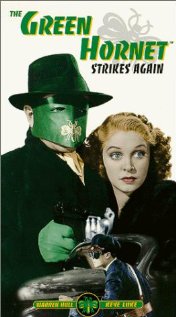
The band played an Irish jig  whenever derby-wearing Michael Axford entered the scene in The Green Hornet Strikes Again, the 1941 movie serial closely based on the Green Hornet radio program. Cop-turned-reporter Axford, played by Wade Boteler in the movie and originally by actor Jim Irwin on radio, provided comic relief with his Irish brogue, blundering manner, polished brass cuspidor, and references to himself as “a man of action.”
But the Green Hornet also was assisted by women of action, making this weekend’s post a double-threat entry for both St. Patrick’s Day and Women’s History Month.
While Axford may have come late to journalism, he clearly valued the new career, as shown in a lot of bantering with his fellow reporters, publisher Britt Reid and secretary (and reporter-wannabe) Lenore Case. Told that he might get his name on a story, Axford responded with an ecstatic sigh, “Ah, a byline!” In this 1942 episode, Torpedo on Wheels, Axford gets scooped by The Sentinel’s aggressive woman reporter, Gail Manning, who uses some deception and risk-taking to get close to a near-disaster scene.

Manning gets a mild scolding from Reid, whose own “vigilante” attitudes — after all, he is the Green Hornet — apparently lead him to condone a bit of rule-breaking by his reporters. He also calls Manning his “best woman reporter.” During its radio years, The Daily Sentinel plots included more than a half-dozen reporters and photographers, including several women characters, and gave them all opportunities to show journalistic skills, find facts, report stories and sometimes be manipulated by the Hornet.

The women reporters sometimes go undercover — Manning impersonating a nurse in one story, another taking over for a switchboard operator and doing some eavesdropping. Photographer “Clicker” Binney subs for the publisher’s secretary at one point, but winds up doing a tough-minded interview with a reluctant source in another. And the multi-talented Lenore Case eventually winds up both reporting and writing an editorial for the boss.

Another strong female character, Linda Travis, plays a pivotal role in a group of 1947 episodes — one of them titled Exposed — in which the new reporter manages to unmask the Hornet. Like Axford, Travis was secretly working for Britt Reid’s father, who had put the young playboy in charge of the daily newspaper to teach him responsibility.

Axford’s backstory was that Reid’s father hired the former policeman to keep an eye on his son. The big Irishman at times functioned as Reid’s bodyguard or as a crime reporter, and was always a sworn enemy of the Green Hornet — never figuring out that his boss and his nemesis were the same person.

The stereotypical stage-Irish character was so popular that it was written into the initial WXYZ Green Hornet radio scripts after cancellation of a previous police drama for which Jim Irwin had created the role. The character was revived with a new actor after Irwin’s death.

While Axford was sometimes portrayed as dumb, the stereotyping was relatively mild — alcohol didn’t enter into it, and other Green Hornet characters had Irish names and accents without negative implications, including a city editor or managing editor named Gunnigan and various police officers.

The 1960s television series brought Axford back minus the derby and brogue, but still Irish enough to wear actor Lloyd Gough’s red hair. The 2011 Green Hornet movie left out all Irish references and ethnic humor, promoted Axford to editor of the newspaper, and cast the un-Hibernian Edward James Olmos in the role.

For details on the Hornet in all media, see the Martin Grams Jr. and Terry Salomonson book-length history, The Green Hornet, which includes a full episode guide.

While the Internet Archive and other online sources have dozens of Green Hornet episodes as MP3 files, higher-quality CD compilations are available in 20-episode sets from Radio Spirits.

Posted in 1940s, adventure, GreenHornet, movies, radio, reporters, undercover, women | Leave a comment

Even soap-opera journalists can fly the flag of human decency

“Betty and Bob have neither thought nor fear of the disasters that may lie ahead. Their newspaper will not only fly the flag of freedom and human decency, but will fight for it.”

Publishers Betty and Bob Drake have turned down the politically corrupt state-capital media magnate’s offer for their crusading paper, The Monroe Trumpet, and seem about ready to renew the fight to make Monroe a “decent American city.” The audio summary at the start of this ninth episode does a pretty good job if you’ve missed the previous days.

(For the past few Wednesdays I’ve been podcasting one or two of what were originally daily 14-minute episodes. They go by quickly, especially if you fast-forward past the two minutes of intro music.)

The episode title, Chet Comes to Visit Claire, refers to a local teacher who is starting to show some interest in both writing and Claire, the widow of the Drakes’ star reporter, Hal, murdered because of his investigative reporting. (Yes, this is a soap opera.) On the night they met, Chet and the Drakes kept a mob from lynching one of their neighbors, and there have been some hints that Chet might be enlisted as a reporter one of these days.

Not to ignore the romance theme, but here’s the next episode, which gets us back to journalism ethics issues, as the Drakes debate whether to suppress a drunken driving story about the new city manager’s daughter:
Bob Is Returning to Monroe to Fight

The quote at the top of this page is an announcer’s summary near the middle of this episode — after a passionate speech by the Drakes about their goals for The Trumpet. I’ll transcribe that speech before I post the next episode, but you have to hear it to appreciate the throb in Betty’s voice.


As mentioned earlier, this storyline is dated June and July 1947 in the Internet Archive’s Betty & Bob collection, but those dates apparently refer to transcription discs sent out when the program was in syndication. There are little hints in the dialogue that suggest the stories are really from the late 1930s.

Earlier JHeroes posts on Betty & Bob and radio soap operas in general.

Posted in 1930s, journalism, newspapers, political corruption, publishers, soap opera | Leave a comment

Teamwork at The Daily Planet

For this weekend, four episodes concluding “Professor Thorpe’s Bathysphere,” transported from the fall of 1940 for your March 2012 entertainment.

9: Sept. 13, 1940 10: Sept. 16, 1940
11: Sept. 18, 1940 12: Sept. 20, 1940

At this point in what was originally a 12-day Superman serial, reporter Clark Kent’s role has pretty much concluded. His news assignment set the plot in motion, with his newspaper job playing more of a part in the storytelling than it did in later 20th century Superman stories, but getting to the end of the story naturally requires more super-doing.

The script writer has to stretch some “recap” muscles at the start of each of these four final episodes of “Professor Thorpe’s Bathysphere,” as the narrator, a despondent oceanographer and Kent take turns catching listeners up with a complex plot involving exploration, deception treasure-hunting and piracy. I’m presenting all four at once, trusting that listeners will make judicious use of the fast-forward button. (The episodes are 12 minutes each, with two or three minutes of introduction, recap and conclusion.)

In the eighth episode last week, Clark Kent also demonstrated that a good reporter has excellent first aid skills among his other attributes, taking care of the professor’s stab wounds after the pirates attacked at sea and stole the $2 million in gold. As episode nine opens, Kent convinces the professor that he also can do something for the more seriously injured ship’s captain. (Thorpe, of course, does not suspect the “something” involves donning a red cape and flying the dying captain to a doctor.)

Meanwhile, back in Metropolis, Kent’s editor Perry White has become suspicious and sent another Daily Planet reporter to the Caribbean looking for Kent. Perhaps the actress playing Lois Lane had the month off. In any case, the rescue mission fell to a reporter named “Bill Wentworth,” whom I haven’t run into in other Superman episodes.

In a further demonstration of newsroom camaraderie, Jimmy Olsen — still a copy boy of 12 or 13 — managed to stow away on Wentworth’s chartered plane out of concern for his pal, Kent. In rapid succession, he put Wentworth’s rescue project in jeopardy, and then found an essential clue in the mystery — one of the gold doubloons from the professor’s stolen treasure.

Up to this point in the first year of the series Superman was keeping secret his very existence, not just his secret identity as Kent. By the end of this story, that begins to change, when Jimmy becomes one of the first people on Earth to meet the mysterious flying man — and ask him whether he ever changes into normal clothes. (Curiously, one of the first people radio’s Superman met was another boy named Jimmy who asked a similar question — and who christened the alien visitor “Clark Kent.” See Getting off the ground at The Daily Planet.)

Kent doesn’t get to exert many of his “mild-mannered reporter” skills in these closing “Bathysphere” segments, although in episode 10 he does notice a red glow in the sky and knows a house on fire when he sees it. Far from the Planet’s circulation area, that’s not a story for Kent to cover — but it is another job for Superman, rescuing Wentworth and Olsen from the burning building, a convenient coincidence pulling the two plotlines together, and sending Wentworth to the hospital — and out of the story.

Like any good wordsmith and mentor, Kent also gets to teach Jimmy (and this juvenile series’ young listeners) some vocabulary, starting with a discussion of his dehydration after the fire, and including nautical vocabulary like port, starboard, channel and jetty. After that, the concluding episodes are all a job for Superman – literally putting a minefield between him and the story’s finale in the pirates’ treasure cave, with a surprise from Mother Nature as well as that surprise for Jimmy Olsen.

In fact, Kent doesn’t get to be a journalist again in this serial, which leaves him and Olsen in the Caribbean. In a similar fashion to 1930s radio soap operas, “The Adventures of Superman” segued into its next story while wrapping up the last. So, as Clark and Jimmy say farewell to Professor Thorpe, the boy catches a turtle as a souvenir — and finds the words “Help” and “Dead Man’s Isl.” carved into its back.

“There may be a swell story behind this plea for help,” says Kent, a reporter again.

Thus began a new six-episode story called “The Curse of Dead Man’s Island,” all of which is available at the Internet Archive’s Superman collection. For the curious, here’s the The Curse of Dead Man’s Island transitional episode.

If Kent found time to sit down at a typewriter and knock out a story about the Bathysphere adventure or phone in a synopsis to the rewrite desk, radio listeners missed it. With another adventure starting, it would be six more days before Kent was reminded of his professional responsibilities by a cable from his editor: “Return at once. Big story breaking. Need you.” But, once again, the newspaper assignment would set the radio plot in motion.


See my notes on previous installments of the Professor Thorpe story: first and second, third and fourth, fifth through eighth. Earlier JHeroes podcasts include Superman, Clark and Lois origin stories.
For anyone who prefers skimming to listening, James Lantz at the Superman Home Page has written a full plot summary of Professor Thorpe’s Bathysphere.


As I mentioned last week, this series does show one sign of its 1940 origin — casually racist references to the pirates as “greasy half-breeds.” After World War II, the Superman series was filled with more enlightened messages about international peace and brotherhood, including an anti-discrimination story pitting The Daily Planet against the Ku Klux Klan.

Posted in 1940s, Clark Kent, Jimmy Olsen, Perry White, Superman | Leave a comment