Pacific Action with Soldiers of the Press

William Tyree was already in Hawaii as a United Press reporter when the Japanese attacked Pearl Harbor. In this “Soldiers of the Press” episode a year later, he recalls being talked out of his first impulse after the attack — to quit the wire service and enlist in the military. Instead, he became one of U.P.’s most experienced correspondents covering the war in the Pacific. Google’s news archive, much of it drawn from smaller papers that relied heavily on United Press, includes many stories with Tyree’s byline and Pacific datelines.

The 15-minute radio drama includes his editor’s advice at the start of it all — that in the Army he would just be “a passable buck private,” while as a war correspondent he would be able to put his six years of training and experience to work.

“You’re a trained man working on a job that it vitally important to the war effort, gathering the news, getting it right, and getting it out.” –Tyree’s editor

The dramatization includes several examples of the World War II correspondent’s identification with the war effort, from Tyree’s constant use of “we” to describe the U.S. forces (and “Nips” to describe the Japanese) to his remark that, “I cheered with the crew when the skipper announced the score over the ship’s public address system.”

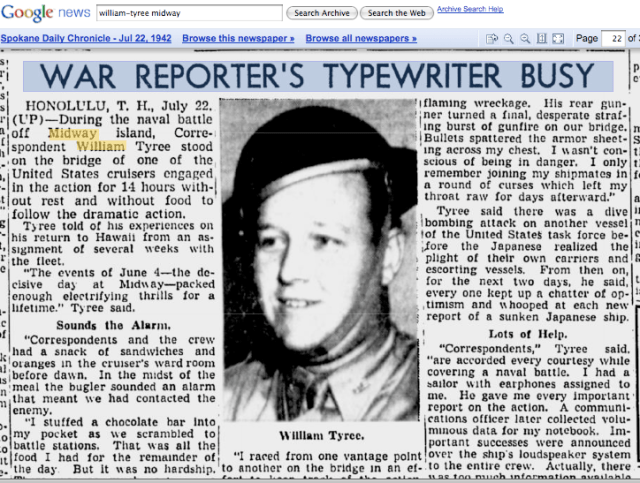
The clip above from July 1942 (click through for full text) describes some of his experiences aboard ship during the Battle of Midway, which is also mentioned in the autobiographical broadcast. (He wrote more about Midway as a turning point in the war in a 1944 United Press retrospective story.)

Long before the word “embedded” was used to describe a war correspondent’s role, Tyree saw action aboard battleships and bombers from Pearl Harbor to the Coral Sea, Midway, Guadalcanal and on to the bombings of Tokyo and Hiroshima. In the “Soldiers of the Press” episode, he describes several “too close for comfort” times when his life was at risk.

On Guadalcanal, he meets up with another U.P. man, Francis McCarthy, oblivious to broken ribs suffered on patrol with the Marines. They discuss breakfast while bombs explode around them, and they joke about Japanese snipers who can “knock the ashes off your cigarette at 200 yards.” “Sounds just lovely,” Tyree says. He continued to report on the war in the Pacific through its end.

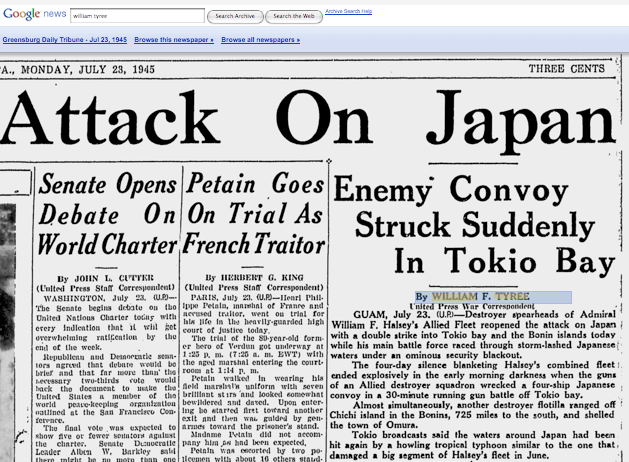
The full page one banner headline read, “Fleet Reopens Attack On Japan”

As with all “Soldiers of the Press” broadcasts, actors took the roles of the real war correspondents, soldiers, sailors and military officers. The series was both a dramatic form of public service reporting and a self-promotional effort by United Press, a smaller service that competed with the Associated Press for newspaper and broadcast news subscribers. (See previous JHeroes items from World War II, or the JHeroes.com “Soldiers of the Press” page and links on that page.

In 2009 what is now United Press International, a much scaled-down service, reprinted Tyree’s story about the bombing of Hiroshimaon its website. Tyree stayed with United Press after the war, working in Los Angeles and Oregon, where he was radio editor. He later became Los Angeles manager of United Press Movietone-Television and died in 1960 at the age of 46, according to his New York Times obituary.


For additional information about “Soldiers of the Press,” see the Digital Deli Too logs and discussion of the series. About 40 of the 140 or more broadcasts are available online at the Internet Archive, through the Old Time Radio Researchers Group Soldiers of the Press collection.

Posted in 1940s, foreign correspondents, true stories, World War II | Leave a comment

Approaching D-Day with Soldiers of the Press

For June 6 last year, I pulled out a D-Day story from Soldiers of the Press along with the archived radio of actual newscasts and more than a dozen related links, including several about then United Press correspondent Walter Cronkite.

Last time, I didn’t include a picture of Virgil Pinkley’s D-Day story as it appeared in a 1944 paper, but since I collected a few clips while documenting a string of “Soldiers of the Press” reports for Memorial Day, here is Pinkley’s story on the right. (The full story can be read in Google’s newspaper archive copy of the June 6, 1944, Berkeley Daily Gazette.)

Dry Martini


Last year’s D-Day item also didn’t include a player for one of Cronkite’s stories as dramatized by “Soldiers of the Press,” so here is a sample. His own D-Day activities aren’t available in the audio archive, so this story is from 1943, when Cronkite was covering the air war over Europe.

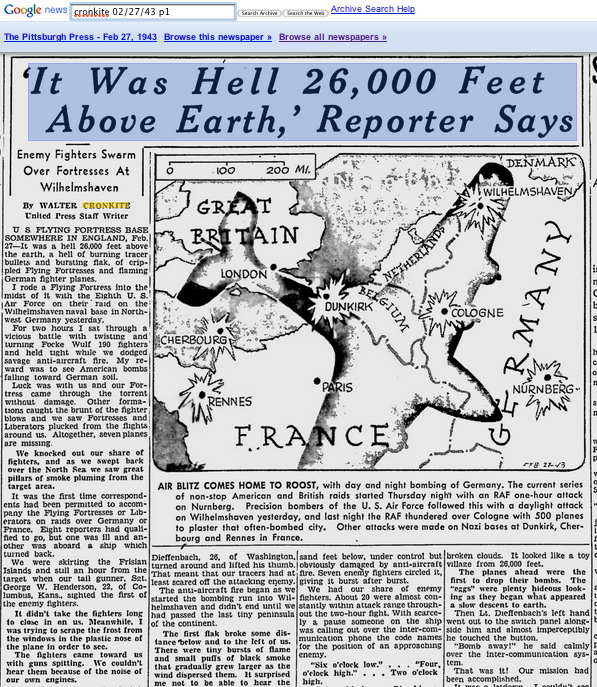
Cronkite, assigned to a Flying Fortress base in England, was one of the first correspondents to fly on a bombing run — over Wilhelmshaven naval base in Germany, as described in the digital newspaper clip below. That story is mentioned in this later audio “Soldiers of the Press” episode, but for this one he stays on the ground to write about a bomber named “Dry Martini” headed for an aircraft factory in France — by profiling a single crewman, one of the “real American lads who have a grim and dangerous jobs to do and do it.”

(I’ve searched online archives for both a “Soldiers of the Press” episode on the Wilhelmshaven raid or a news clipping of the “Dry Martini” story, but I haven’t come up with either. If you find either of them, please send me a link.)

Of course what you hear is not the familiar voice of CBS’s famous TV news anchor (as discussed last time), but a radio actor playing him in the “Soldiers of the Press” dramatization, promising a gunner on the “Dry Martini” a steak dinner if he shoots down a German plane. (He gets three, and tells Cronkite, “They made me mad, I guess.”)
As in many of the episodes, you do get a feel for the camaraderie between war correspondents and the soldiers and fliers they covered. United Press seemed particularly intent on emphasizing that its reports went beyond the official headquarters briefings to include human details, “the colorful exciting stories of United Nations fighting men in action.”

American reporters had a dangerous job, too. The day after his bombing-run story, Cronkite reported losing a colleague in action:  New York Times reporter Robert Post was on a plane that was shot down during the same raid. A sidebar reported casualties among American war correspondents in the year and three months since Pearl Harbor: 10 dead, 26 wounded, 27 missing, 22 captured.


For more examples, see
The Old Time Radio Researchers Group collection of Soldiers of the Press episodes at the Internet Archive.

Posted in 1940s, foreign correspondents, reporters, true stories, Walter Cronkite, World War II | Leave a comment

First Purple Heart for Working Reporter

For Memorial Day, part 2:

United Press advertisement in Broadcasting magazine, 1942

United Press advertisement in Broadcasting magazine, 1942

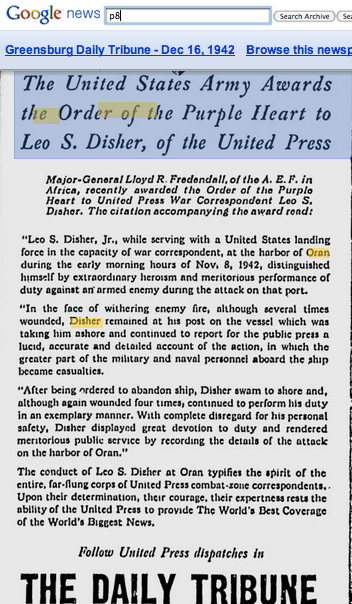
United Press correspondent Leo S. Disher Jr. became the first combat reporter awarded the Purple Heart — citing “extraordinary heroism and meritorious performance of duty” for action on a day in November 1942 that started with his ankle already in a plaster cast.

Disher was aboard one of two U.S. Coast Guard cutters that came under heavy fire while crashing a harbor boom to open Algeria’s Oran harbor. His survival account became the fifth episode of United Press’s “Soldiers of the Press” radio series.

The audio account of Disher’s experience at Oran harbor starts slowly, a “journalism procedural,” with the war correspondent being called from London by a courier to an assignment to “destination unspecified,” a destination which turns out to be North Africa.

On the way to Gibraltar via transport, he broke an ankle in a fall, but carried on to his assignment aboard a Coast Guard cutter. Disher’s narration of the 3 a.m. battle — the last five minutes of the 15 minute broadcast — is intense, full of bursting shells and machine gun bullets, shouted commands, and lines like, “as I groped over the piles of bodies…”

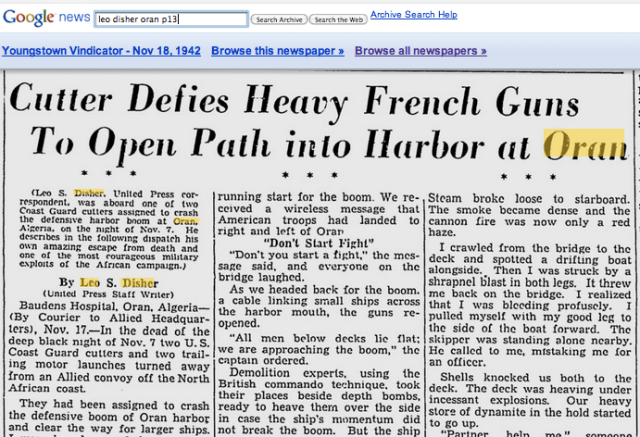
The unnamed actors and uncredited script writers pulled no punches and might be accused of overdoing it, but Google’s newspaper archive includes the original November 1942 story for comparison. I prefer Disher’s own turns of phrase, dictated to his U.P. colleague Phil Ault at the hospital:

“Then a shot hit me in the heel of my crippled foot. I crawled away on my elbows, with shrapnel and bullets splattering about like somebody throwing corn at a duck…” — (p. 19, Youngstown Vindicator, Nov. 18, 1942)

Saturday Review writer Percival R. Knauth, discussing a book-length account of the North Africa campaign, said, “for sheer courage Leo Disher’s story… can take its place alongside anything I know. Probably the reason he didn’t write more was because he had 26 bullet holes in him when he finally reached shore.” (Springboard to Berlin, by John A. Parris Jr. and Ned Russell, in collaboration with Leo Disher and Phil Ault, 1943, reviewed Oct. 2, 1943.)

In print or on the radio, the details of the exploding ship and Disher’s injuries are harrowing, even if the exact number of wounds varies between accounts.

For me, the French-accented nurse informing Disher that the battle is over is the weakest part of the radio episode, too much “Hollywood drama.” In reality, the battle of Oran — a rare episode when Americans and French were shooting at each other — continued for more than a day and was resolved after tanks arrived to secure the city and the French ceased resisting.

For more background, see this article on the Oran harbor assault, by Michael G. Walling. For general information on those few days when Vichy French forces resisted the British and Americans, see the North Africa campaign pages at WorldWar2History.info and Naval-History.net.

Human Interest: Letter to a Hero’s Widow

Disher’s eyewitness account of the Oran battle became the basis of a second “Soldiers of the Press” episode two months later, titled “A Letter to Mrs. Marshall.”
Another “behind the scenes” story from the United Press, it opens with an Augusta (Ga.) Chronicle newspaper editor contacting the wire service on behalf of the widow of one of the officers killed at Oran. In the broadcast, unidentified actors play the editors, Disher as he dictates a reply and, in flashback, Disher, the young colonel, and others, transforming details of the letter into a dramatic scene, complete with battle sound effects of machine guns, cannons and the ship’s ammunition exploding.

The letter itself was published as a United Press story under an Atlanta dateline after Mrs. Marshall released the correspondence. Lt. Col. George F. Marshall’s role in the battle would bring his widow a posthumously awarded Distinguished Service Cross, but she wanted more to tell her boys when they were old enough to understand.

In response, Disher’s letter was full of dialogue and detail about their father’s bravery, describing him as “a slim, straight silhouette against the red flashes of the guns…. stabbing back until the last, while the flames of our burning ship broke around him and shells tore away pieces of the bridge where he stood…”

No extra invention was needed for the radio script writers to make the story dramatic or make Col. Marshall any more heroic. The New York radio actors added Southern accents to their portrayals of the Augusta Chronicle editor, Col. and Mrs. Marshall.

Like the published United Press story, the dramatization includes an account of Mrs. Marshall contacting her local paper, the Augusta Chronicle, whose editor forwarded her request to the United Press, which got it to Disher in England, where (the announcer informs us) he was recovering from 15 bullet and shrapnel wounds suffered at Oran.

I haven’t found an Augusta Chronicle online, but in The Pittsburgh Press, the story of Disher’s letter ran under a six-column headline with a one-column second deck (click-through to read the full story):

Young Boys Now Can Be Told Details of Their Dad’s Heroic Death
Young Colonel Killed,
Leading Men In
Oran Action

From the text of Disher’s letter:

“You need never fear the boys’ questions, Mrs. Marshall. You can tell them their father tackled a job of greatest importance to the success of our armies, that he never quit fighting against impossible odds and that he never struck the ship’s colors.”

The “Soldiers of the Press” announcer added a closing comment, a variation of the series’ usual tag line:

“Leo Disher is one of a corps of United Press correspondents whose privilege it is to record the heroic deeds of our fighting men on the warfront. In fulfillment of this assignment, these soldiers of the press share the dangers of soldiers in arms. And because in our democratic way of life war correspondents do see at first hand the actions they report, the free peoples of the world are today the best informed.”

The message is concise and similar to that of United Press’s “Soldiers of the Press” advertising campaign, as noted in my first Soldiers of the Press item. For more about the series, see the JHeroes.com “Soldiers of the Press” overview page and its links.


Additional audio episodes are available from the Old Time Radio Researchers Group: Soldiers of the Press collection at the Internet Archive, which I use for playback on this site.

Posted in 1940s, foreign correspondents, World War II | 4 Comments

Soldier of the Press wins medal, launches series


News clip:

For Memorial Day weekend listening and reading:
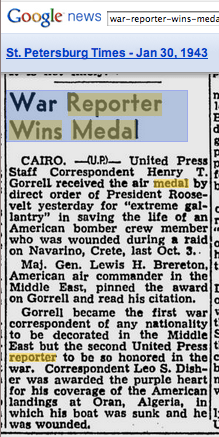
Veteran United Press reporter Henry T. Gorrell flew on an October 1942 bomber mission over Navarino Bay in Greece, wound up serving as a medic for shrapnel-scarred fliers — and had his experience dramatized as the first episode in the “Soldiers of the Press” radio series. A few months later, Gorrell was awarded the Air Medal for “extreme gallantry under fire” for helping the bomber crew, and was mentioned again in an April 1943 story about correspondents’ accomplishments. On the job since before the U.S. entry into the war, he continued to cover the action in Africa, the Middle East and Europe, including the liberation of Paris and reopening of the U.P. Paris bureau.

In the Henry Gorrell flies with bombers to Navarino Bay broadcast, an unnamed actor voices Gorrell’s story-behind-the-story narration: “I was in my quarters pounding away on my typewriter when…”

Other actors play reporters, military briefing officers and the Army Air Force B-24 bomber crew, with sound effects ranging from Gorrell’s typewriter to airplane engines, machine guns and bombs.

“I make my way back to the gunner’s turret, I have to take off my parachute harness, life jacket and sheepskin coat to negotiate the narrow catwalk in the bomb-bay… From where I sit, I count 25 cannon and bullet holes inside the plane…”

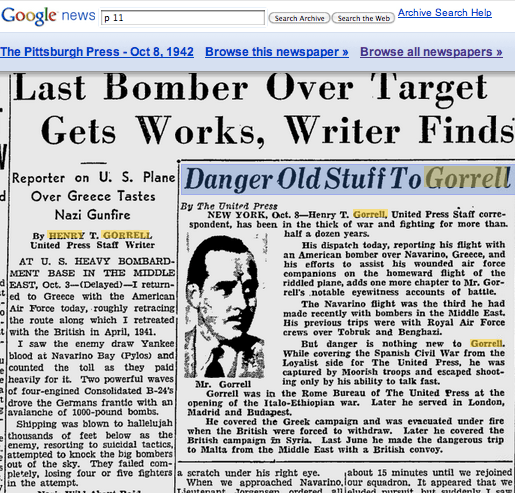
Seven war correspondents were aboard various bombers on the high-altitude raid, including an AP reporter named Edward Kennedy whose version of the story is preserved in Google’s scan of the Portsmouth Times. Gorrell was on “The Witch,” which Kennedy describes as taking the brunt of the German attack. The Pittsburgh Press (below) carried Gorrell’s own story.

Google’s news archive has a copy of Gorrell’s dispatch from the bombing run; click the image to see the full clip and compare his first-person story with the radio narration.

The United Press “Soldiers of the Press” series was recorded in New York — with state-of-the-art radio sound effects and production values — while the U.P. correspondents were still in the European or Pacific war zones. The 15-minute episodes not only told war stories in a dramatic way, but helped promote the United Press, “The world’s best coverage of the world’s biggest news.”

“By braving enemy gunfire, by accompanying our troops, our ships and our planes into battle at the risk of their lives and freedom, Gorrell and other correspondents of the United Press enable American radio listeners and newspaper readers to know the facts, the truth of important war actions clearly, completely, quickly. They bring you the stories behind the headlines…” — announcer

Later episodes introduced Unipressers who went on to fame in radio and television years later, including a young Walter Cronkite. (Cronkite later told NPR listeners the series was “part wartime propaganda and part PR,” but an honorable effort to inform the public and “more or less true.” He said it sounded like an adventure series, “A variation of Gangbusters with war correspondents instead of G-men.”) Gorrell was featured several times, including one story covering the fall of Aachen and another telling a Christmas story.

More than half a century later, Kenneth Gorrell found the manuscript of his grandfather’s cousin Henry Gorrell’s memoir in a family attic and saw it through to publication. The book is titled “Soldier of the Press: Covering the Front in Europe and North Africa 1936-1943.”

After the war, Gorrell became publisher of a veterans’ newspaper, The Veterans Report, in Washington, D.C. He died of a stroke in 1958, according to obituaries in The New York Times and Washington Post.

For additional information about the radio series, see Dennis Nyhagen and Dee Neyhart’s Digital Deli Online website, which has researched program logs in newspapers to create a Definitive Soldiers of the Press listings page.

Audio episodes are also available from the Old Time Radio Researchers Group: Soldiers of the Press collection at the Internet Archive, which I use for audio playback on this site. Over the years some volunteer-created online collections have had spelling and identification errors or suggested that the actual U.P. reporters narrated the series, but this set makes 40 full episodes available for free download, and they speak for themselves..

What was United Press trying to accomplish with the series? This advertisement pretty much sums it up… although it does not mention United Press’s own battle for subscribers, competing with the Associated Press, International News Service (with which it eventually merged to form UPI), Reuters and other wires.

For more… see the Soldier’s of Press JHeroes overview page.

Profiling five U.P. reporters

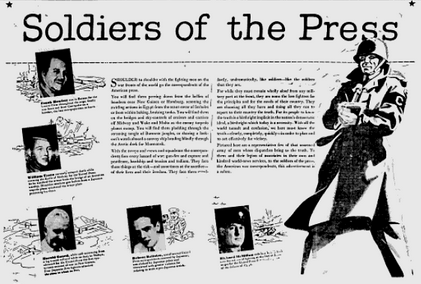
United Press honored its correspondents — and previewed its upcoming “Soldiers of the Press” radio series about their exploits — with this Oct. 5, 1942, newspaper ad (here from the Victoria, Tx., Advocate, p. 5). Featured were reporters Frank Hewlett, William Tyree, Harold Guard, Robert Bellaire and Richard MacMillan. The ad was published the same week that Henry Gorrell flew on that bomber raid over Greece.

— text of the advertisement —

Shoulder to shoulder with the fighting men on the war fronts of the world go the correspondents of the American press.
You will find them peering down from the bellies of bombers over New Guinea or Hamburg, scanning the swirling actions in Egypt from the scant cover of foxholes or from within baking, bruising tanks. You will find them on the bridges and sky-controls of cruisers and carriers off Midway and Wake and Malta as the enemy torpedo planes swoop. You will find them plodding through the steaming tangle of Burmese jungles, or sharing a look-out’s watch aboard a convoy ship heading blindly through the Arctic dark for Murmansk.
With the troops and crews and squadrons the correspondents face every hazard of war: gunfire and capture and pestilence, hardship and tension and tedium. They face these things at the risk — and sometimes at the sacrifice — of their lives and their freedom. They face them steadfastly, undramatically, like soldiers — like the soldiers that they are.
For while they must remain wholly aloof from any military part at the front, they are none the less fighters for the principles and for the needs of their country. They are chancing all they have and doing all they can to report to their country the truth. For its people to know the truth is a birthright implicit in the nation’s democratic ideal, a birthright which today is a necessity. With all the world tumult and confusion, we here must know the truth — clearly, completely, quickly — in order to plan and to act effectively for victory.
Pictured here are a representative few of that unarmed army of men whose dispatches bring us the truth. To them and their legion of associates in their own and kindred world-news services, to the soldiers of the press, the American war correspondents, this advertisement is a salute.

Posted in 1940s, foreign correspondents, reporters, World War II | Leave a comment

A woman with a scoop

“Scoop? You couldn’t scoop the insides out of a cantaloupe.” — her editor.

The 1935 Bette Davis film promoted by that trailer, Front Page Woman, was brought to radio four years later with Paulette Goddard in the title role and Fred MacMurray as the defender of male supremacy in the newsroom, courtesy of Lux Radio Theater.

“The love story of two reporters, a boy who thinks that journalism is purely a man’s profession and a girl who won’t say ‘yes’ until she proves him wrong” — that’s how the announcer introduces it.

For more discussion of what we like to think is a dated “battle of the sexes” romantic comedy, see the IMDB page for Front Page Woman and the analysis at She Blogged By Night.

Supporting player Roscoe Karns, as a smart-aleck photographer named “Toots,” is the only cast member to make it from the movie screen to the radio adaptation. Karns’ career is fascinating — the character actor was repeatedly cast as journalist — editor (Copy, 1929 & The Roadhouse Murder, 1932), photographer or reporter (His Girl Friday, 1940 & Woman of the Year, 1942).

On Lux Radio Theater, host Cecil B. DeMille waxes nostalgic about real-life women journalists, two of whom I’ve written about here, Anne Royall and Nellie Bly. Among other things, DeMille repeats the apparently apocryphal story about Anne Royall interviewing a naked president of the United States. Keeping with the reality-radio theme, there is also a long-distance guest-appearance by Floyd Gibbons, a real-life fast-talking star reporter of the day.

For a case of popular culture citing popular culture in this film, listen early in the story when the infuriating leading man calls the young woman reporter a “sweet little kid who’s read too many newspaper novels.” He later mentions that he doesn’t write them, either.

“I don’t write novels or newspaper plays, and I do take off my hat in the house.” — reporter Curt Devlin

He may not write fiction, but he does have a strange grasp of newspaper writing vocabulary. One plot twist turns on his decision to use the too-memorable words boniface and expiate in the same news lead for two newspapers.

“With a song on her lips, Mabel Gay, Broadway’s famous female boniface, walked to the electric chair last night to expiate the murder of dapper Rudy Spain.” — execution story lead by Curt Devlin.

I hope journalism students will quickly add to the film’s list of unlikely plot twists the thin odds of two copyeditors letting that sentence get by. I also look forward to a class discussion of Hollywood’s usual “all’s fair…” attitude toward reporters’ ethics.

Eventually I’ll move the contents of this post and add more details about “Front Page Woman” on a page of her own.

Note: If there’s one film-to-radio 1930s stereotype stronger than “cranky editor,” “wise-cracking, rule-breaking newspaperman” and “feisty, but ultimately marriage-minded newspaper woman,” it’s this episode’s portrayal of an “Irish cop” during the fire scene. For comparison, listen to Michael Axford and his friends on the force in almost any “Green Hornet” episode.

Posted in 1930s, reporters, women | Leave a comment

Newspaper says Yale cheats; Merriwell to the rescue

Last time it was scrappy Boston reporters heading for Connecticut to cover Yale-Harvard baseball. This week we jump to another sport and season, to watch an investigative New Haven newspaperman get the scent of a sports scandal for a Front Page Story

Yale’s coach, meanwhile, accuses the reporter of spying on his team’s practice and threatens to get him fired for relaying its new secret plays to the opposing team. It’s sports-ethics versus media-ethics, with plenty of suspicions all around!

By the end of the program, there’s even an innovative “active readership” response to the threat of a false newspaper report harming a  player’s reputation.

Set in 1902, the “Adventures of Frank Merriwell” series was based on the dime-novel sports hero created by Gilbert Patten under the pseudonym Burt L. Standish. A newspaper reporter for several years, Patten ran a weekly paper for a year, but gave it up when his dime-novel Merriwell character took off.

His “brains and brawn” collegiate hero not only excelled at all sports, but at selling dime-novels, full-length novels, a comic strip, movies and two radio series.

The Internet Archive has 39 half-hour Frank Merriwell episodes from this 1946-49 incarnation. Not all the stories worked journalists into the plot, but I’m listening to those that do, curious whether they carry classic stereotypes of journalists or suggest any insights into the craft and history of the newspaper business.

This 1948 broadcast opens with a confrontation in a newspaper editor’s office, one of those bantering reporter-editor scenes  common in popular culture portrayals of journalists. Sarcasm flies in both directions.

The editor asks his reporter, “What’s on your alleged mind this afternoon?”

The reporter tells the editor his assignment is so insignificant, “You could cover it yourself.”

Part of it is about status. An experienced sportswriter, Terry Reid expects to cover Ivy League football rivalries and protests being assigned to cover Yale’s game against a small Midwestern school identified only as “State College.”

But the editor brushes off the “cover it yourself” insult and informs Reid there really is a story worthy of his seniority: The game isn’t the main assignment; Reid is to profile Yale’s three candidates for the All-America team. Along with Merriwell and his pal Bart Hodge, they include a new tackle named Joe Marcy.

That’s where reporter Reid smells an even bigger scoop. Having covered western teams in a previous job, he recognizes the 23-year-old Marcy as a former star tackle at Western Tech, where he played under a different name four years earlier. It looks like Yale is fielding a ringer who has already played four years of college ball.

Single-mindedly, the reporter heads for the practice field to interview Marcy and his teammates, but cuts the visit short when Marcy isn’t available after all.

Merriwell and Hodge were friendly with a reporter in the baseball story, Frank Merriwell’s Promise, but this time Hodge expresses a low opinion when the reporter cancels their interview.

Merriwell: “He certainly acts like he was on the trail of a big story.”

Hodge: “All those reporters act the same way, Frank. He’s probably one of those so-called ‘experts’ who are always predicting an upset.”

Using the best turn-of-the-century reporting techniques, Reid races to Bridgeport to catch a special train into New Haven so that he can interview the State  coach on route to the game.

Without revealing his actual suspicions, Reid asks the coach, “just for the sake of argument,” how he would respond if Yale was breaking the rules. He gets a spicy quote for his afternoon edition, “I’d register a protest that would singe the eyebrows off the whole Yale faculty.” The coach discloses that he has a heavier team and a bunch of secret plays.

On the field, the State team seems on its way to an upset when Merriwell and the Yale coach come to the conclusion that the reporter relayed those secret plays to the State coach before the game. The reporter denies it — the State coach and Yale coach were both borrowing a third team’s playbook, and State started practicing the new plays earlier.

Then he springs his allegations about Marcy, who Marcy admits to changing his name, but insists he didn’t play for all four years at Tech. Lacking proof and fearing a scandal, Yale’s coach pulls the player from the game — while the reporter races to get his scoop into print. Perhaps he’s in too big a hurry; perhaps he doesn’t give Marcy enough of a hearing.

Rather than spoil the suspense, I’ll stop there. But here’s a hint: There’s one more historic “newspaper role” on the way to the ending, along with a legal alternative to “prior restraint of the press” that might have worked with a small-town paper in 1902. Would it really work in this case? It depends on the “real” circulation statistics of a presumably fictional New Haven newspaper.


Background source on Patten and Merriwell:

Patten, William G.” in Albert Johannsen, “The House of Beadle and Adams and Its Dime and Nickel Novels,” Northern Illinois University Libraries.


For another example of old-time sports journalism as portrayed on radio, try these radio biographies of sportswriter Grantland Rice.

Posted in 1900s, 1940s, adaptations, ethics, journalism, newspapers, reporting, sports | Leave a comment

Newspapers Battle to Cover Merriwell at Yale

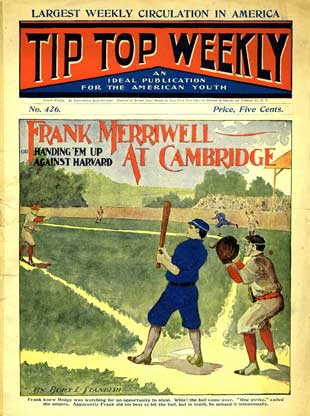
Tip Top Weekly baseball game cover, 1904
The game on this 1904 cover was in Cambridge; the radio episode’s action is in New Haven; home-team advantage: Merriwell, but difficult for Boston press.

“When a big story is involved, a good reporter doesn’t worry about what is or isn’t legal.”

Here’s nostalgia doubled, as we turn back the clock a half-century to hear 1949 radio do the same — back to the era of gaslights and horse-and-buggy. In this story, dime-novel sports hero Frank Merriwell has a ballgame to win, but also investigates turn-of-the-century media innovations to help a reporter get the story to his paper.

The episode Frank Merriwell’s Promise has all the latest gee-whiz gimmicks: The telegraph, typewriter, heliograph, telephone, even a gasoline-powered horseless carriage that plays a role  in the race for the story.

From our “newspaper heroes” perspective, this 1949 broadcast celebrates what already may have seemed an old-fashioned journalistic tradition: Competing big-city newspapers in a no-holds-barred fight to get a big story. Hear sports reporters employ state of the art technology to get the advantage, even if it means unsportsmanlike dirty tricks.

The dramatic conclusion of the episode’s Yale-Harvard baseball game is a bit far-fetched, but perhaps no more so than the idea that one of three Boston newspapers battling to get the story from New Haven would actually be partial to Yale, rather than the almost-local boys in Cambridge! The Banner, Standard and Chronicle are the three Boston papers (Connecticut papers apparently aren’t worth mentioning), and a Yale friend of Merriwell’s is the son of the Chronicle’s publisher, who says his father will pay anything to get the story.

At Merriwell’s suggestion, they have a secret telephone installed — hidden in a bench at the ballfield. They basically invent what will become a radio standard, a reporter giving a live play-by-play account of the game. (The actor even says “play-by-play” as if inventing the phrase.)

“This will make newspaper history if we can pull it off!” one of the conspirators says.

The young men also enlist a female assistant to help the Boston reporter identify the Yale players. Among other things she types! “You’ll do such a good job that Bruce’s father will probably offer you a position on the paper,” Frank says.

Along with its “new tech” twist, the media ethics questions raised by this adventure are worth a journalism class discussion. They range from monopolizing telegraph lines to stealing a horse, along with an issue that spans technological eras — the deadline temptation to fabricate the dramatic ending of a story that hasn’t actually ended yet. That “When a big story is involved, a good reporter doesn’t worry about what is or isn’t legal” line at the top of this article is delivered in all sincerity by either the “good” Boston reporter or his publisher’s son, at the suggestion that the competition might destroy special telephone.

There’s also a journalism ethics issue in the reporter’s accepting all that help from one of the teams — even borrowing the coach’s Daimler. (Come to think of it, could a Yale coach afford a Daimler back then? Automotive trivia: Daimlers were built in Connecticut in the 1890s, according to Mira Wilkins’ The History of Foreign Investment in the United States to 1914, p. 419.)

Give a listen. The audio quality is quite good, as are the production values for this post-war NBC broadcast. You can hear not only the echoes of the crowd on game-day, but the squeak of an old porch swing and perhaps even crickets in the New Haven evening as Merriwell and his friends plot their strategy.

As usual, the attached audio file is thanks to the Internet Archive, which has a good collection of the 1949 NBC “Adventures of Frank Merriwell” broadcasts, as well as digital copies of Gilbert Patten’s “Burt L. Standish” novels.

While sports, not journalism, was Merriwell’s usual passion, I’ve discovered another journalism plot in the radio collection, so I’ll showcase an encounter between Frank and a less supportive newspaperman soon.

More about Frank Merriwell

See Frank Merriwell is Back, from FrankMerriwell.com including Robert H. Boyle’s article “Frank Merriwell’s Triumph, or How Yale’s Great Athlete Captured America’s Fancy, Purified the Penny Dreadfuls, and Became Immortal.”

E.M. Sanchez-Saavedra overview of Frank Merriwell at Yesterday’s Papers.

Posted in 1940s, 19th century, adaptations, competition, journalism, newspaper stunts, newspapers, reporters, reporting, sports, technology | Leave a comment

Ernie Pyle in newspapers, film and radio

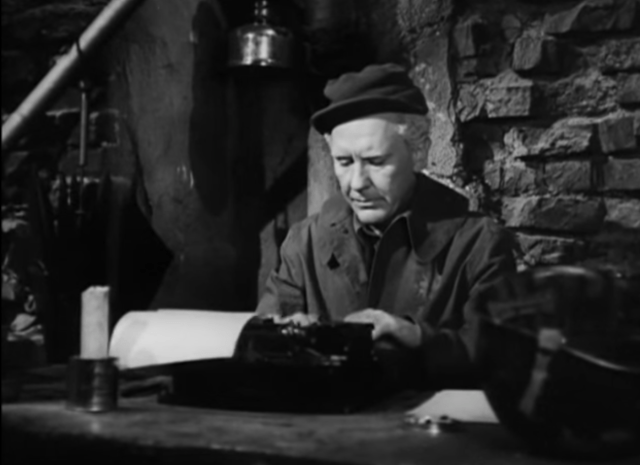
Burgess Meredith as Ernie Pyle

Making room on a bookshelf next to my old copy of Agee on Film, I re-read James Agee’s 1945 review of “The Story of G.I. Joe,” a piece titled simply “A Great Film.” I went looking to see if YouTube had  a clip from the movie, which was based on the work of war correspondent Ernie Pyle. (Update: for a while, YouTube had an unauthorized copy of the entire film.)

Surprise: I didn’t realize until writing the last paragraphs of this note that the anniversary of Pyle’s death was just three days ago.

The stars of the film are Burgess Meredith as Pyle and Robert Mitchum as the lieutenant.

Lieutenant: “Pyle? Say, aren’t you the fellow that writes that column about weekend trips or something?”

Pyle: “Mostly about ‘something’…”

Lieutenant: “Come to think of it, y’know, my old man reads your column. He thinks it’s great.”

Pyle: “Well I’ll be darned.”

Pulitzer-winner Pyle’s name was familiar to radio listeners as well as newspaper readers. For example, “Green Hornet” fans in May 1944 heard a PSA of Pyle’s account of a serviceman calling “V-mail” from home “a five-minute furlough.” Pyle’s stories were told to radio listeners in broadcast adaptations of his writing before his death and testimonials afterward.

Here’s a sample: “Here is Your War,” a 1944 Cavalcade of America episode that featured James Gleason as Pyle, often called America’s best-loved war correspondent because of his attention to the life of that average soldier, “G.I. Joe.”

(Gleason was no stranger to Hollywood newsrooms, playing roles like the crusty editor in “Meet John Doe” and Broadway columnist in the radio adaptation of “Wake Up and Live.”)

My UNC grad school classmate Brad Hamm, while dean of the IU School of Journalism, put it well:

“Anyone who covers tragedy or war needs to see how Pyle personalized the stories he was covering. These were people caught up in larger events and he showed how valiant they were and also of the basic frustrations they had. He was not doing hero worshipping, he was doing a celebration of the average soldiers, some of whom were heroes and others who were just heroic in being there.”

In 1943 the NBC series “Words at War” also did a “Here is Your War” episode, but it was less a dramatization than a dramatic reading from Pyle’s book.

Other sources of information about Pyle, his legacy, and the film he inspired:

Pyle died in action on April 18, 1945, just months before the release of “The Story of G.I. Joe.”

In 1958, the radio program “Biography in Sound” told his story, Ernie Pyle: Typewriter in a Foxhole. About a half hour into the 50-minute broadcast, there’s a fine reading of Pyle’s famous dispatch, “The Death of Capt. Waskow,” which you also can read for yourself at the PBS “Reporting America at War” site.

Update Jan. 26, 2015: Veteran oldtime radio podcaster Bob Camardella’s Boxcars711 recently presented an Ernie Pyle bio-drama that I hadn’t found in other online archives. Featuring Burgess Meredith in (and as) “Mr. Pyle,” it was written in 1945 by one of radio’s top dramatists, Arch Oboler, who clearly appreciated Pyle’s skill as a storyteller.

Further update:
The podcast version that I had linked to here is no longer at its original address, but I found another copy of the program in 2018 at the Old Time Radio Researchers Library (download).

Posted in 1940s, cavalcade, foreign correspondents, historical figures, Pulitzer Prize, reporters, World War II | Leave a comment

Clark Kent, meet John Carter!

Journalists aren’t the only people who were sometimes stereotyped in old-time radio dramas or other popular culture forms of the 1930s and 1940s.

In these closing episodes of a 15-part Superman adventure from September 1941, we find ourselves in Central America with several “types”: a tribe of “savage head-hunting Indians,” a treacherous British-accented “local white derelict” of the tropics, and the ironically named John Carter, manager of a rubber plantation, typical of the “great white hunter” characters in films and stories by the likes of H. Rider Haggard and Edgar Rice Burroughs.

Were the “Adventures of Superman” writers making a conscious reference to Burroughs’ character John Carter of Mars? A superhero of sorts himself, Carter had been popular in pulp novels for 30 years by 1941, even if he didn’t prove a box-office blockbuster when he finally made it to the movie screen in 2012.

In these episodes, Superman not only battles dangerous natives, he convinces their aging chief he is “the Great Spirit” and promises him long life in exchange for the jungle medicines he has travelled to Central America for — both to save Carter’s life and to rescue the Metropolis Football team from a sleeping-sickness poison they were given at the start of the series.

In any case, Clark Kent’s sudden expedition to Central America does remind us that journalists sometimes took on an “explorer” role as early as the 19th century, with Henry Morton Stanley’s search for David Livingstone in 1871 and Nellie Bly‘s record-setting trip around the world in 1889, both of which had been dramatized in popular-history programs on the radio.

Neither Stanley nor Bly was as well equipped to negotiate with natives or fight a 50-foot boa constrictor and fly home quickly as Superman — in time to make a difference in a “last three minutes of the game” football drama.

Episode 13: Clark Kent and John Carter Episode 14: Superman as Great Spirit.
Episode 15: Get those Central American drugs!

The final episode brings Kent back to Metropolis and his original goal of helping the university football team recover from a drug the players had been given, one that sapped their strength and left them dizzy and stumbling around the field just as they were headed for a championship.

Winning the championship was presented as an essential ingredient in raising matching-funds to qualify the university for a $3 million bequest for medical research. Its ultimate target was to find a cure for infantile paralysis (polio), a real-life villain in the 1940s. (A search of the New York Times archives finds 421 stories during 1940 and 1941 about the disease and attempts to combat it. The first polio vaccines were not developed until the 1950s.)


This is the final JHeroes installment for the story, “Metropolis Football Team Poisoned,” each including several “Adventures of Superman” daily episodes from the 1941 serial.

First installment: Clark Kent, unethical sports reporter

Second installment: Clark Kent, burglar or bungler?

Third installment: Lois Lane Steps In

Posted in 1940s, Clark Kent, stereotypes, Superman | Leave a comment

Mike Wallace on radio, from Information Please to the Green Hornet

While this blog usually deals with fictional journalists and the  dramatized lives of historic journalists, today’s news is worth an exception.

Legendary television newsman Mike Wallace, who died Saturday at 93, got his broadcasting start in radio, and this may be his first national appearance — preserved in the Internet Archive’s collection of old-time radio programs:  Information Please, Feb. 7, 1939, with Myron Wallace, a 21-year-old University of Michigan student at the time, as a guest panelist on the era’s top quiz show.

“A mere beardless boy, a student at the University of Michigan, selected by his university to represent the spirit of youth on our program…” is how host Clifton Fadiman introduces Wallace. When one of the quiz topics is “alibis,” Fadiman asks the student, “When you’ve flunked an exam, what do you generally say — or don’t you ever flunk an exam, Myron?” “I’d say, offhand, no,” Wallace replies. “It’s the truth, though. I don’t remember ever being in that situation.”

Other panelists included Franklin P. Adams, one of the best-known  journalists of his day, someone we’ll be hearing from again in a later JHeroes.com item. Signing his columns “F.P.A.,” Adams wrote for most of the major New York newspapers in a career spanning almost 40 years. Wallace’s broadcast reporting was with us even longer, more than half a century.

On the 1939 Information Please broadcast, however, he was the voice of a new generation. At one point, Fadiman, literary critic of the New Yorker magazine, asks the panel for modern-slang equivalents of lines from Shakespeare.

For “He is of a very melancholy disposition,” Wallace offers, “What a droop!”

“See, that’s the collegiate slang… Slap him on the back, Mr. Adams,” Fadiman replies. “We need somebody like that on this program.”

Wallace’s professional career in radio began soon after, and included a variety of acting and announcing roles, some at Detroit’s WXYZ, home of The Lone Ranger, The Green Hornet and “Cunningham News Ace,” apparently reading the news on a program sponsored by the Cunningham drugstore chain. He was still identifying himself as “Myron Wallace” in 1941 broadcasts, including the closing i.d. on this Green Hornet episode, Murder Across the Boards.

In it, newspaper publisher Britt Reid and his reporters investigate a racetrack racket and a criminal mastermind named “Mister X.” Although known later in life for his hard-hitting interviews, Wallace doesn’t get to be part of the story, but simply provides introductions, transitions and the closing credit. (At the time, the radio actors were not named, but the main announcer was.)

Wallace’s role in the program is discussed briefly in the book The Green Hornet, by Martin Grams and Terry Salomonson. They don’t speculate on whether Britt Reid and The Daily Sentinel contributed to Wallace’s eventual interest in journalism, or to his famous confrontational style on 60 Minutes and his 1950s television interview program, Night Beat.

(The latter, coincidentally, also had been the name of a radio series about an equally hard-boiled newspaper columnist, Randy Stone.)

Detroit radio provided another journalism role model, but a bit before Wallace’s time: Gerald Buckley, murdered after a broadcast expose in 1930, is described here by radio historian Elizabeth McLeod as a possible inspiration to the creators of The Green Hornet.

Someday I would like to read through all of Mike Wallace’s memoirs and biographies to see if he ever mentioned the hard-hitting journalists from Britt Reid’s Daily Sentinel as a source of inspiration for his eventual switch from the “announcing” to the “reporting” side of the broadcasting. Perhaps not; his radio work must have introduced him to plenty of inspiring real-life reporters, as well as making him feel comfortably at home behind a microphone.


Obituaries and retrospectives

Biography, memoir and more

  • Mike Wallace: a life, by Peter Rader. New York: Thomas Dunne Books/St. Martin’s Press, 2012.
  • Close encounters: Mike Wallace’s own story, by Mike Wallace. Berkley, 1984.
  • Between you and me : a memoir, by Mike Wallace and Gary Paul Gates. New York: Hyperion, 2005.
  • Heat and light: advice for the next generation of journalist, by Mike Wallace and Beth Knobel. New York: Three Rivers Press, 2010.

updated May 8, 2012 

Posted in 1940s, GreenHornet, historical figures, journalism, radio, reporters | Leave a comment