Listening to 1951’s Orson Welles “The Lives of Harry Lime” in parallel with the 1957 radio series “Europe Confidential” can be a surreal experience — and never more than in this episode about a stolen painting that changes from Rubens to Van Gogh through the art of script recycling.
Harry Lime: Work of Art, 1951
In the original, Lime is his usual charismatic international thief, smuggler, ladies-man and con-man. This time he’s out to charm his way to one of a wealthy woman’s old masters.
In “Europe Confidential,” syndicated as part of a broader title called “World’s Greatest Mysteries” with Basil Rathbone offering introductions, the only continuing character is Mike Connoy, played by Lionel Murton. Connoy is billed as “Paris correspondent of a famous American newspaper,” but this is one of the episodes where he is merely the “as it was told to me” narrator — for a rewritten version of what was originally a Harry Lime script.
And this time he’s one step farther from the story. Our narrator says he only read the original news reports, so there’s no breaking-news journalist in the plot. In the real world, columnist Connoy wouldn’t keep his job for long that way! Sadly, for this blog, that means there’s not much discuss about radio fiction’s “portrayal” of journalists — except that they can make excellent narrators, and that using the Connoy character that way probably saved producer Harry Towers a bundle on fresh scripts.
At least some of the plot shifts are intriguing…
In the original 1951 story, international thief and con-man Harry Lime (“The Third Man”), voiced by Welles himself, is in Argentina to steal a painting, an original Peter Paul Rubens.
In the 1957 version, Connoy tells us about an art thief named Larry (not Harry) in Madrid (not Buenos Aires). And he’s after a painting by Vincent Van Gogh (not Rubens).
Incidentally, the Canadian collector who digitized copies of the Europe Confidential transcription disks mentioned that there were no episode titles on the disks themselves, just numbers. As a result, the titles on MP3 files at his website and the copies at the Internet Archive are improvisations. (In this case, that includes a phonetic spelling of “Van Geoff” in the MP3 filename; if someone corrects the name, the link above may stop working.)
Back to the plot: With Welles as the star, the original caper was told in the first person and had an amusing double-twist ending. As in all Harry Lime stories, we can be pretty sure Lime will not die or go to jail for long, since he must remain free to — eventually — meet his end in the sewers of Vienna in the movie “The Third Man,” dramatically foreshadowed at the start of each radio episode.
In “Europe Confidential,” there’s a triple twist, since Welles former collaborator Harry Towers (producer of both series) wasn’t constrained by Lime’s back-story or future-story.
The result is a somewhat different ending, and some closing remarks from Connoy. But in losing Welles’ Lime as the main character we don’t get as strong a replacement, and we still learn nothing about the American reporter-narrator, unlike some “Europe Confidential” episodes where Connoy is more action-hero foreign correspondent. There are also no lessons in media ethics or technique.
However, there is one bit of U.K. Fleet Street trivia in term you wouldn’t hear from a typical American. At the end of the episode, Connoy speculates about a follow-up to the events of the story — if only one could cover a meeting of a couple of the characters behind bars.
“That would have been a real human-interest story,” he says, “although it might have required a lot of sub-editing before publication.”
“Sub-editing” is a British term for what U.S. newspapers just call the work of the “copy desk.” Or, when an article needed more work in the old days, “the rewrite desk.”
Coming from the American reporter Connoy is supposed to be, either of those would be a better term — all the more because the story itself is a rewrite — and an export product that may have been heard more in England, Australia and Canada than the U.S.A.
(See the last three blog posts for my previous Europe Confidential items, which I’ll eventually combine and polish into a chapter-length “page” essay here: Europe Confidential.)
No this isn’t about “Citizen Kane.” It’s about one of the famous actor’s returns to radio in the 1950s. (Before his first film, he was famous on radio — for everything from “The Shadow” to that Mercury Theater “War of the Worlds” broadcast.)
Having started listening to Orson Welles “The Lives of Harry Lime” to find scripts that were later recycled into a journalist series, I was surprised to find a 1951 episode — not recycled later, as far as I know — in which Lime impersonates a journalist.
The Bohemian Star is not a newspaper, but “a diamond as big as a duck’s egg,” and Lime pretends to be a well-known Associated Press reporter so that he can offer to switch places with another reporter who has a last-minute assignment that will get him close to the jewel. (The reporter wants the day off to take his fiancee to a Betty Grable movie.)
“A pretty poor newspaperman who won’t help a colleague when the opportunity turns up.” — Harry Lime
The theme of one journalist “covering” for another is not uncommon in fiction about the newspaper business, “Front Page Woman” being one example; there is even a scene along those lines in “Citizen Kane.” The theme of a crook impersonating a journalist to get information probably shows up now and then in the movies, too, but I can’t think of an example right this minute.
In this radio episode, Lime — crook posing as reporter — makes a passable interviewer, interrogating his Argentine jewel-expert subject on the procedures involved in getting access to appraise the stone, and asking lots of questions about its guards, staff and more. In the process he accidentally learns that the jewel expert was actually planning to steal the diamond himself. Being Harry Lime, he survives, even after the crooks conk him on the head and find out who he is.
In the end, the real journalist shows up and proves to not exactly have been a dummy. Meanwhile, our anti-hero Lime pulls off a bit of good-guy/bad-guy bait and switch worthy of “The Green Hornet” — radio’s blackmail and sting specialist who, as old-time radio fans know, had his own journalism connection as newspaper publisher Britt Reid.
More blog posts being added here about crossover “Europe Confidential” and “Lives of Harry Lime” stories:
This “Europe Confidential” story is a less-satisfying adaptation of a “Lives of Harry Lime” script than the espionage episode mentioned last time, but this one illustrates a very different way journalism can become part of dramatic storytelling.
In the previous episode, the Harry Lime spy story “The Third Woman” was adapted by transforming the lead character into reporter Mike Connoy, who got to reminisce about being on temporary spy duty during World War II, a not implausible framing of the story. Turning Orson Welles’ anti-hero Harry Lime into Lionel Murton’s hero-journalist, Connoy, took some creative rewriting. But clever insertion of the memes and themes of fictional adventurer-journalists did the job.
This time, there is no attempt to write foreign correspondent Connoy into the plot — a gambling-swindle “caper” story. Connoy simply becomes the narrator, telling the story from the outside, supposedly after having it told to him by one of the principal characters.
“Reporting” is a natural way to involve a reporter in a story, but putting the Connoy character in that position — after having both an unnamed announcer and “host” Basil Rathbone introduce the story — makes the episode seem framed and reframed. Ironically, Rathbone’s introduction to the episode talks about a breaking news story being enough to send Connoy “speeding to the scene,” but in the episode the reporter never leaves his armchair.
The original tale was about a Cuban boxing match and an attempted gambling swindle by the shady anti-hero character Harry Lime, plus a female accomplice. Their complicated sting took on a naive insurance executive from Cleveland. Lime, played by Orson Welles as the character was in “The Third Man” movie, narrates his own story with self-deprecating good humor and worldly chuckles — the radio equivalent of a raised eyebrow.
In the recasting of the story, Connoy simply has less to say, including these sentences of introduction:
“Writing this column of mine, Europe Confidential, you come across all the stories in time. The sad ones, the solemn ones, and the amusing, the bizarre, right alongside them. This one, it might go under the title of high comedy with a kick, or, should I say, a knockout?
“I first saw Judy Diamond go to work on the American tourist in the small intimate nightclub called Casa Pepito…”
The focus is so much on the female swindler that radio collector Jim McCuaig, who rescued and digitized old transcription disks of “Europe Confidential,” titled this episode “The Judy Diamond Affair.” (The transcriptions were untitled. The Harry Lime original was titled “It’s a Knockout,” and is part of the Internet Archive’s “Lives of Harry Lime” collection.)
Judy’s boss, the chief swindler, is too thinly drawn to be a sympathetic anti-hero character in this version. At times, his accent has a hint of W.C. Fields, but not enough to make him the confidence man a comic rascal. In contrast, Lime, as the title character of the original series and voiced by the unmistakable Welles, came to each episode with plenty of charisma and useful baggage.
Could the script writer have made done more to get Connoy into the story? Perhaps he could have been on assignment to cover the boxing world, uncovered the swindle bit by bit, maybe wrestled with his conscience about covering the unlicensed match or blowing the whistle. But that would be a bigger writing job, and presumably the reason for turning “Harry Lime” scripts into “Europe Confidential” stories was to economize on both time and money.
Neither broadcast included credits to the writers or actors, other than the series’ stars. Both programs were produced by Harry Alan Towers, about six years apart. The Lime series was widely syndicated; “Europe Confidential” apparently less so, arriving on the scene in 1957 and 1958, when Television had become serious competition for radio drama.
Towers, in fact, partnered with American radio syndicator Frederick Ziv on several television-series projects. Maybe a television historian will discover that one has an intriguing plot about a boxing swindle…
The radio series “Europe Confidential” told mystery tales in the guise of newspaper columns, and is now available as MP3 files with titles like “The Blackmailed Spy Affair.”The “World’s Greatest Mysteries” program is a bit of a mystery itself — apparently a series-in-a-series, with “Europe Confidential” as a subtitle and cascading introductions, first one by an unidentified announcer, then a preamble by long-time “Sherlock Holmes” actor Basil Rathbone. Here’s one of Rathbone’s intros (emphasis added):
“In drama and fiction newspapermen are invariably tough hardboiled characters. In real life this is, well, it’s not necessarily true although several newspapermen I’ve known were as colorful as anything fiction has ever had to offer.
“Mike, whom you will meet in a moment, is based upon a real person who actually works for the European edition of a famous American newspaper.
“Not only is the character real, but many of the stories which Mike tells are also based on fact. The tale you’re going to hear today, for instance, you may even recognize from the headlines in your newspaper of not so very long ago…”
I’m listening my way through the episodes and find these opening voice-overs an intriguing summary of a popular-culture image of journalists of the 1950s. Alas, the program gives no writing credits for its scripts or these introductory blurbs, presumably by someone on the staff of the program’s British producer or international syndicator. (Rathbone was in the U.S. in 1957, appearing in stage productions of “Witness for the Prosecution,” according to New York Times files [30 June 1957: 73].)
Rathbone had no part in the individual episodes and his commentaries, sandwiched between the first announcer and the program, tell nothing specific about the episode at hand. Despite his remark that this first story is one “you might even recognize from the headlines,” the episode is a theatrical World War II spy yarn, and since the radio program was broadcast in 1957 or 1958, it seems unlikely that it made headlines “not so very long ago.”
In fact, the script bears a striking resemblance to a 1951 episode from Orson Welles’ program, “The Lives of Harry Lime,” according to a fan who heard both. It’s probably no coincidence — that series was produced by British media entrepreneur Harry Alan Towers and his Towers of London company, the most likely source for “Europe Confidential.” Towers cooperated on some projects with the American producer and syndicator Frederick Ziv, who distributed “transcription” disks for the series and dozens of others in the U.S. and abroad in the days before audio tape, satellite and Internet.
Perhaps Rathbone’s identification with Holmes made his name a marketing hook for the larger series of which “Europe Confidential” was a part. Titled “The World’s Greatest Mysteries,” the umbrella series included at least one other leading character, an American detective.
Some Canadian newspaper listings identify the show as “WGM/Europe Confidential.” Radio collector David Goldin’s collection (RadioGoldIndex.com) lists two World’s Greatest Mysteries episodes about “Spike Harrigan, New York detective,” but none with the “Europe Confidential” subtitle.
The “Europe Confidential” plots, framed neatly as the memoirs of a foreign correspondent, range far and wide and offer the unnamed actors opportunities to unleash a variety of foreign accents. Examples: a search for a missing Englishman in Tangier, a flashback to tell another reporter’s World War II story, a post-war serial killer story set in Berlin, even an expose of a scientist in Paris offering investors an unbelievable invention — a time machine!
According to the stories and Rathbone’s intros, “Europe Confidential” was the title of a column by an American newspaper reporter based in Paris. The first-person narrator, correspondent Mike Connoy (or “Malloy” in one newspaper ad), was played by Canadian-British actor Lionel Murton, the only cast member mentioned in the recordings. Born in England but raised in Canada, he returned to the U.K. during World War II, according to a 1970s radio interview, and drew on his American accent through almost 40 years of appearances in radio, British television and feature films, including “Patton.” He played another American journalists in the film Pursuit of the Graf Spee (1956).
“The Blackmailed Spy Affair” is the first of 22 “Europe Confidential” episodes digitized by Jim McCuaig, a Canadian radio veteran who found the transcription disks at an Ontario station where he worked in the mid-1960s. His copy of this first story is at his website, Jim’s Playground, at http://www.jimsplayground.com/otr-adventure.html, along with a link to a page containing plot summaries as well as downloadable copies of the rest of his collection. He assigned titles to the stories, since the distribution disks had only episode numbers.
An Internet Archive user apparently copied all of McCuaig’s digital copies to an archive page, where they can be downloaded as a zip file or played individually. http://archive.org/details/EuropeConfidential (As usual, the player at the top of this page uses an Archive.org copy of the program.)
Terry Guntrip (of http://www.whirligig-tv.co.uk), a British old-time-radio and TV historian, tells me the program was first broadcast to the U.K. by Radio Luxembourg, the commercial station that served as an offshore alternative to the non-commercial BBC at the time, and was home to many of Towers’ productions. He pointed me to a book about U.K. radio history, The Golden Age of Radio by Denis Gifford (B.T.Batsford Ltd, London, 1985), which identifies Towers as the producer of Europe Confidential and June 6, 1958, as its first Radio Luxembourg broadcast.
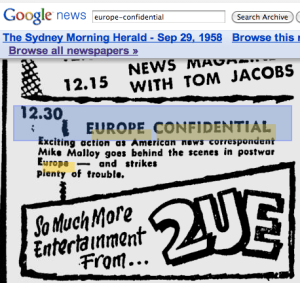
Radio ad, Australia 1958; in later weeks, they spelled Mike Connoy’s name right Click image for example.
A search of Proquest Historical Newspapers files for The New York Times, The Washington Post and The Baltimore Sun finds no references to “Europe Confidential” or “The World’s Greatest Mysteries,” which presumably would show up in daily or weekly radio program schedules. Perhaps Towers and Ziv only sold the series in Europe, Canada and Australia, not the U.S. The program does appear in 1957 and 1958 radio listings in Google-archived international papers like The Sydney Morning Herald, The Saskatoon Star-Phoenix and The Bulletin & Scots Pictorial (Glasgow). (Its run on CFCQ Saskatoon lasted a year, judging by the Star-Phoenix radio schedule listings. It was first heard at 9:30 Monday nights, shifting to 7:30 after a few months. By May 1958 its time slot had been taken over by “Radio Novels.”)
While perhaps not up to the production standards of Towers’ collaborations with Orson Welles — “The Lives of Harry Lime” and “The Black Museum” — “Europe Confidential” does meet my main criterion of featuring a newspaper reporter as the main character, and is a fine example of using a journalist as a narrative framing device to tell all kinds of stories.
Back to the episode at hand: Some of the public’s — or Hollywood’s — preconceptions about newspaper reporters show through in “The Blackmailed Spy Affair,” including competition between newspapermen. Connoy, in a World War II flashback, recalls having a commanding officer who in civilian life had been a reporter for a rival newspaper — one Connoy had beaten to an important story. The former reporter not only has put that life behind him for a military career, he has risen to the rank of general, while Connoy is still a private.
“As a soldier, your just about the worst I have in my army. The trouble with you newspaper guys — you don’t know the meaning of discipline,” the general says. But he has a special assignment for Connoy, more suited to his special talents: A spy mission.
The British spy who prepares Connoy for the field sums up those talents, perhaps the ones that make Connoy a good reporter, or at least in the world of novels, movies and radio shows in need of a leading man:
“We’ve borrowed you from your people because of your special qualifications: languages, looks, a certain celebrated aptitude for the opposite sex, and a fair share of unmitigated gall, plus a knowledge of Europe and some of the people you’ll be meeting.” — spymaster to reporter
Later, when Connoy tells a mysterious woman that this spy business does remind him of the newspaper game, she responds with another reason he was well-suited to the mission: He’s expendable. The idea of being someone on the margins, working outside of government channels, gathering information with a combination of street-smarts and trickery, sometimes disguised or taking personal risks, and making plenty of mistakes — it all certainly fits for a lot of fictional journalists, if not the real-world variety.
Mike has even flirted with the edges of the underworld. “How’s the opium racket?” he asks an old acquaintance.
“You newspaper guys are all the same,” he replies. “Just when a man thinks you’re a real pal, you start the old snoop. What are you after?”
In this case he’s after a kidnapped girl, and (remember, this is a wartime spy story) he’s willing to put a couple of bullets in a Nazi guard to convince him to disclose her location.
Add a little more anti-hero spice, shakier ethics and some zither music, and the character does sound a bit like Orson Welles’ trench-coated character in “The Third Man” and 1951’s “The Lives of Harry Lime,” an episode of which was recycled into this “Europe Confidential” script. Its title was “The Third Woman,” with much of the dialogue used verbatim minus the newspaperman references. Lime, of course, is not a reporter. He’s a confidence man and black-marketeer, but not without his charm, and he shares most of the skills the spymaster attributed to Connoy. In fact, that paragraph is almost word-for-word from “The Third Woman.” The one addition: The last phrase about “knowledge” was added for the reporter. Another interesting detail in the rewrite: At a key point in the story, it takes the naive and usually under-funded reporter Connoy a moment to figure out he has to bribe someone for information; Harry Lime does it in the blink of an eye.
I’m going to keep listening and digging into the background of this program. A “Europe Confidential” item will be added to the “World” menu above when I’ve found enough to tell more of the story.
The full-length 1937 film “Storm in a Teacup” is available from the Internet Archive, with Rex Harrison as a crusading young journalist and Vivien Leigh as the beautiful daughter of the smalltown dictator he crusades against.
The 1948 Ford Theater radio adaptation shifts the scene from Scotland to the U.S. and trims the story to fit the hour-long format, but still tells it entertainingly.
Can the right newspaperman get a seemingly heartless politician to change his ways? Along with the upstart journalist’s speaking truth to power, it helps that the official has a beloved daughter to help him find his heart.
The 1937 film audience may have left the theater chuckling at the comedy’s happy ending and wishing Hitler had such a daughter — along with more opposition from a free press. In fact, as the Ford Theater host tells us, the story began as a play in pre-Hitler Germany. Its British adaptation — play and film — took a decidedly “United Kingdom” theme, minus only a Welsh component: The story is set in Scotland, amid bagpipes and kilts, with a gentlemanly English journalist coming to the aid of an outspoken Irish street peddler.
The Irishwoman maintains her brogue, blarney and bluster in the 1948 American radio version, and — appropriately enough — operates a newsstand. The postwar U.S. radio audience may have had a new perspective on the references to tyranny, but the “power of the press” theme is still strong.
As in the original, the ambitious and authoritarian municipal executive has a beautiful daughter, who becomes the dashing reporter’s romantic interest. (In the 1937 film she is just back from finishing school; in the radio play, she is just back from helping with European war relief.)
The radioplay by Ford Theater maintains the journalist’s crusading speeches and his dedication to telling the true story about the arrogant politician, although it will surely cost him his job.
Pre “Gone with the Wind” Vivian Leigh and pre “My Fair Lady” Rex Harrison are a hard act to follow, and the movie set in Scotland is full of lovely accents and scenes, but the radio adaptation also has its charms, including its portrayal of a smalltown pol trying to manipulate the media in smalltown ways, from attempting to literally dictate a story to a reporter to a more direct modification of his image:
“Do something about that picture. Tell the printer or whoever it is put a little more hair on my head.” — Mayor Gow
Journalists will note the newspaper offices in both versions are small, quaint places where a new member of the staff can slip a controversial story onto the front page while the boss is out of town. In both versions, the reporter stands by his story — half editorial though it may be — despite the threat to his continued employment at any paper.
As the title suggests, the story is hardly man-bites-dog news, but it does provide a good example of both a politician and a reporter getting stubborn about a matter of principle.
In a spirit of opinionated, progressive journalism, the reporter also edges into a rabble-rousing advocacy campaign, but he also sees through the “helpfulness” of an interest group that come to his aid in order to publicize its own cause. Both topics could make for a good discussion in a classroom full of student journalists and bloggers.
Finally, both versions maintain a 20th century optimism about both journalism and politics: Yes, an idealistic reporter can make a difference. And he might even get the girl.
The star of the radio adaptation was one of the best-known voices in radio, hall of fame member Les Tremayne, who also played Nick Charles on “The Thin Man” and another gentleman detective known as “The Falcon.” Tremayne crossed over into the real-news world as an announcer for Drew Pearson’s news program, and as a cast member for the hybrid news/soap-opera, “Wendy Warren and the News.” Elsewhere in the cast, radio fans and watchers of 1950s television may recognize the voices of Jackson Beck, announcer of the Superman radio series, and Honeymooner Art Carney. A cast list is given at the end of the program, without identifying all of the parts they played. See also David Goldin’s Ford Theater Page at RadioGoldinDex.
Both versions involve a suspicious newspaper reporter and a policeman, each investigating a serial strangler and speculating about the murderer’s psychology and motivation. Prepare for some great radio screams by the victims.
Radio City even hesitated to give the title of the play at the start of the broadcast, to avoid giving anything away.
Suspense, 1948, with well-known film stars Claude Rains and Vincent Price, set the story in the London fog.
Radio City Playhouse, 1949, as “Attraction 35,” moved the story to New York, with the less famous — but very skillful — radio actors John Larkin and Edwin Jerome.
The story also was adapted for television by Suspense and in 1957 by Alfred Hitchcock Presents (available via Hulu).
As DigitalDeli notes in its Radio City program guide, the radio versions are listed in some “old time radio” logs and MP3 collections as “Dr. Ottermole” instead of “Mr.” — apparently through an often-copied typographical error, perhaps inspired by other “Dr….” tales, such as “Dr. X” or “Dr. Clitterhouse.”
A third radio broadcast of “The Hands of Mr. Ottermole” preceded these two — on the Mollé Mystery Theatre in 1945 or 1946 (the date is given differently on collector websites), but it is not included in the Internet Archive collections that I tap for this site’s podcast. However, it is available from several online sources, including RadioEchoes.com, and on disk from Radio Spirits and OTRcat.
Collector David Goldin’s “RadioGoldIndex” gives the date as February 6, 1945, and says the broadcast was “A repeat broadcast of a story that ‘deserves to be ranked with the greatest classic mystery stories of all time.'” RadioEchoes and RadioSpirits give the Mollé broadcast date as 1946. Goldin identifies the cast as Arnold Moss, narrator, Bernard Lenrow as host “Geoffrey Barnes,” and Dan Seymour, announcer.
Half-way into this half-hour broadcast of The March of Time, February 3, 1938, we get to hear a newspaper reporter sign himself into a mental hospital as a patient — only to have trouble getting out.
Stories about New York’s colorful Mayor LaGuardia, a theatrical labor union conflict, and a Spanish Civil War crisis at sea are all visited before we get to the reporter in this typical multi-part episode of “The March of Time.”
The radio series began in 1931 — long before audio-tape — and had voice actors and sound effects specialists re-enact news events. It was certainly a more dramatic approach than having announcers read news stories, but listeners may have scratched their heads at actors — in English — delivering the translated speeches of foreign leaders.
(According to the Encyclopedia of American Journalism (p.292), theradio feature provided a “narrative template” for the “The March of Time” newsreels, four years later. However, models also may have come from several other newsreel companies. The closest many of today’s students have come to the “newsreel” experience is probably the newsreel parodied in the opening of “Citizen Kane.”)
Along with newsmakers, newspaper journalists also were portrayed in the radio series, which is what qualifies March of Time for inclusion in this collection of “Newspaper Heroes on the Air.” Script-writers created scenes and dialogue for the print reporter “characters” in the brief radio dramatizations. In this episode, you can skip ahead to the middle of the half-hour program for a four-minute portrayal of a newspaper reporter in the midst of what the announcer calls a “hot campaign against New York State’s lunacy commission.”
The story has echoes of Nellie Bly‘s “Ten Days in a Madhouse” adventure, which also had been dramatized for a radio historical series. This time, New York Journal-American reporter Allen Bernard has himself committed to a mental institution to write an expose.
Broadcast in the days before more polite terms for mental illness, the script has Bernard putting his plan to his editor this way:
“Why not go right up to the asylum and register myself as a nut?”
Perhaps the actual reporter’s sensitivity was greater in print — or increased when the hospital’s staff didn’t take him seriously, even after he “confessed” he was a sane newspaper reporter and petitioned to get himself released.
“Schizophrenia,” the doctor in the radioplay dramatically whispers to a colleague, before sending the reporter off for hydrotherapy and other treatments. Even after Bernard’s identity is confirmed, the doctors express their doubts:
“He may be a reporter all right, but I still say he’s crazy,” the head of the hospital concludes.
Did “The March of Time” or Time magazine over-dramatize the case? Did the reporter do the same in his newspaper story? Which storyteller dealt more in stereotypes, the reporter or the radio writer?
The script may be another step removed from Bernard’s report: Time magazine told the story in print under the headline “The Press: Crazy Carlin,” (The headline uses the name Bernard assumed while under-cover.)
In a much less colorful account, The New York Times covered Bernard’s testimony at a subsequent hearing, under the headline “‘Easy’ Commitment for Lunacy Told” (Feb 18, 1938, pg. 20). The Times reported that the only “treatment” Bernard said he received was “exercises in mopping and cleaning the hospital ward.”
According to the Times report, “He obtained his release two weeks later, and said when he tried to get out he was told he was dangerous and should not be permitted at liberty.”
When I get a chance, I may dig up the microfilm of Bernard’s original accounts to see how sensationally The Journal-American told the story. (The paper was Hearst’s New York flagship, but its archives are now at the University of Texas.)
The March of Time
Radio historian John Dunning (On the Air pp. 435-437) says that "like any good newspaper", the weekly program was criticized from both ends of the political spectrum:
It was damned left and right. Real newsmen condemned it for hamming up the news. Communists called it fascistic. William Randolph Hearst labeled it Communist propaganda and forbade mention of it in the pages of his newspapers. It was banned in Germany… It was accused of being pompous, pretentious, melodramatic, and bombastic. But it was never dull.
Working holidays Casey, Crime Photographer was a weekly fixture on CBS radio for a dozen years, 1943-55, and listeners probably felt they were dropping into the Blue Note Cafe along with the hero and his reporter friend Ann Williams — even on the holidays.
That included the Thanksgivings of 1947 and 1948, one of which is here for your after-dinner listening. It’s not the greatest half-hour in radio history, but it has a couple of good scenes for fans of old newspaper dramas. Family holiday or not, this 1947 “After Turkey, the Bill,” is about people who dine-out on Thanksgiving — dating couples, newspaper staff, restaurant workers, cops, and stick-up artists.
A couple in a restaurant open the story, talking about their problem romance, which builds a little tension; then the story shifts scene to Casey and Ann at the Blue Note — their regular bar — having dinner with their bartender pal Ethelbert, who has to work on the holiday.
When they try to convince him that their great act of friendship (dining with him) deserves a free meal, the hard-to-snooker Ethelbert points out that Casey and Ann are also working on Thanksgiving Day, with just enough time for dinner at their usual place.
Almost on cue, the editor calls with an assignment. It’s a seemingly routine filling station holdup. Casey launches into familiar reporter-editor grumbling, but they are really just pro-forma complaints. He’s on the job.
“For a run of the mill story like that we have to leave our dessert? Well, OK Bert, alright, goodbye… Why I have to stick to this newspaper racket, I don’t know… Just one of those inside-page fillers. Bert says news is light and we have to cover it…”
For a “family holiday” story, the episode features a rather dysfunctional family. It includes cousins accusing each other of a frame-up, and a girlfriend caught between them and a father who doesn’t want her to marry the one she thinks she loves most, criminal record or not. Before the story ends there are three suspects. And, of course, Casey sorts it all out, even pointing us toward a reasonably happy ending.
(That’s all I’m telling you. That’s why they call it “radio” — you have to listen for yourself.)
Well before we get to that happy ending, Casey and Ann visit the crime scene with one of their police friends, a scene with some of the banter and “We’re all in this together” camaraderie that appeared to be common between policemen and newspaper reporters in the 1940s — at least on radio.
Police sergeant: “Why don’t you two get jobs that won’t make you work on holidays?” Casey: “Why don’t you?” Ann: “You mean like Captain Logan?” Sergeant: “I’ve been thinking about it… for 25 years.”
Notes on other episodes Similarly, the 1948 Thanksgiving installment, “Holiday” has the photojournalist crime-fighter sacrificing part of his (and Ann’s) holiday celebration to help someone in trouble, solve a crime, get a story, and wish their bartender friend Ethelbert a Happy Thanksgiving. The real suspense is whether Casey will finally pay his October bar tab. (That episode is part of the sixth CD of the Internet Archive — Old Time Radio Researchers collection of Casey episodes, available only in six big “zipped” CD-length downloadable collections, not one of the “single episode” pages I use for embedding here.)
The 1946 and 1949 Thanksgiving week episodes also had the holiday’s name in the title, but copies aren’t present in the Old Time Radio Researchers’ Group collection at the Internet Archive for comparison. Researcher Joe Webb estimates that collectors have identified only 78 circulating recordings of Casey shows out of 431 broadcasts.
His 13-page “Casey, Crime Photographer — Random notes about the series” and many other documents are included with the OTRRG collection at the Internet Archive, along with two “Casey” films from the 1940s, pulp magazine covers, and several comic books.
MP3 collections also are available online from other sources, including Radio Mick Danger (although I couldn’t get his copy of “Holiday” to download tonight) and on CD from OTR Cat: Casey, Crime Photographer
While Casey was more crime-solver than storyteller, the dialogue and the annual repetition of this “must work holidays” theme did emphasize that fact of daily newspaper life. See last year’s Christmas items for more on this theme.
The long-running “Yours Truly, Johnny Dollar” series put the Hartford-based insurance investigator on the case of a newspaper reporter friend in a 1956 broadcast. Called “The Big Scoop Matter,” it has a couple of common newspaper-drama themes: a reporter with a failed marriage, and a risky news assignment that puts his life in danger.
Or is the real threat to his life the $100,000 insurance policy payable to his estranged wife?
Dollar, “the man with the action-packed expense account,” goes to New York to offer his services as a bodyguard after hearing from the insurance company that his old friend has been beaten up once and that someone tried to run him down. He finds his friend in a bar, another frequent newspaper-drama scene, but the friend refuses to take on a bodyguard because he might scare away informants.
“It’s hot and big, real big,” reporter Art Wesley says of his story, “a national gambling syndicate and run by a guy here in New York.”
Wesley says his “real insurance” is a safe deposit box holding the syndicate boss’s name until he gets his last facts in order and can expose the crook in print. Later, he calls Dollar to announce a breakthrough.
“Tonight could be the jackpot… I can take care of myself,” are his last words.
I don’t know if Art Wesley appeared in any earlier Johnny Dollar episodes. The Internet Archive’s collection from the Old Time Radio Researchers’ Group has scores of episodes available for download, but “The Big Scoop Matter” is the only one I’ve heard with a reporter. The series ran for 13 years and was one of the last radio dramas to sink beneath the waves of television. It kept going until 1962 and is one of the series I remember listening to as a kid. Coincidentally, years later I wound up working as a reporter in Hartford.
(I never wound up with a high-powered insurance investigator as a friend — or a $100,000 insurance policy — and I generally stayed away from dangerous stories.)
Two recent journalism school grads, Betty and Henry Beetle Hough, that’s who. Their adventure is explored in this week’s radio program, “Once More the Thunderer.”
Some context: My “Portrayal of the journalist in popular culture” students are watching “Teacher’s Pet” this week, a film that takes an interesting twist on the contrast between a tough almost-modern city editor (Clark Gable) and a legendary country editor, the venerated father of the perky journalism instructor played by Doris Day. (Yes, it’s a variation on the newspaper-as-battle-of-the-sexes theme, with an academic twist.)
That father figure is clearly based on William Allen White of Emporia, Kansas, famous for half a century as a voice from the nation’s heartland. His life was dramatized for radio (see the link in the previous sentence), and got at least a tip of the hat in Will Rogers Jr.’s radio series, Rogers of the Gazette.
Today’s “Once More the Thunderer” program offers another small Gazette for comparison — especially timely for students who want to hear more on a “weekly newspaper” or “alternative press” theme after watching both “Teacher’s Pet” from 1958 (where the country weekly is described as old-fashioned, no matter how good its editorials) and “Between the Lines” from 1977 (in which a scrappy counter-culture weekly is being sold to a yuppie businessman more interested in profit than public service).
This radio drama is also a fresh look at a “newspaper couple” for students to compare with the troubled relationships in “Between the Lines,” “Teacher’s Pet,” “His Girl Friday,” “Front Page Woman,” “Up Close and Personal,” “The Paper” and many other screen and radio tales, not to mention the many incarnations of Clark Kent and Lois Lane.
Laraine Day and Franchot Tone play Betty and Henry Beetle Hough, co-editors of the Vineyard Gazette on Martha’s Vineyard island, “one of the most frequently quoted of country weeklies,” in this true-story episode of DuPont’s Cavalcade of America, an always-upbeat (but not always this good) docu-drama series about inspiring Americans.
While the radio production is based on a 1950 book, the Houghs attitudes toward covering their small community should be interesting for 21st century online entrepreneurs exploring “hyperlocal journalism.” (They also should see Hough’s 1974 autobiography, “Country Editor.”)
Both the radio play and the original book echo much lore of the press, including the anecdote that puts “The Thunderer” in the title, and explore common themes in the portrayal of smalltown journalists. Some examples:
A lecture to a young reporter on the “facts of life of a country newspaper,” how giving someone a gold watch can be an important story.
An exercise in journalistic ethics and integrity, when a local woman asks the Houghs to suppress a story.
Evidence of courage and commitment to public service — with a heavy dose of Yankee gumption — when a hurricane hits the island.
Some pressroom lore, complete with brand names.
The equal-partnership romance of a couple moving off to a small town to run a country weekly. (None of that “His Girl Friday” nonsense here!)
As the woman who wanted the story suppressed eventually concludes, “I’m sorry I said the Gazette was ‘a little paper.’ I think that I’ve learned it’s a pretty big paper.”
Some background: The Houghs met at the Columbia Journalism School. Henry’s father — also a publisher — bought the Vineyard Gazette from its retiring owner and gave it to the couple as a wedding president in 1920. Elizabeth died in 1965; Henry sold the paper three years later, but remained active and lived to be 88. Read more in this 1984 AdWeek profile and interview, published a year before his death.
When I first read the Gazette, it was in another couple’s hands. James “Scotty” Reston, two-time Pulitzer winner at the New York Times, and his wife, Sally, bought the paper in 1968. Reston also wrote a memorial column when Henry Beetle Hough died in 1985. (Curious students can retrieve the full text by searching for the headline in the Proquest Historical Newspapers database at the library.)
Despite the modern website and a move to modern computer typesettng, the Gazette’s print edition back in Edgartown still looks something like the Hough’s version, as the website mentions: “The Gazette has kept its distinctive publication format – an oversized black-and-white broadsheet measuring 17.5 by 23 inches with seven columns of type.”
Format isn’t the only tradition the paper upholds. According to its website:
In 2011, the Gazette received a record-setting 27 awards from the New England Newspaper and Press Association, including one for general excellence, the top prize for small newspapers. The judges called the Gazette “an outstanding, fascinating weekly newspaper” with “superb newspaper writing.”
— note: This item has been updated and edited a few times since the original posting,
adding links, movie comparisons, and real-world background information
 Newspaper Heroes on the Air