A Christmas story – Superman versus the Nielsen racket

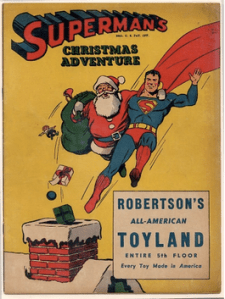
Superman and Santa on a promotional comic from 1940

In the 1940s Superman did his part as a commercial spokesman at Christmas, while not-that-mild-mannered reporter Clark Kent fought crime on the radio.

December 1946 — The bad guy in this Superman story isn’t threatening the world, but he could cost Clark Kent his job, and right before Christmas too!
Yes, as the headline above suggests, the villain is a racketeer named Nielsen, but not to be confused with the outfit that introduced a new high-tech “audimeter” that year for rating the popularity of radio programs.

photo of audimeter 1946

The evil doer’s name may have been a coincidence, or a radio-writer’s in-joke — presumably flying well over the heads of the youthful listeners to Mutual Broadcasting System’s daily “Adventures of Superman” serial.

(The audio-player above, if visible in your browser, plays the second episode of nine, since the first wraps up a previous storyline; all nine episodes can be downloaded at the end of this page.)

As with many of the Superman radio stories, this one, “The Phony Housing Racket,” has “the power of the press” as hero, not just the super powers of a certain alien visitor. While Superman movies usually have the hero face super-villains who threaten the whole world, from 1940 to 1951 radio’s Superman tales usually were more down-to-earth narratives with social messages aimed at young listeners, and full of reminders that journalism was important.

Here, Clark Kent’s reporter identity is at the center of the action. So are his colleagues at The Daily Planet, especially editor Perry White. Kent’s costumed alter-ego is there for emergency rescues and key cliffhanger moments, but the action revolves around Kent as inquiring-reporter and his boss as a crusading — albeit stubborn, blustering and recklessly over-confident — editor-in-chief.

From episode two of the ten-part serial, White sets out to batter a gang of racketeers with daily headlines warning the public of a real-estate swindle. Kent even urges him to go slow on the expose until his own undercover reporting can identify the mastermind and alert the police. But White presses on. Instead of stopping the racketeers, the Daily Planet’s crusading page-one stories convince the gang leader to silence the paper and intimidate its competition. That turns out to be harder than they expected.

“We’ve thrown the book at Perry White, but he won’t scare. He’s one tough rooster,” a hoodlum tells his boss after a failed attempt to blow up the Planet — the newspaper, not the Earth.

In this two-week story arc, newspaper editor White declares war on racketeers who have been preying on the housing needs of returned World War II veterans. (Only we, the listeners, know that Kent is Superman and that the criminal boss is “square-jawed, immaculately groomed Brock Nielsen.”)

The crooks aren’t fooling around. Before police inspector Henderson tips Kent and White to the mystery of the housing swindles, the gang has already killed one police investigator and one suspicious military veteran. White still insists that racketeers are bluffing cowards. But after the first Planet story, they try telephone threats, then escalate to bombing, kidnapping and extortion.

“Did Nielsen mean death for the dauntless editor?” — cliffhanger ending of Dec. 19, 1946, episode four, as hoods blackjack the gray-haired Perry White in his driveway and carry him off.

Over the weeks of the 15-minute-a-day story, the radio audience got to hear White’s speeches about the paper’s duty to the public, and heard Kent weigh the ethical question of protecting consumers from swindlers versus continuing to risk White’s life.

In a “journalism procedural,” we hear Kent interview a swindled veteran, visit a county clerk’s office to check property records, do some forensic investigating at the scene of Perry White’s kidnapping, and logically deduce that a Daily Planet security guard was framed to cover up the attempted bombing. No super-powers are involved in any of this, just good reporting skills: intelligence, curiosity and powers of observation.

OK, so Kent also goes beyond the average journalism textbook and strays into hard-boiled private-eye territory, like many other dramatic portrayals of reporters, including radio’s “Big Town” and “Casey, Crime Photographer.” In the Christmas Eve episode, Kent tracks down a fake real estate salesman with the help of the whistleblower vet, forces the salesman’s car off the road, disarms him and gives him the third degree before turning him over to the police, narrowing in on the big boss. With White’s life hanging in the balance, Mr. Nielsen gets a more extreme form of Superman third-degree, a bit startling in what was, after all, a children’s show.

The action — and the social messages of “power of the press,” good citizenship, honesty and equal rights — build just in time for Christmas Day and an unabashedly religious message from Superman. Even the hoodlums get second thoughts about what they are doing, with the studio organ softly playing hymns and carols while they reminisce about childhood days when they went to church with their families.

“I bet you robbed the collection plate…” says one.
“Yeah, but not on Christmas Day,” his crony replies.

The story ran from Dec. 16 to 27, 1946, overlapping slightly with two other racket-busting stories, which are also available for downloading on page 11 of the Internet Archive’s extensive collection of old-time radio Superman episodes.

Note: This is the latest in a series of posts and pages about the Adventures of Superman serial and its journalist characters, not all of which are mentioned on the Clark and Lois overview page. Incidentally, an early episode of The Phony Housing Racket mentions that Lois is off “in California.” Perhaps “Lois Lane takes vacation!” should be the real headline of this story.

Another clarifier for infrequent Superman radio listeners: Perry White has an unusual cook named Poco, who speaks only in rhyme. While many radio shows used ethnic-accented houseboys and minority-stereotyped characters for comic relief, Superman had a running post-war anti-Fascist, equal-rights and pro-refugee message, as you will hear in Superman’s Christmas-Day speech in this episode. Poco was strange and comic, but non-ethnic. Like Superman himself, he was a refugee from another planet, which had been destroyed in an earlier episode.

For more discussion of Superman radio show episodes, see the Superman Home Page radio section and the Wikipedia Superman radio page.

The Phony Housing Racket episodes at the Internet Archive can be downloaded from these links or streamed or downloaded with other stories from the archive page. Each program is a little over 3 MB in MP3 format, about 15 minutes of audio including the original cereal-company commercials and promotions.

(Files are listed as date “yrmoda,” overall episode number, and name)…

  1. 461216-1443 The Phony Housing Racket Pt 01
  2. 461217-1444 The Phony Housing Racket Pt 02
  3. 461218-1445 The Phony Housing Racket Pt 03
  4. 461219-1446 The Phony Housing Racket Pt 04
  5. 461220-1447 The Phony Housing Racket Pt 05
  6. 461223-1448 The Phony Housing Racket Pt 06
  7. 461224-1449 The Phony Housing Racket Pt 07
  8. 461225-1450 The Phony Housing Racket Pt 08
  9. 461226-1451 The Phony Housing Racket Pt 09
  10. 461227-1452 The Phony Housing Racket Pt 10; Phony Restaurant Racket Pt 1
Posted in 1940s, adventure, Clark Kent, comics, editors, Jimmy Olsen, journalism, newspaper crusades, newspapers, Perry White, reporting, Superman, World War II | Leave a comment

It Happened More Than One Night — on radio

by Bob Stepno

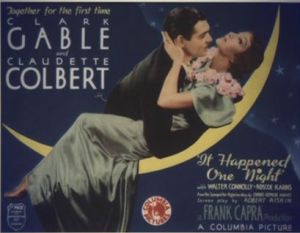
The poster and the movie handled romance differently

Even the movie itself handled romance differently than the advertising; on screen and radio, this well-dressed embrace was left to the audience’s imagination.

“It’s a Wonderful Life” had no newspaper characters to give me an excuse to include the seasonal favorite here, so I’ll make a holiday present of another Frank Capra classic: It Happened One Night appeared on the silver screen in 1934, swept the Academy Awards, then showed up at least two more times on radio. Here’s the first radio replay of “It Happened One Night.”That was March 20, 1939 — Clark Gable apparently took a night off from making “Gone With the Wind” to be a newspaper reporter again — presenting a live on-stage re-creation of “It Happened One Night” with several members of the original cast. It was that week’s episode of the Lux Radio Theater, with its regular host, producer Cecil B. DeMille, tipping his hat to Capra’s creation.

The live audience must have had a great time watching stars Gable, Claudette Colbert, Walter Connolly and Roscoe Karns on stage re-enacting their original roles (as the reporter, the heiress, her father and an annoying travel companion, respectively).

“Told to the tune of a roaring bus motor, it’s the fast-moving story of a runaway society girl and the reporter who helped her run,” the announcer explains.

The “fast moving” was true. The Lux crew and script-writer George Wells fitted introductions, some soap-selling, a brief interview with an actual long-distance bus driver, and brief bios of the two main stars into a 55-minute broadcast adaptation of the already fast-paced 105-minute Hollywood film. (Radio archivist J. David Goldin provides cast and crew information at his RadioGoldIndex.com)
It’s one of at least 50 “newspaper movies” that were adapted for radio broadcast during the golden years of both Hollywood and radio drama.
Continuing with my theory that radio portrayals presented newspaper reporters as more positive characters than they sometimes appeared in the movies, the Lux production version of Gable’s reporter Peter Warne isn’t the stereotypical boasting drunk you may remember from the film.
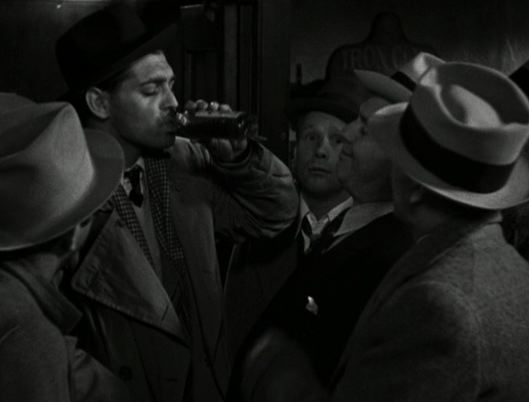
When we first see him in the movie he’s in a phone booth surrounded by other inebriated gentlemen of the press with a bottle in his hand, trading insults with his editor by long distance, collect. Long after the editor has fired him and hung up, Warne continues a monologue pretending to quit his job, then get’s a hero’s escort to his Greyhound “chariot” to leave town — after another snort with the guys.

One for the road with newsroom pals...

Radio’s reporter Peter Warne (still played by Clark Gable) appeared a bit more sober; on screen, he had ‘one for the road’ with boozy newsroom cronies…


At Lux, the reporter’s story is somewhat cleaned up — he’s not fired for being a drunk, but simply for missing the story of the runaway heiress. His boasting about being the paper’s best reporter doesn’t sound as much like false bravado without the bottle, slurred speech and gaggle of drunken reporters. We go straight into the scenes of the road-wise reporter taking charge of bratty runaway Ellie Andrews, then negotiating the right to tell her story in exchange for his assistance getting from Florida to New York.
Of course they still fall in love.

Another hero of the newspaper industry is added to the plot as a radio storytelling device: An unnamed newsboy Warne interrogates to get a summary of the runaway-heiress story between buses. The boy clearly has read enough headlines and leads to fill the role of 1930s equivalent of a blogger, delivering a snappy summary of the bored-little-rich-girl bio. Warne jokes about not buying a paper, then gives the boy a healthy tip.

Along with skipping the phone-booth-and-bottle scene, other visual gags in the movie get converted to dialogue, including the “Walls of Jericho” hanging of a blanket to add some propriety to the couple’s shared tourist cabin, his lesson in donut dunking, and their shared attempt to hitchhike — without the visual of Miss Colbert’s stockinged leg as an improvement over Mr. Gable’s thumb.

Gable/Warne even sounds a bit like a newspaperman waxing poetic when he’s composing descriptions of himself as a whippoorwill singing in the night, or verbally diagramming the blanket-hanging process with clothesline from nail A to B and it’s woolen barrier between her ” bed x” and his “bed y.” He also makes two references to things he should “write a book” about. (The donut-dunking and hitch-hiking.)

As a journalist, Warne demonstrates some of the profession’s ethical gray areas often presented by Hollywood. He’s a smart aleck, a fast talker and a master of deception, convincing detectives that he and Ellie are a squabbling married couple and convincing the fast-talking Karnes that he’s a kidnapper with a couple of machine guns in his bag.

But his bad-boy image and the hitching scene must have been fun for the radio audience, judging by the audible chuckles.

“I’m going to write a book about it, call it ‘The Hitchhiker’s Hail.'”– Peter Warne

When Ellie’s come-hither look stops a car, she convinces the driver to take Peter along, even though the driver says he doesn’t like his looks, some dialogue added for the radio version.

“He’s my uncle, he can’t help looking like that,” says Colbert’s Ellie. “He used to be a newspaperman.”

For some reason, they get the ride.
On the radio or on screen, Lux’s 1939 production of “It Happened One Night” is still a good trip. As a bonus, the Internet Archive’s Lux collection for 1939 also has a live rehearsal recording, minus the audience reactions, but enhanced by a gender-bending all-male reading of a “Lux your undies after every wearing” commercial.

It Happened Again
If you haven’t had enough, and don’t mind a less likable newspaper hero, try a somewhat different production of “It Happened One Night,” from Orson Welles’ Campbell’s Playhouse, the successor to his Mercury Theatre of the Air of “War of the Worlds” fame. The program was originally broadcast January 28, 1940.

The Lux and Campbell’s scriptwriters made different choices of what to include and how to compensate for the lack of sight-gags.

Welles, on the eve of his movie role as millionaire newspaperman Charlie Kane, cast himself in Walter Connolly’s role as the millionaire father of the runaway bride. The reporter, his name inexplicably changed from Peter Warne to Peter Grant, was played by guest star William Powell. The heiress is Miriam Hopkins, who gets to play the escape-from-father’s-yacht scene that was edited from the Lux version. The return of the yacht also gives Welles another exuberant scene as her father, although I wonder whether the sponsor appreciated the reference to her throwing a bowl of soup at a steward.
“The Thin Man” star Powell had plenty of experience playing gentlemen under the influence, and the drunks-in-phone-booth alcoholic reporters scene is back in this version, along with a stereotypical Southern black accented bus depot porter that May sound offensive today.
In resigning, this version of Peter says he’s quitting the newspaper business all together. He reconsiders only after finding out that Ellie is a story. But his ambivalent attitude toward journalism is hinted at when Ellie asks what he does for a living. His response is: “Nothing, if I can help it…. Whatever is the least work.” Later, he adds to his independent man-of-the-road philosophy, “Life’s all right if you don’t try too hard.” He doesn’t mention writing books, even about hitch-hiking technique or donut-dunking.
In the end, producer Welles gets a big scene as father of the ambivalent bride, encouraging her switch from the aviator she had eloped with to the sometime-newsman she met on the bus.
In this version, Peter’s editor still thinks he’s a “drunken bum.” And Peter only seems interested in writing “the biggest story of the year” to get enough money to marry Ellie. Until the deal falls through, he tells his editor he just needs to cover the wedding expenses “until I can find something to do.”
It’s too bad Welles didn’t decide to expand the part of Peter’s editor and deliver a “Charlie Kane” soliloquy about the significance of tabloid stories about the idle rich. But comparing the two versions is still fun.

For more about “Frank Capra and the Image of the Journalist in American Film,” see USC professor Joe Saltzman’s 2002 book by that title and my growing page of links about other Capra-newsies in radio adaptations. The book’s forword, by media historian Loren Ghiglione, former dean of the Medill School of Journalism, is online at Saltzman’s Image of the Journalist in Popular Culture project.

Inevitable Capra Christmas Bonus
Finally, if two Capra-adaptations of a non-Christmas movie didn’t set the proper holiday mood, the Internet Archive does have Lux’s production of his “It’s a Wonderful Life,” despite its lack of journalist characters. You’ll find it on the Internet Archive’s Lux page for 1947.

Posted in 1930s, 1940s, adaptations, Capra, comedy, reporters, romance, stereotypes | Leave a comment

A dark “Christmas Holiday” on radio

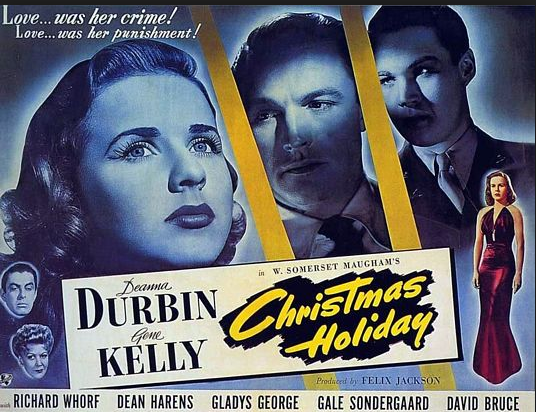
poster-ChristmasHoliday

Despite the title, “Christmas Holiday” is no Santa-and-sleighbells yule feature, but a “film noir” drama with a newspaper reporter as a pivotal character: He starts out on the shady side, does a couple of favors for the lead characters, and gets almost-heroic when facing a gunman.

Of the many ways journalists are used in radio dramas, this reporter isn’t the star and doesn’t tell the story. Instead, he’s an outsider, a catalyst who moves things along in key scenes at the beginning, middle and end. That’s an almost realistic job description.

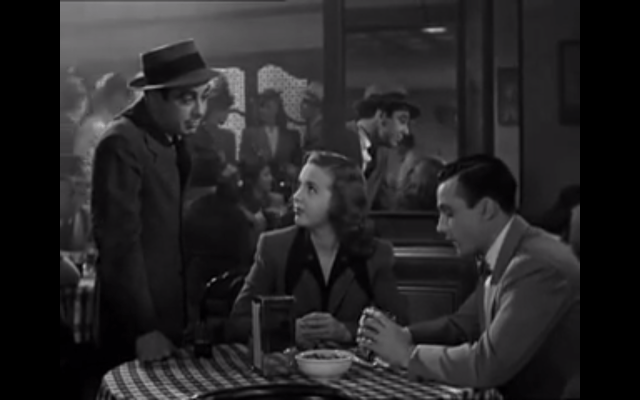
The story is about a soldier on leave, stuck in New Orleans for a day, a girl with a troubled past, and her husband — the source of the trouble. The movie version is memorable for casting two of the three leads “against type”: Gene Kelly, without dancing a step or singing a note, played a convicted-murderer; former teenage sweetheart Deanna Durbin, as his wife, filled a much darker role than usual, although she still got to sing a bit. The third star was the lesser-known Dean Harens, as the just-commissioned Army lieutenant.

In the story’s 1944 movie incarnation, reporter Simon Fenimore was played by Richard Whorf, just before adding directing and producing to his resume. He directed 10 films and episodes of 33 television series, but made only a half dozen more appearances as an actor after “Christmas Holiday.”

Unfortunately, the hour-long radio episode’s version of the role wasn’t big enough for the producers of Lux Radio Theatre’s Christmas Holiday to identify the actor among the cast of its Sept. 17, 1945, broadcast. But more about that later.

Neither Kelly nor Durbin appear in the radio adaptation — although mentions of Durbin in a soap commercial during the show might make one wonder whether she was originally expected to be part of the cast. Harens was also absent.

Lux gave the three starring roles to Loretta Young, William Holden (as the lieutenant) and David Bruce as the at-first-charming murderer. While not as big a star as Young or Holden, Bruce is the only member of the original film cast heard in the radio version — he had a brief part in the movie’s opening scene, as one of the lieutenant’s Army buddies.

As the story unfolds, the young officers have just been commissioned and are on leave — when the lieutenant gets a “Dear John” letter from the woman he was headed to San Francisco to marry. He still boards his cross-country flight, apparently intending to confront her, but instead his plane gets stranded in New Orleans in a Christmas Eve storm.

At a hotel there, the cynical reporter is the first person he meets. Newsman Simon Fenimore is disappointed that there were no casualties in the emergency airplane landing. “I was afraid of that,” he says. But “no story” means he can head for the bar, where he winds up drinking enough to be slurring his words before he again runs into the lieutenant, who doesn’t want a drink, but is willing to talk a bit. The reporter orders another double. The unidentified radio actor playing the increasingly intoxicated reporter delivers his inebriated lines well.

This reporter role is obviously a stereotypical one that Hollywood offered for years — a drunk who has connections with some of the shadier people in town. Fenimore even moonlights as, he says, “public relations counsel — press agent” for a “charming little place” that employs a lot of unescorted women in low-cut dresses.

Whorf, Durbin and Kelly, in the gambling-den flashback

“Just a newspaper reporter…” — Whorf, Durbin and Kelly, in the gambling-den flashback (frame capture from film)

A telling detail from a flashback later in the story: When the eventual murderer introduces the reporter to his sweet young fiancee, after taking her to a dive full of gamblers and bookmakers, her response is, “He isn’t really a friend of yours, is he?”

His answer, “Just a newspaper reporter I happen to know.” That’s the kind of impression the reporter makes. But he’s good with words. He excuses himself, saying, “Got a lot of good stories to write. Fire of mysterious origin… bad boy meets good girl… damage estimated at $3,000.”

In the radio version, when the lieutenant observes that the reporter is “pretty tight,” the young woman, who has gotten to know the newsman over the years, replies: “Not for him. He’s been drinking himself into the gutter for a long time. They’re running out of gutters now.”

But alcohol apparently taps the reporter’s Good Samaritan streak. He takes the stranded soldier to see a resourceful businesswoman — a nightclub operator of the Maison la Fête, who might be able to find emergency out-of-town transportation.

“Simon has a heart as big as all outdoors…” the proprietor says. “He likes to help people, if I can do it.”

Even she can’t help with train tickets on Christmas Eve. However the reporter also suggests she introduce the soldier to the nightclub’s star singer. (Of course broadcast-into-the-living-room radio does not characterize the establishment as a brothel or the singer as a “fallen woman.” The motion picture version could at least show women in low-cut dresses waiting for male customers. The original novel, by W. Somerset Maugham, is more specific.)

Just before the good-hearted reporter passes out, he suggests that the lieutenant take the singer to Christmas’s Eve midnight mass at the cathedral. They go, and she dissolves in tears, then tells him her life story. The reporter’s role is all of this has been subtle. The flashbacks only hint that even in his alcoholic haze he has great insight into what both the woman and the young soldier need.

She apparently needs to stop carrying a torch for her bad-boy husband, serving life for murder, and she needs to shed a guilt complex over not managing to reform him in the six whole months they were married. Meanwhile, the angry soldier needs to cancel his plans to fly west and confront his unfaithful fiancee, which might lead to his doing something he will regret.

Like the movie, the radio episode is told mostly in two-year flashbacks. The action takes place in one evening, but we learn about the husband’s domineering mother, the couple’s brief marriage, the gambling habit that led him to murder and robbery. And now his Christmas Eve escape from prison — after which he immediately seeks out his old friend the reporter, then brings him along when he goes off to confront the wife he assumes has been unfaithful. After all, his formerly pure and sweet bride has been working in that “party house” with a French name since he went to jail.

Robert Siodmak directed the 1944 film. Former Chicago Tribune newspaperman Herman J. Mankiewicz wrote the screenplay; newspaper-film fans don’t need reminding that he was co-author of “Citizen Kane” a few years earlier. Sanford Barnett adapted the story for radio and Fred MacKaye directed the show, according to radio historian J. David Goldin.

On the big screen, “Christmas Holiday” had some cinematic advantages over the radio version, despite Lux Present’s Hollywood’s star-quality cast and high production values. Just seeing how young and innocent Deanna Durbin looks as the “nightclub” singer, despite her shady work situation, helps establish her character. The club’s shadiness is accented by the plunging necklines of women sitting alone until their hostess passes notes directing them to particular male customers — all transactions conducted silently. The combination eventually makes it clear that the young singer has been degrading herself by working in such a place, because of guilt feelings induced by her strange mother-in-law. On radio, dialogue has to tell the same story — and in half the time of a feature film.

The movie is also clearer about the street-wise reporter’s role in the final dramatic scene — a showdown with the escaped murderer-husband.

In the rapid-fire dialogue, punctuated by gunshots, radio listeners might think it’s the soldier who saves the day. But it’s the tough-guy (and finally sober) reporter — who tells the gunman, “You’re not going to kill anybody here… You’re not going to shoot me because you’ll have to wait until I turn my back on you, and I’m not going to turn my back on you, see….”

In the film, he also talks the gunman into a visible position, and gives the nod to a uniformed policeman outside the window.

Neither the film nor the radio script follow Simon back to the newsroom to write-up a story about all of this. The drama isn’t about him — as is usually the case with reporters.

———————————

Who played the reporter?

Old-time-radio collector J. David Goldin lists cast members for the Lux episode, some of whom “doubled” in additional roles, but he does not say which one played the reporter. His RadioGoldIndex.com gives the cast as: Loretta Young, David Bruce, William Holden, Charles Seel, Ed Rand (doubles), Norman Field (doubles), Colleen Collins, Gerald Mohr, Billy Roy, Ed Emerson (doubles), Noreen Gammill, Anne Stone, Devona Doxie and Toby Williams.

Does that mean Charles Seel played the reporter? If someone with an ear for actors’ voices can identify the player, please add a comment here.

Coincidentally, the “coming events” announcement at the end of the program mentions that actress Gail Sondergaard will be among the stars of the next week’s episode. She did not appear in the Lux production of “Christmas Holiday,” but she co-starred as the killer’s manipulative mother in the original film.

Changes in the radio adaptation:
The singer is from Vermont in the movie, but from Maine on the radio.
The soldier’s name is Charles Mason in the novel and movie, but Jerry Mason on the radio. He has a friend named Jerry in the opening scene of the film — played by David Bruce, who shifts to the killer’s role in the radio version.

The (family values) radio version goes to great lengths to emphasize that the lieutenant and the singer do not sleep together. The chivalrous lieutenant fibs to her, saying his plane is leaving, gives her his hotel room, then goes off to sleep “at the athletic club.” (In the movie, it was easier to show their polite separation in a two-room hotel suite, where she could insist on sleeping on the couch, giving him the bedroom all to himself.)

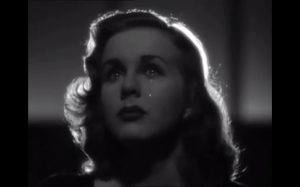
A single tear in the moonlight

The End

The radio version adds an extended scene at the end of the story, replacing some lovely cinematography in the movie. Radio had its great techniques, too, but it just couldn’t shine a light in a starlet’s eyes and have a constellation-filled Christmas night sky break through the storm clouds the way a classic black-and-white Hollywood film could.

Other sources:

Posted in 1940s, adaptations, crime, holidays, movies, reporters | Leave a comment

Warming up with June Bride

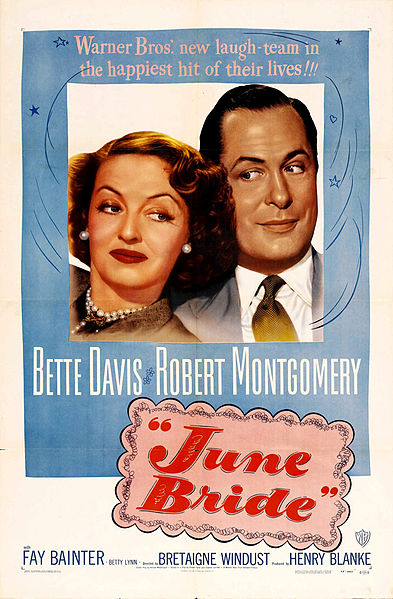
Davis and Montgomery, looking askance at each other on the movie poster
Here two radio adaptations of a snow-flaky romantic comedy called “June Bride,” about a magazine team trying to get a wedding feature written in a midwestern winter so that it will be set in type to greet spring readers. The complication: The magazine editor and her star reporter were once a romantic couple. The trailer for the movie said it: “Turns a one-ring ceremony into a three-ring circus.”

June Bride, the film, starred Bette Davis and Robert Montgomery in 1948. Its success reportedly made Davis the highest paid actress in Hollywood — and presumably had something to do with Lux Radio Theatre’s decision to adapt the Hollywood tale as an hour-long radio drama the next year, and then do it again just three years later.

The plot and its questions:

  • Reporter Carey Jackson has been fired from his foreign correspondent job — and reassigned to write “Home Life in America” features for his former girlfriend, Home Life magazine’s editor Linda Gilman.
  • Can he be happy writing family-wedding features from Indiana instead of uncovering big news in Berlin?
  • Can he stifle his inclination to find “an angle” that makes the wedding story a case of tabloid chaos?
  • Can she forgive him for panicking at the prospect of marrying an ambitious female editor and walking out on her three years earlier?

In some ways it’s a flipside of “His Girl Friday,” but with the woman editorially on top. In the three years since her reporter-beau left town, she has become a strong and practical executive, more interested in her career than marriage to anyone — especially not marriage to an adventure-seeking foreign correspondent.

“I’d wake up some morning and find you were in Afghanistan,” she tells him, back when that was a place name synonymous with locations least likely to be visited by American reporters.

For today’s journalism students, along with arguments over mid-century stereotypes and the “female-editor-authority-figure vs. irresponsible male reporter” theme, the story might launch good discussions of differences in the “news values” of a scandal-mongering reporter and the expectations of a “service feature” magazine.

Both the magazine’s treatment of the planned wedding and the reporter’s search for a news angle have elements of manipulation worth talking about — from the editor’s staging a “June” wedding in the winter and sawing the family couch in half for the benefit of the magazine’s photographers, to the reporter’s idea of orchestrating a romantic triangle to make the story less than routine. (Even he has second thoughts about that idea.)

And then there’s the possibility of another romantic triangle that might resolve the editor-reporter romance.

If nothing else, students may be amused — or aghast — at the story’s cuteness and its treatment of gender roles in mid-20th century. They may learn something about apple cider. And a discussion of what has and hasn’t changed in 60 years could fill a chilly winter-semester classroom. (I’m also curious whether younger listeners who don’t know their “Golden Age of Hollywood” stars will prefer the 1948 or 1953 versions.)

Other sources:

YouTube usually has a few clips from the film, and sometimes a trailer. Here’s a scene where the inquiring reporter is put in his place: “Uncle Henry… We don’t talk about him…”

Posted in 1940s, 1950s, adaptations, comedy, editors, foreign correspondents, magazines, romance, women | Leave a comment

An honest newspaperwoman fights for a clean election

thumbnails from 1950s TV series

Guy Madison played Wild Bill Hickok on TV as well as radio

Juvenile listeners to the 1950s Adventures of Wild Bill Hickok radio series heard at least one or two episodes suggest that some Western heroes were journalists, not just gun-fighters.

And, while the program’s introduction sings the praises of “a few strong fearless men like Wild Bill Hickok” in bringing law and order to the frontier, the new hero in this episode is a woman.  The plot of this 1951 story (“Press for Justice“) focuses on a brave newspaper editor  and her spunky young son, putting up a fight for clean government.

“It’s the duty of a newspaper to tell people folks the truth… It’s sure time somebody told them,” the editor declares early in the story.

Editor “Mrs. Crawford” (her first name is never given) runs the Horizon City Banner with her son, Johnny, who delivers the paper around town and knows how to run proofs off the press.

As the story begins, the widow Crawford is carrying on the paper started by her late husband, a not uncommon theme in both adult and juvenile westerns — or in American newspaper history from colonial times. She has called in Wild Bill Hickok, a U.S. marshall, to supervise the town election, and has written a page-one editorial calling the current mayor a “gambler, gunman, a man devoid of every decent instinct.”

“The facts are all here. Read them, and then decide,” her editorial declares. The program’s young listeners don’t hear much about reporting in this story, but at least the paper claims to have facts along with its reform editorials.

The simplified “white hats vs. black hats” children’s adventure series had little or nothing to do with the historic Wild Bill Hickock (1837-1876), a gunfighter who served as marshal in several Kansas towns among his adventures, and was famously shot to death during a poker game in Deadwood in the Dakota Territories.

In this episode, as you might expect, the radio sound-effects soon include type being smashed and thrown on the floor by the corrupt mayor’s thugs, but (also as you might expect) Wild Bill and Jingles arrive just in time. They also show up later, when there is an attempt to burn down the printshop just as it finishes printing the election ballots.

The Internet Archive has six pages of episodes of the Adventures of Wild Bill Hickok series, which starred Guy Madison and Andy Devine as the marshall and his plump deputy.  The half-hour program was recorded in Hollywood radio studios during the run of stars’ 1951-1958 television show of the same name.

The “Press for Justice” episode was pointed out to me by another Old Time Radio fan on Twitter. From the episode titles, I don’t see many other hints at newspaper-centered story lines, although there is a communication-themed “Wires to the West” from 1954, with troublemakers trying to block the progress of the telegraph, and another a few weeks later called “The Missing Reporter.” I’ll give that a listen next…

Other information sources:

Posted in 1950s, 19th century, adventure, newspaper crusades, newspapers, political corruption, westerns | Leave a comment

History provides bad example for Gunsmoke newsies

Ned Buntline, dime-novelist

Ned Buntline served as a bad example for reporters on Gunsmoke

The six-gun adventures reported by 19th century writer Ned Buntline came up in conversation more than once in the 1952-1961 radio drama “Gunsmoke.” As an “adult” Western during the mature days of American radio drama, Gunsmoke distanced itself from the tall tales and romantic stereotypes of cereal-sponsored kids programs, Saturday matinee cowboy movies, and the pulp entertainments by Buntline and his ilk that preceded them.

One of the ways radio challenged those “Wild West” myths was to hold up storytellers like Buntline as a bad example and make snide remarks about his accounts of frontier heroes like Jim Bridger and Wyatt Earp, which audiences once accepted as a form of journalism, then as legend. Gunsmoke’s writers did not put Buntline himself into a story, but settled for stand-ins, fictional newspaper scribes from the East appearing as myth-makers and scandal-mongers. (This will be the first of four blog posts about them.)
In this “Sunday Supplement” episode from June 24, 1956, Sheriff Matt Dillon, played by gravel-voiced radio star William Conrad, faces two “dude” correspondents from an unnamed New York paper. Along with arriving in a fancy surrey — presumably a bit like driving up in a Mercedes today — they make the mistake of mentioning Ned Buntline (E.Z.C. Judson) and his tales of “mountain man” and scout Jim Bridger.

The Dodge City marshal says he actually knew Bridger, and that Buntline’s stories were lies that made Bridger look foolish. (Gunsmoke script writer John Meston did his research. A recent Bridger biography says Judson, “got enough adventures out of Bridger that winter of 1860-61 to keep him writing the rest of his life,”  p. 295, Jim Bridger, J.Cecil Alter, University of Oklahoma Press, 2013).

Despite the marshal’s misgivings, his friend Miss Kitty, co-owner of the local saloon, welcomes the reporters in hopes of some free publicity that might bring visitors to Dodge City. Dillon seems happy that he has to leave town for a week anyway, which means he won’t have to deal with the reporters. However, he returns just in time to get seriously bad news: Settlers and cavalry have been attacked by formerly peaceful Indians.

You can hear the whole story at the link above, but if you are in a hurry, here’s a summary: It turns out that the reporters desecrated an Indian grave, setting off a chain of bloody massacres. Whether the newsmen expected that outcome or not, their response to the carnage is a cynical observation that it is “about time” they saw some action. Their insensitivity is in human.

As the plot unfolds, the reporters not only take an artifact from a grave, they lie about it, attempt to implicate a soldier, and finally make racist “now he’s a ‘good Indian'” comments about the chief who sought revenge and was killed by the cavalry as a result.

Marshal Dillon says he regrets that he can’t hang the Easterners for anything they have done — and wishes he could turn them over to the chief whose burying ground they desecrated. But the chief is dead, and all Dillon can do is punch the more offensive of the two reporters — the one who made the “good Indian” remark — and run them out of town.

Group portrait in Western costumes

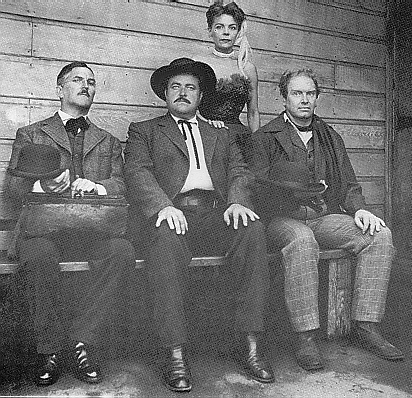
Gunsmoke’s cast: Howard McNear (Doc), William Conrad (Matt), Georgia Ellis (Kitty) and Parley Baer (Chester)

Footnote: Ironically, John Dehner, who played the hero journalist of the series “Frontier Gentleman,” appears in this episode of  “Gunsmoke,” but he is no hero here. Cast as the quieter of the two reporters, at least he doesn’t say anything that gets him punched by Marshal Dillon.

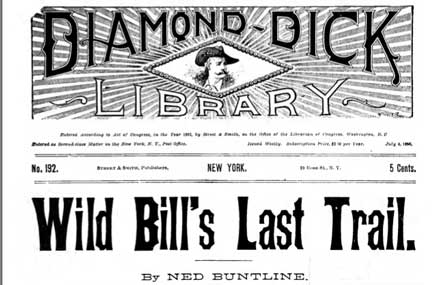
Finally, if you’re curious about Ned Buntline, the Internet Archive, which I use for my audio samples, also has a scanned copy of an original dime-novel, “Wild Bill’s Last Trail.”

Wild Bill's Last Trail, cover

A Buntline story, 1892


(OK, cheap story publications at the turn of the century were called “dime novels,” but this one was only 5 cents, as the cover clearly shows — and today it’s yours for free at the Internet Archive.)

Posted in 1950s, 19th century, adventure | Tagged | Leave a comment

Newspaper in the radio family living room

In the 1940s, the newspaper habit was hard to break, as demonstrated in the “Seventeen Days” video of readers lining up to buy daily papers off the loading docks during a New York delivery strike, and New York’s mayor reading the comics on the radio.

Classic radio comedies like “Vic and Sade,” “Easy Aces” and “The Couple Next Door” also reflected the prominent place of the newspaper in American homes during the Golden Age of Radio, although the stories themselves were rarely about newspaper reporters. Radio was the era’s “new medium,” but families still subscribed to a morning newspaper, an evening newspaper, or both — and that daily habit showed up in radio’s “domestic comedy” series — not just in the crime and adventure shows punctuated by shouts of “Extra! Extra!”
Today’s example is a 1944 episode of one of the most popular programs of its day, the brilliantly quirky and subtle “Vic and Sade.” Stories often began with the couple at home reading their respective sections of the newspaper aloud to one another, no matter what else was going on.

Both Vic’s inevitably interrupted dramatic readings from the evening paper and Sade’s devotion to a newspaper-serialized love story appear in this episode, titled “Miss Keller’s Wedding Ring,” broadcast on Sept. 15, 1944. (That title appears on the script in a collection of a dozen published on the Web by the Generic Radio Workshop. Vic & Sade expert Jimbo calls the story “Sade Helps With a Ring” in a blog post that also includes a link to an better-quality copy of the audio file than the one I’ve used at the Internet Archive.) From the script:

ED: Well sir, the evening meal has been over only a little while as our scene opens now and here in the living room of the small house halfway up on the next block we find Mr. & Mrs. Victor Gook. Our friends are seated on the davenport with sections of the newspaper and the master of the menage seems to have come upon an article of interest for he is reading aloud with briskness and enjoyment, listen.

VIC: Multiple co-efficients of modern business procedure. Mr. O’Slooner also touched on the variance in imponderables connected with the mercantile conduct in general. Thinking men in this day and age, he said, may be likened to the merchants of ancient times to whom miscellaneous tenants of humanitarianism and occult perceptive considerations were in direct relation……

SADE: Oh ish Vic ….. Let me read my own trash here.

VIC: What trash is that?

SADE: A little daily love story.

VIC: You would prefer to occupy your mind with childish and trivial …

SADE: Yes, and anyway I heard the kitchen door open. Is that you, Russell?

RUSS: Hi Mom. (muffled) Somebody’s here.

VIC: Mr. Curtis O’Slooner says, whose words I was quotin’ formerly taught mathematics in college.

SADE: Did he?

RUSS: We’re going to have company.

VIC: Seems to me as long as a man of his intellectual caliber is willing to surrender the fruit of his rich thoughts in a newspaper article the least we can do…

As was standard practice, Vic and Sade’s conversation was interrupted repeatedly by the arrival of their son, Russ, and Uncle Fletcher, each with his own attempt to break into the conversation, but Vic was steadfast about his newspaper.

VIC: Curtis O. Slooten of course never says anything with nonsense. He’s just a poor half-wit. Poor old Curtis O Slooten….

SADE: Oh, ish Vic. Where is Uncle Fletcher?

RUSS: He’ll be right along. He paused out in the alley a minute to speak to Mr. Razerscum.

SADE: Mr. Razerscum’s in Peoria.

RUSS: Oh, I mean Mr. Kneesoffer. …

VIC: Say, here’s something you can understand. ‘Human ingenuity, Mr. O’Skooner, went on to say, is merely…’

SADE: I don’t want to understand that craziness. Vic, read it to yourself.

VIC: Craziness she calls it.

SADE: What do I care about human ingenuity and trash.

VIC: Trash. Trash she says.

FLETCH: Hello

SADE: Here we are.

RUSS: Hi….

SADE: You’re not going to hold that newspaper up in front of your face and read while we got company, I don’t suppose.

VIC: I have a paragraph to finish.

SADE: Put your newspaper down.

VIC: I’ll put this newspaper down after I have finished this paragraph.

SADE: Who was it who used the word childish a minute ago? What great big man said somebody was childish and made some…

For further discussion of this episode and others, see the Comedy topic page here.


If the Seinfeld-like strangeness of “Vic & Sade” is tempting, the prolific blogger and Vic & Sade expert who goes by the handle “Jimbo” is the author of these resources:

http://vicandsade.blogspot.com/ (Note the more than 50 links in the left column, headed “Crazy Stuff”)
http://vsresearchnotebook.blogspot.com/
http://vscharacters.blogspot.com/ (More than 750 characters mentioned by the name-dropping Gooks and their friends)
Jimbo discusses earlier Vic and Sade chroniclers in his Tribute to ‘Friends of Vic and Sade’

Posted in 1940s, comedy, newspaper readers, newspapers, readers | 1 Comment

Newspaper stories behind a September Song


Knickerbocker Holiday (Theater Guild on the Air, Dec. 1945).
The hit song remained, but the “journalist” character disappeared in the radio adaptation of the musical “Knickerbocker Holiday” — one of many films that were presented in radio versions. The radio version actually is closer to the script of the original 1938 play by Maxwell Anderson, with no newspapers or journalists in the plot.
In fact, Anderson himself had been a newspaperman, but both the stage musical and radio version are true to the story’s historical setting in 1647, when a town crier’s trumpet and “Oyez” or “Hear ye, hear ye…” were as close as things got to “Extra! Extra!”

“No news by land. No news by sea. Absolutely no news whatsoever.” — Town crier
“That’s what he thinks. I’ll give him news to report… even if I have to make the news up, it’ll be there.” — Washington Irving

Some watchdog-press issues are central to the “Knickerbocker Holiday.” Its scene-setting narration is about the task of writing historical fiction, voiced by early American author Washington Irving. His 1809 book, Knickerbocker’s History of New York, is  the inspiration for the play. In that book, Irving even mentioned the lack of newspapers in 17th century New Amsterdam.

However, a 1944 film adaptation made the romantic young troublemaker in the plot, Brom Broeck, into a journalist. Played on screen by Nelson Eddy, he was a “crusading newspaper publisher,” according to Turner Classic Movies. “Printer and pamphleteer” might be a more accurate description, since newspaper publishing didn’t come to New York until the 1700s.

In this radio version, David Brooks plays Broeck as simply a man willing to speak truth about the powerful — pointing out hanging-offenses committed by the New Amsterdam Council members. And he’s willing to go to jail over his right to free speech, as well as suffer for his inability to take orders from anyone. In the end, his philosophy is, “Let’s keep the government small and funny.”

Those leading-man troublemaker qualities sound enough like a journalist to suggest where the screenplay authors got the idea — and to include the broadcast here.

However, although he plays the tyrannical Governor Peter Stuyvesant, not the troublemaker, Walter Huston gets the star billing and steals the show, singing the musical’s biggest hit — “September Song.” (The mature old governor offers the “It’s a long, long way from May to December…” song to persuade a much younger girlfriend of Brom Broeck to share Stuyvesant’s “vintage years.” He loses that battle, but gets another chorus later — to another girl — for a happy ending all around, with the help of some deus-ex-machinations by Washington Irving.)

Connections and Coincidences

Huston, incidentally, was married to a newspaperwoman, Rhea Gore Huston, mother of director and actor John Huston. Rhea was a reporter for the sensational 1920s tabloid, the New York Evening Graphic, as was her son, if only briefly. Rhea also helped mentor a young Graphic reporter named Samuel Fuller, according to his autobiography. Fuller went on to write a novel (The Dark Page) and screenplays (Power of the Press) about newspapers, and to direct the classic newspaper movies “Park Row” and “Shock Corridor.”

Coincidentally, the original Brom Broeck when “Knickerbocker Holiday” opened — at Hartford’s Bushnell Memorial, then on Broadway — was played by actor (and later producer) Richard Kollmar, who later married a second-generation journalist named Dorothy Kilgallen. Among their other on-air activities, the couple hosted the popular radio morning show, “Breakfast with Dorothy and Dick.”

Revivals

The original play was revived briefly in 1971 and was presented as recently as 2011 in concert form (preserved on CD by the Collegiate Chorale). See the Playbill article, with photos of the original 1938 principals and another with more discussion.

Posted in 1940s, adaptations, free speech, historical figures, movies, New York City, tabloids | Leave a comment

Radio propaganda about Russia, Iran, 1953

“I came here for Uncle Joe’s funeral, but I’m also here to learn about the new boy…” — Douglas of The World

The release of more CIA records concerning the coup that re-installed the Shah of Iran in 1953 inspired me to do some editing on a 2011 item about the series Douglas of the World, and to add a new episode of that series today.
Produced by Armed Forces Radio, “Douglas of the World” told the adventures of a fictional foreign correspondent for an American newspaper, landing him in world trouble spots — and in personal trouble — from Teheran and Istanbul to Oslo and Moscow.

If anything about the series turns up in the CIA papers, I’ll thoroughly rewrite the Douglas-in-Iran item as a more complete essay. For now, I’ve just added a few links and corrected some spelling, plus this new post.

For today’s listening, here’s how Douglas “covered” the death of Stalin with a personal style that included casually sexist remarks and snarky banter with his Soviet handlers. Borrowing heavily from Hollywood portrayals of Russian women going back to Ninotchka in 1939 and from the current attitude of radio tough guys in general, the smart-aleck American calls his female escort “kid,” “lover,” “honey” and “legs,” praises her “good-looking gams,” and attempts to hold hands at the theater.

As for professional relations, Douglas sarcastically calls his  Soviet journalist escort “Flash” and “Scoop” and finally “Comrade Flash” when he is asked to use “Comrade Editor” as a form of address. More to the point, Douglas’ visit to Pravda gives him an opportunity to remind the listeners of the differences between American and Soviet newspapers of 1953.

The editor gets so flustered that the woman handler has to remind him that he was about to tell Douglas about the greatness of the state newspaper Pravda, always a butt of American jokes. The Russian doesn’t get much of a chance to sing its praises before Douglas responds:

“Oh yeah, great… Great, all four pages of it… one page of news and three pages of fan mail to Malenkov, the new premier.

“Great little paper all right. Even if it doesn’t have any comics or columnists or cheesecake, you can’t overlook that it has three whole lines devoted to sports. Yeah, you’ve got a great little paper here.” — Brad Douglas, on Pravda

(Today’s readers may need reminding that healthy, advertising-supported twentieth century American newspapers sometimes ran to more than a hundred pages, not counting advertising supplements full of coupons to clip.)

Back to the Moscow episode’s plot and the portrayal of journalists: That theatrical hand-holding is how Douglas makes contact with an apparent Soviet underground agent, in order to later relay information to a British spy. As the story unfolds, Douglas fits both the Soviet and popular-culture stereotypes of Western journalists as government agents or at least participants in foreign intrigue. The press’s independence from government influence is not something the Armed Forces Radio Service chose to emphasize, to whatever extent real impartiality survived Cold War communist-fighting.

But all is not as it seems, and before Douglas gets back to his office he winds up framed for murder, offered Soviet nuclear secrets,  knocked on the head more than once — and he leaves Moscow under Secret Police escort. That’s all in one half-hour program.

Written by John Vlahos and starring radio and TV actor Jack Moyles, “The Murder Rap” episode of Douglas of the World is one of only four stored at the Internet Archive from the short-run 1953 series.

Produced for broadcast to the American military overseas, it was both an entertainment series and a bit of sugar-coated current-events and policy indoctrination for the troops. Other than the patriotic speeches about how great American newspapers were, and the cloak-and-dagger spy story, there’s not much here about the practice of journalism. But maybe it inspired a few of the servicemen and women listening to apply some of their G.I. Bill education benefits to journalism school tuition, in hopes of a life of adventure.

The archived Digital Deli Too’s Douglas of the World page was the most comprehensive resource on the program I’ve seen, using files of the military newspaper Stars & Stripes to list 22 episodes of the six-month run that are not in the publicly shared digital archives or, as the old-time radio collectors say, “in circulation.”

Posted in 1950s, cold war, foreign correspondents, international, propaganda, reporters | Leave a comment

Newspaper audience hooked on comics

"The Spirit," 1946 newspaper comic

“The Spirit” comic, 1946 Chicago Sun newspaper

No journalist shows up to solve the 1944 “radio noir” mystery of “The Comic Strip Murders,” but the audio drama draws an over-the-top picture of dedicated newspaper readers, and the popularity of newspaper crime comics like “Dick Tracy” and “The Spirit.”Most of the story is told from the point of view of a district attorney interviewing the wife of a comic strip artist whose creation seems to be taking on a murderous life of its own. Is the artist going mad and planning to murder his wife in a decorative fish pond full of acid?

The “tense and frightened” wife says she has lived with the madness of increasingly gory comic strip murders for nine years — and that she expects to be killed at midnight:

“You follow Buzz O’Keefe in the Morning Telegraph, don’t you? Of course. Everybody does… one bloody episode after another… blood and pistol shots and poison and charred bones…”

Fortunately, Molle Mystery Theatre was not a continuing-serial-drama, so the whole story is told in one half-hour episode.

Color Sunday comics page

A full newspaper page of Dick Tracy, 1938

For our newspaper-in-popular-culture perspective, throughout the broadcast we hear obsessed comic strip fans discussing new episodes of the newspaper crime comic strip serial about a detective and sadistic killers.nThe radio actors use a variety of accents, highbrow and low, to suggest a strip as popular as “Dick Tracy,” and as full of grotesque characters.

The newspaper readers’ guilty-pleasure involvement wIth the strip is reminiscent of morning-after discussions of “The Sopranos,” “Dexter” or similar hit TV shows today.
(It also has some of the comic strip readers muttering about comics not being funny anymore, a topic that even turned up in serious academic research. See Hutchison, below.)

Were newspaper readers this involved with comics? Perhaps — remember 1945 was the year that the mayor of New York took to the air reading comics to citizens deprived of their papers during a delivery strike. A New York Daily News documentary captured his performance, as well as the passionate newspaper audience standing in long lines outside pressroom loading docks. Download the film at the Internet Archive or see three YouTube clips from it on my “Real Newspapers” page.

Back to Molle’s “Comic Strip Murders” episode, the broadcast even used the comic-strip theme in a commercial for its sponsor,  Molle shaving cream, having the presenter laugh heartily at a user of a competing brand nicking his face in a comic called “The Little Shaver.”

The audio file is part of a three-CD Old Time Radio Researchers Molle Mystery Theatre collection at the Internet Archive, with notes from Digital Deli Too.

While violence in comics is not the topic of “Newspaper Heroes on the Air,” here are a few links for readers who stumble on this page because of its title. For crossover research on comics and violence, see articles like “Male and female relations in the American comic strip” by G. Saenger, in D. M. White & R. H. Abel (Eds.), The funnies, an American idiom (pp. 219-231). Glencoe, NY: The Free Press (1963), and Bruce D. Hutchison’s “Comic Strip Violence, 1911-1966,” in Journalism Quarterly, Vol. 46, 1969, pp. 358-362. (The latter content analysis research said 100 per cent of newspaper strips were literally “comic” in 1911, with “serious” strips beginning in 1924 and becoming the most common  by the 1940s. What Hutchison called “crime and crime-cowboy strips” amounted to 18 percent of the comics during World War II.) Newspaper comic strips were a common topic for academic research in the 1950s and 1960s. See, for example, “Trends in Newspaper Reading: Comic Strips, 1949−54,” by Jack B. Haskins and Robert L. Jones, Journalism & Mass Communication Quarterly, 1955, 32: 422. 

For a more comic-book focused discussion during a 1950s controversy over violence in comics, see “Juvenile Delinquency: Crime Comics,” Congressional Digest, Vol. 33, Dec. 1954, p. 293ff. Dr. Frederic Wertham’s book, Seduction of the Innocent, was a major document about the controversy over violence and sex in comics.

Interest in the topic went international. The Internet Archive has full-text copies of the 1977 Canadian Royal Commission on Violence in the Communication Industry report, “Violence in Print and Music,” with an extensive bibliography.

How to Murder Your WIfe film poster from Wikipedia

A lighter approach…


For a more recent book-length treatment, see Why We Watch: The Attractions of Violent Entertainment, edited by Jeffrey Goldstein (1998), Oxford University Press.

Other recent studies include Henry Jenkins’ research into audiences, fan cultures and “transmedia” from comics and films to television and video games. For example see his book, Convergence Culture: Where Old and New Media Collide, New York University Press, 2006, or this 2011 course syllabus for “Comics and Graphic Storytelling.”

Movie-crossover fans might enjoy the lighter approach to a similar story, the comedy “How to Murder Your Wife,” with Jack Lemmon and Virna Lisi as the cartoonist and his suspicious wife, plus Terry Thomas as the cartoonist’s valet. I wonder how many times TV and films have explored the darker side of cartoonists?

I see “Martin Kane Private Eye” had a TV episode with a similar name: The Comic Strip Killer, but the plot twist was that the cartoonist based his strip on a true-crime story and promised to reveal the murderer’s identity… unless the killer got to the penman first. At this writing, YouTube has the full episode online:

Lee Tracy stars as the detective here, not a journalist playing detective, the way he did in the original “Dr. X” and other movies. Tracy was no stranger to fictional newspapers, having been the original Hildy Johnson on Broadway’s “The Front Page,” the Winchell-like gossip in “Blessed Event” and a reporter or editor in many other pictures.

Posted in 1940s, audiences, comics, newspapers, readers | Leave a comment