A note to newcomers, including journalism students visiting this month.
There are 10 major topics to this discussion of the portrayal of newspaper journalists in old time radio shows, and there are 75 subtopics, and hundreds of blog posts, which the most recent may not be the most interesting. Seeing the rest depends on your screen…
Two screen captures may help… full-screen browser or smartphone:
A full-screen web display of menus and categories
An Android view of this site.Menus are on top-left drop-down icon of three horizontal lines.
This site is done with WordPress software, which automatically provides a mobile phone version. That can be very handy, but also overemphasizes the most recent item posted, revealing WordPress’s roots as blogging software.
The 10-item main menu is horizontal at the top of the screen on a standard computer display, but it is just indicated by a small three horizontal line icon in the top left of the smartphone version of a web browser. Clicking that item sends the other 75 subtopics cascading down in a long list. On the big screen version, some of the subtopic lists are only one or two pages, while the “Real life” menu is substantial.
I will come back to say more about this program, but I think it is worth listening to as an example of a radio storytelling technique that uses a fictional magazine or newspaper reporter as a “wrapper” or frame to dramatize the story at hand.
In this case it is a profile of the American Negro Theater for a 1944 episode of the New York series, New World a-Coming.
The MP3 copy of this episode is at the internet archive in a collection of uploaded dramatic stories, possibly from a larger collection of fragmentary episodes from the late Jim Beshires, a founder of the Old Time Radio Researchers group, which set about trying to compile complete and near complete sets of radio series that had been circulating on radio collector tapes and as digital files in various internet forums.
This episode was uploaded to the Internet Archive as part of a collection titled “Great Stories, Great Storytellers Collection, Part Two” compiled by Larry Mauplin and Alan Litsey, 2024-01-21.
For their notes on this and 20 other stories, see the collection at the Internet Archive:
The regular “Aunt Jenny” at The Gazette is out of action, and Fibber McGee volunteers to replace the advice columnist for a day, with wife Molly as his secretary.
Old-time radio programs of all kinds worked newspapers and journalism into their plots now and then, including one of radio’s biggest hits, “Fibber McGee & Molly,” which ran for more than 20 years.
Searching more than 1,200 McGee titles and plot summaries for words like “columnist,” “reporter” and “editor” quickly turned up this 1950 episode, which includes a visit to a newspaper building, from newsroom to pressroom, complete with the roar of the presses punctuating the punchlines.
While there is no page one news in the half hour, we do visit the softer side of the oldtime daily paper; along with Aunt Jenny, we encounter the crossword editor, a local doctor doubling as medical columnist, and even the classified ads are good for a groan-producing joke.
McGee, although perhaps not the most reliable source, delivers an endorsement: “Newspapers are a great institution, Molly. Where would we be without ’em?” — while Molly reflects on the romance of the newsroom itself, over the clatter of typewriters:
“My, I just love a newspaper office, McGee, pencil shavings all over the floor… the smell of printer’s ink and old cigar butts…”
As I recall, series co-creator Don Quinn was married to a reporter, as well as having a famous talent for puns and wordplay, which this McGee episode is certainly full of… along with some reminders of 1950 culture, values, and a closet full of what the kids today call “Dad jokes.”
Prepare to wince for various reasons at a joke about a “cub” reporter, some old fashioned banter about a secretary sitting on the boss’s lap, one dated skin-color reference, and the ultimate use of the home-delivered newspaper as a wrapper for domestic detritus.
(Note to early readers: This entry in the blog was composed entirely with the WordPress Android app, and I’m happy to see that its MP3 player link works. If there are other problems, or if you have other newspaper related Fibber McGee episodes to recommend, add a comment below.)
John and Anna Zenger weren’t radio stars, but I’ve just found a third appearance for them… In an episode of the CBS series “You Are There.”
Feb. 06, 1949 “The Trial of John Peter Zenger”
It’s an entertaining “live news report,” as if the 1949 CBS radio news crew had been present to cover the Zenger libel trial in colonial New York in 1735. The radio reporters seem businesslike, one even rushing Anna Zenger through a more passionate part of her interview. (Perhaps they had to pretend that on-the-scene in 1735 they didn’t know then that an Associated Press executives’ novel would one day declare her the “Mother of Freedom” for her role in her husband’s newspaper and its stand for a free press.)
They CBS announcer almost routinely declares that Zenger’s chances are slim, according to “informed observers.” Later, CBS news reports with surprise when distinguished Philadelphia lawyer Andrew Hamilton is added to the case for the defense. “We didn’t recognize him because we’ve never seen him before,” the reporter apologizes, after the famous defense attorney’s identity is announced. (For a brief account of the trial, and Hamilton’s career, see The First Amendment Encyclopedia at Middle Tennessee State University.) Or just listen to the dramatization…
At the end, when the surprise verdict is announced, CBS newsman John Daly struggles to be heard over the voices of cheering spectators, but manages to get out the key detail that “The principle that truth can be used as a defense to a charge of libel is upheld.” As his voice fades, the You Are There announcer’s voiceover, with godlike echo, summarizes in 20-20 hindsight the even greater conclusion: “John Peter Zenger is acquitted, and the American colonies win a free press to spearhead their fight for independence.”
CBS staff, whose voices would have been familiar in 1949, play themselves in this radio-time-machine play, including Daly and Don Hollenbeck. Hollenbeck was also the host of CBS Views the Press, a pioneer radio effort in media criticism. His death by suicide was a subplot in the movie “Good Night and Good Luck,” and his life if the subject of a 2008 biography. (See “Remembering a Fallen Newsman,” 2008, New York Times.)
Previous radio plays about the Zengers included episodes of Hallmark Hall of Fame and Cavalcade of America. The Internet Archive includes a collection of 83 episodes of the You Are There radio program, broadcast 1947-50, reporting events from the death of Julius Caesar to . While all episodes feature events as they might have been covered by radio news, the Zenger case appears to be the only one in which a newspaper editor or reporter is the central feature of the story.
Ottmar Mergenthaler already had been the subject of a Cavalcade of America historical-biography radioplay in 1937, but here he is getting the Hallmark Hall of Fame treatment 16 years later… a story that includes a suspenseful beginning for anyone who doesn’t recognize his name. Perhaps in 1953 it was still familiar? (Certainly Hollywood star Lionel Barrymore, the narrator, was better known then.)
This starts as an “Everything must begin with a dream” romance-in-America immigrant drama, and then a man walks into the shop and explains how a newspaper — remember them? — was set in type, one letter at a time, a process little changed in the 400 years since Gutenberg spread the magic of movable type.
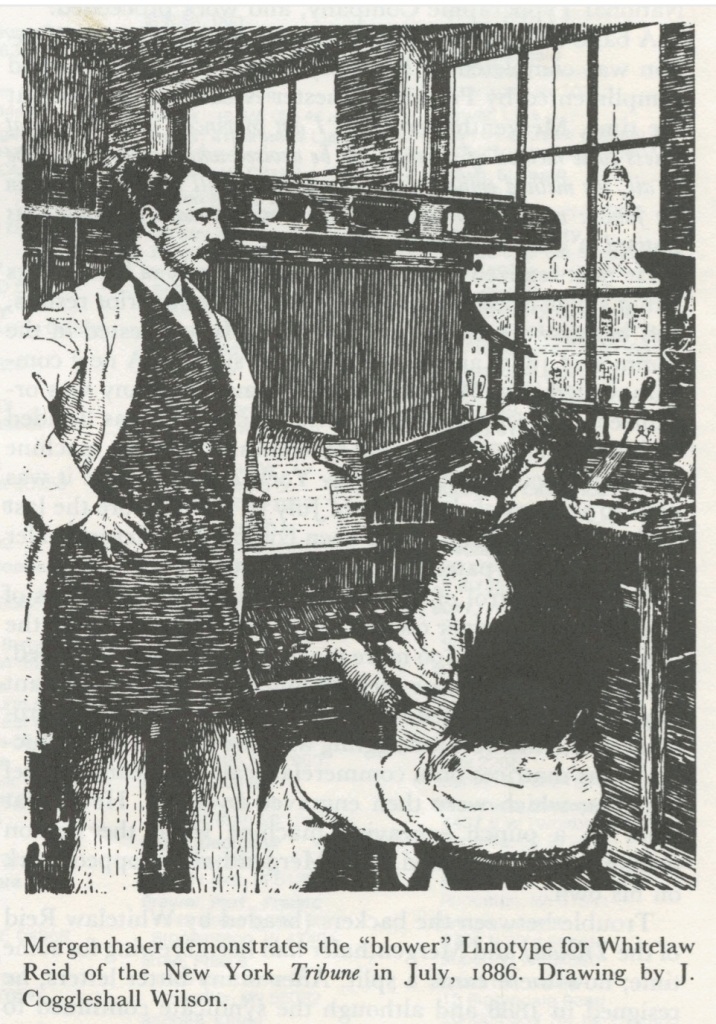
Mergenthaler, originally a watchmaker, went the next step… and his Linotype machines, full of cogs, levers, molten lead and matrices, fed news into the columns of daily newspapers — and more — for a century. Of course Hallmark Hall of Fame took liberties to compress his life and invention within its broadcast half hour. For more detail, see the PDF of the printing history newsletter linked beneath the illustration.
Personal perspective: My own byline was set in hot type for most of my first decade as a newspaper reporter. But then optical and digital “cold type” arrived — even before that American Printing History Association publication about the 1986 Linotype centennial — and Mergenthaler’s inventions became museum pieces.
Thanks to the collectors who save, restore, digitize and freely share radio recordings, and to the Internet Archive, which hosts them in such a way that I can link to them, and also to the programmers who make WordPress. They all make it possible for me to share my search for newspaper journalism related stories from the golden years of American radio broadcasting. If only Mergenthaler could see this system at work!
She’s a high-school-age Shirley Temple, but distracted by playboy artist Cary Grant.
It’s The Bachelor and the Bobby Soxer, the 1947 Hollywood hit adapted in 1949 for Lux Radio Theater, with two of its original stars. (Myrna Loy, as Shirley’s older sister, the judge, was replaced for the radioplay by Frances Robinson, a frequent Lux cast member.)
And it’s not much of a lesson in journalism… High School newspaper editor Shirley, smitten, but technically “interviewing” for a story, asks the famous artist (who just happens to look like Cary Grant) whether he’s ever been in love… and whether she’d make a good model.
“Goodbye Miss Winchell,” he says to the 17-year-old, invoking the name of the naion’s best-known gossip columnist, but she gets it into her head that he wants to paint her, and somehow gets into his apartment to wait for him…
The results are a bit 1949 predictable… and we probably will not get back to the newsroom.
This also begins to sound a little like the “A date with Judy” radio episode I listened to a few weeks ago. In that case, Charles Boyer was the teenage reporter’s interview subject… but although starstruck, she wasn’t as interested in romance.
Back to The Bachelor and the Bobby Soxer, as you can see in the trailer below, both Myrna Loy’s character and visual gags had bigger parts in the original movie.
Footnote: When she played that perky 17-year-old on radio, Shirley Temple was actually 21, married, a young mother, and about to get a divorce… She remarried and retired from show biz the next year, at 22. Eight years later she did some TV before going on to a political career: an unsuccessful run for Congress, followed by appointments to the U.N. and two ambassadorships. See more on the Shirley Temple Wikipedia page.
On D-Day, one of America’s most famous reporters, Front Page Farrell, was not involved in the war coverage at all… But, of course, Dave Farrell was fictional.
Still, his June 7, 1944, episode above has hints of America’s mood on the day the troops landed at Omaha Beach, even if the script was written far in advance, with no knowledge of the war developments.
I’ve heard very few episodes of “Front Page Farrell,” a daily soap opera about romantic couple David and Sally Farrell, and mentioned the program briefly in an overview page on journalist characters in soap operas. (Coincidentally, one of those earlier episodes, from 1942, was about the possibility of David leaving his job to go to war, and former-reporter Sally going back to newspaper work! I wish I knew how that “to be continued” story concluded, days or weeks later.)
Daytime soaps aren’t as widely available in digital archives as “prime time” evening comedies and dramatic series. But this June 7, 1944, episode is caught up in archived recordings of NBC’s coverage of the invasion day, D-Day, and D-plus-one, 2:50 a.m. Eastern War Time June 6 to 6:00 p.m. the next day… The 106 quarter-hour and half-hour recordings would make fascinating listening, with their 79th anniversary approaching.
In 1921, William Allen White writes an editorial when his 16-year-old daughter dies, not an obituary, and in 1954 Hallmark Hall of Fame uses his process of writing it to frame the story of her father, perhaps America’s most famous small town newspaper editor, on the tenth anniversary of his own death.
(Eventually I’ll incorporate this Hallmark broadcast into that page. For more radio dramas about historical journalists, see the menu item “Real-Life.”)
There’s really no journalism practiced in this episode of “A Date with Judy” from April 3, 1945, although the teenage heroine is going off to do a celebrity interview with actor Charles Boyer, in town for a wartime Red Cross benefit. Judy even mentions Boyer’s charm in the previous year’s hit with Ingrid Bergman and Angela Lansbury in Gaslight, photo at right. Her interview is hardly as dramatic, just a charming case-of-mistaken-identity, followed by an apologetic editorial, but it’s the only even loosely journalism-related episode of the series currently in
this Internet Archive collection.
More may be on the way, however. Radio collector J.David Goldin’s RadioGoldIndex online database of episodes, which may be in various not-online library collections, includes several possibilities, all fitting my theme about how important the daily newspaper was in American culture for most of the 20th century.
In one of the episodes Goldin mentions, in which “Judy has a ‘job’ with The Daily Chronicle, she’s a society editor,” was apparently broadcast in 1942 and again in 1945. Judy was “covering” her Aunt Lilly’s wedding. I doubt that journalistic conflict of interest is part of the plot. And then in 1944 Judy tried to get a job as assistant to the paper’s society editor. She apparently wound up getting a date with the handsome son of “the editor of the Daily Bugle” instead. (So it looks like Judy Foster and family lived in a two-daily-newspaper town, not uncommon in the 1940s.) Also in 1944, her brother was in the running to be editor-in-chief of the school newspaper, and a year later Judy was (briefly) editor of what was apparently a school literary magazine, “The Purple Flamingo.”
I haven’t heard any of these, but according to online discussions, the Old Time Radio Researchers Group (https://otrr.org) is preparing a new collection that will eventually be shared at the Internet Archive, so maybe some of Goldin’s old favorites will be included.
Meanwhile, the most significant “newspapers in popular culture” connections for the “A Date with Judy” series may be its author and producer. The creator of the character was a Pittsburgh Press columnist, Aleen Wetstein (1908-2010) who went from being secretary of the Association Against the Prohibition Amendment to writing a weekly column in the 1930s called “One Girl Chorus,” which Wikipedia says was “eventually adapted by Wetstein and Jerome Lawrence as a radio domestic comedy titled A Date with Judy, which she adapted and exploited across all entertainment forms possible at that time, including theatre, film, television, and comic books.” (Jane Powell was Judy and a 16-year-old Elizabeth Taylor was her best friend in the newspaper-free 1948 movie “A Date with Judy.”)
According to Wetstein’s L.A. Times obituary, <<“A Date With Judy” was originally conceived as a radio vehicle for her friend, actress Helen Mack, whose “crazy stage mother” kept pestering Leslie to write a show for Mack, Diane Leslie said. By the time the teen-angst comedy debuted on the radio in 1941, Mack was too old to star, but she directed episodes that Leslie wrote and produced.>>
The radio series producer was, in fact, Helen Mack, whose earlier acting career included the classic newspaper movie “His Girl Friday,” in which she played the memorable Mollie Molloy, “hooker with a heart of gold,” treated terribly by newspapermen. She was also the co-star of “King of the Newsboys” in 1938, but again not in a journalistic role. Her appearance in “His Girl Friday” was brief, but memorable, with Rosalind Russell as Hildy Johnson, her one friend in the courthouse newsroom:
Hildy Johnson : Come on, Molly. Let’s get outta here.
Molly Malloy : They ain’t human!
Hildy Johnson : I know, they’re newspapermen.
Molly Malloy : All they’ve been doin’ is lyin’! All they’ve been doin’ is rotten lies!
I hope “A Date with Judy” included a more positive newspaper role model for teen listeners, although society editors and editor’s sons may not be the most promising possibilities.
During the past month, “The Dusty Attic,” a classic-radio program of the Radio Talking Books Service offered a series of four hour-long programs on the same theme as “Newspaper Heroes on the Air,” exploring the role of newspapers in society and their depiction in audio dramas.
A special attraction: A comparison of two broadcasts inspired by the same real-life newspaper investigation that freed an innocent man from jail. One production was an “audition” for an eventual radio series, the other a dramatization of a classic Hollywood film based on the case, “Call Northside 777.”
The shows were hosted by researcher and collector Joe Webb, who has done extensive investigations of “The Big Story” and “Casey Crime Photographer,” among other series. The four-part series has been preserved on its own Internet Archive page as “Dusty Attic Newspapers.



 Newspaper Heroes on the Air