Fictional reporter Tom Farrell’s “Dispatch to New York” from the 13 colonies about their new draft Constitution.
Patrick Henry, Benjamin Franklin and Alexander Hamilton are among the news sources interviewed by a thorough, and presumably thoroughly fictional, newspaper reporter trying to get the backstory on the US Constitution before its signing in 1787.
While Tom Farrell is collecting opinions both for the Constitution (Franklin) and against it (Henry), he is hardly a “hands off” reporter. He threatens to drag one of the delegates to Constitution Hall to fight a boycott of the final vote by some members of the convention.
I will have to go back to some of my journalism history textbooks to see if there are any anecdotes about news coverage of the Constitutional Convention, and whether they’re actually was an attempt by some delegates to prevent having a quorum for the vote. If the Press at the time did play a role in forcing the matter to a vote, I like to think it was through editorial opinion, not by the means employed in this short broadcast, taking dramatic license to get the story told in less than 15 minutes.
The 1953 radio series The American Trail was sponsored by the Ladies Auxiliary to the Veterans of Foreign Wars. I’m listening to the collection of episodes below, to see if Farrell or other fictiona journalists are used as narrators to tell the story of America’s development westward. If I find any, I will add them here.
Back in 1939, The Green Hornet fought crime by tricking crooks into giving themselves away, but his radio series was also giving away snapshots of the lives of newspaper reporters.
The staff of The Daily Sentinel worked for Britt Reid, the newspaper publisher whose secret identity was The Green Hornet, his way to fight underhanded lawyers, officials and other crooks who previously could not be stopped by the law, news exposes or editorial crusades.
The August 1st 1939 episode, Bait for a Burglar, includes conversations between Reid, reporter Ed Lowery, news photographer Clicker Benny and police contacts. The press-police relationship portrayed may or may not have been typical of newspapers in the 1930s. It might be as out of date as the program’s description of a police officer apprehending a burglar by grabbing him by the collar, enough of a cartoon cliche to have long ago given us “collared” as a slang synonym for “arrested.”
In this story, the police are quite willing to give Lowery information off the record, because they trust The Daily Sentinel not to release it prematurely. Lowery still seems to find the situation very frustrating, but he is a man of his word, only telling his boss, not knowing that he is giving the Green Hornet vital information.
Even less trustworthy, ironically, is a former policeman on The Daily Sentinel staff, the radio show’s comic-relief Irish-accented Mike Axford, who at various times serves as a reporter or Reid’s bodyguard. Axford’s ego and tendency to gossip are used to spring one the Green Hornet’s traps for the crooks.
Other Hornet episodes are available by searching JHeroes for browsing the Hornet page on the Adventure tab of the main menu.
Note: This post’s first draft was done with the WordPress Jetpack application on my phone, which I have not been using very often. I wanted to see if I could get both the YouTube video and Internet Archive MP3 link working properly, without having to update from my main computer. It took a couple of tries to discover that there are separate “block entry” definitions for YouTube links and uploaded videos. So far so good.
Reporters weren’t a regular feature of Theater Five … but a project aimed updating the archived copies of this 1964-1965 ABC Radio series has me listening for newspapers and newsies.
I also listen for references to the “newspaper habit” — delivering, buying, daily reading… Those are all here.
This one is melodramatic… Mr. Sherman, the old man having a heart attack at the beginning, is a retired printer.
There’s another episode I’ve found, looking at the plot summaries… “Around the Corner from Nowhere,” with a sexist male photographer calling a woman reporter a “sob sister” at the start … I’ll get to it next.
He’s a bit heartbroken too, if that’s an excuse. The reporter returns at the end of the story, before the cameraman develops his film… sounds like it might be a single exposure from a film pack Speed Graphic. ‘Fast film, slow exposure,” he says.
So far from my cruising through the updated Theater Five collection, it’s clear that it was a well produced attempt to keep alive radio drama after most Network series had given up to the forces of rock and roll and top 40 radio format… and it also kept alive some stereotypes about newspaper reporters, cynical, sentimental, frequently found at the corner bar.
But it also reminds me that in the 1960s, daily newspapers were still quite alive, something that even the characters in the radio dramas picked up and read every day. In fact, in 1965, the year is to program broadcast, I got my start as a reporter on the college newspaper, and before the 1960s were over, I was going to have my first job at one of the papers in America, The Hartford Courant.
This isn’t about journalism’s “newspaper heroes,” but another convergence of America’s 20th century “newspaper culture” and that mass media upstart, radio broadcasting — and the more recent “collector culture” of old time radio on the internet. The crossover medium here is a radio show featuring the Hearst Corporation’s “Comic Weekly” color Sunday supplement… and maybe it even mentioned a newspaper reporter once in a while. It did suggest that listeners have the paper open while they listened, which isn’t practical today, but one oldtime radio collector tried to put a simulation on YouTube. Here’s a sample:
(The Wikipedia page about Hearst’s King Features Syndicate and Puck: The Comic Weekly includes a section about William Randolph Hearst’s personal involvement in creating the patriotic/historical series “Dick’s Adventures in Dreamland” — “a strip that made its debut on Sunday, January 12, 1947; written by former Daily News reporter Max Trell and illustrated by Neil O’Keefe.”)
Back when newspapers routinely carried dozens of color comic strips, and radio was a few decades into figuring out its role among “the mass media,” someone came up with the idea of having a dramatic reading of those newspaper comic strips on the air, a radio show titled “The Comic Weekly Man.” It ran only from 1947 to 1954. I came around about the same time, but I don’t remember listening to it as a child, even though I loved the Sunday comics, which were where I learned to read. (My mother and my grandmother did the comic-reading until I was ready to do it on my own.)
The “someone” who came up with the idea was presumably at Hearst, which syndicated the radio series as well as providing “Puck, The Comic Weekly” to members of its newspaper chain. Radio historian J. David Goldin’s RadioGoldin database of episode summaries at the University of Missouri, Kansas City, identifies the unnamed-on-air actor reading the funnies as Lon Clark, and speculates that “Little Miss Honey,” the girl to whom he read the comics, may have been played by actress Cecil Roy.
In the past 30 years or so, collectors of the “transcription discs” of those shows have taped, traded, bought, sold and digitized more than 100 episodes… Now you can download them for free at The Internet Archive, stream them at YouTube or buy from radio-archive retailers. Just search the Web for “Comic Weekly Man.”
One set of YouTube videos is among many multimedia projects by an Old Time Radio Researchers group member, blogger and podcaster, who went by the pseudonyms “James Mason” and “Jimbo,” and died a few years ago.
For this project, 13 years ago, he managed to unearth about 40 original comic strips that corresponded with Comic Weekly Man broadcasts, photograph them, and combine them with the radio show episodes. They are jumbled together with his other YouTube projects at https://www.youtube.com/@FanApart/videos, but I think the sample above is a fine starting place…
“Dick’s Adventures in Dreamland” was a comic strip whose young hero dreamed his way into adventures with historical figures. In this one he runs into some of his heroes from 1775. To get to the sequel, you might have to settle for the audio-only archives. But I think you know how the story turns out — until next week, at least.
Here’s an Old TIme Radio Researchers collection of 120 half-hour episodes of the radio show posted at YouTube — no comic strips to read along, but sometimes it’s fun to rest your eyes and just listen.
Back to video for another of Jimbo’s composites of Comic Weekly Man and an actual Comic Weekly, in which our friend “Dick’s Adventures” do turn him into something like a journalist — a courier delivering the Declaration of Independence to General Washington and a hostile audience of tories.
Time for some reorganizing. JHeroes hasn’t had a “Sports” heading on its main menu, but there have been at least a half-dozen posts and pages over the years with baseball, football and boxing themes. Here’s a list of the date-stamped blog “posts” I’ve tagged with the “sports” category name so far: https://jheroes.com/category/sports/ …
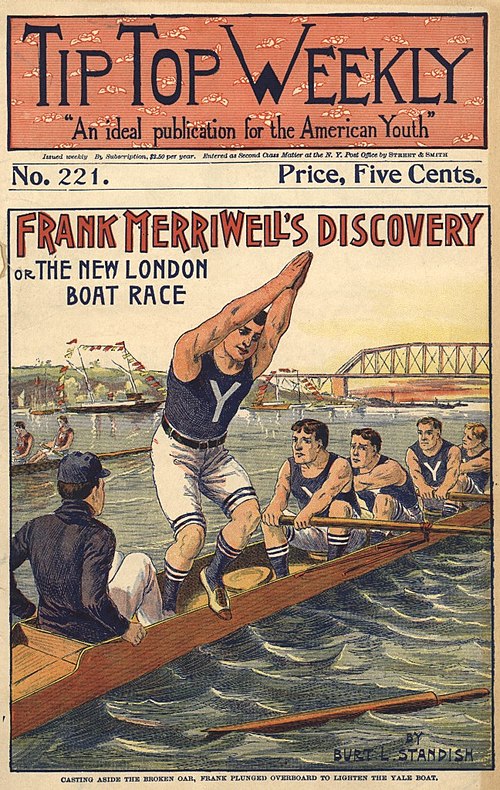
Fictional s ports hero Frank Merriwell made it from dime novels to radio.
Those include stories of general-assignment reporters like Clark Kent and Lois Lane and their editor Perry White getting involved with crimes or scandals involving local sports teams (including copyboy Jimmy Olsen’s youth teams), and Daily Sentinel sports reporters bringing the Green Hornet into a baseball-gambling story, and another episode involving a football player.
“Shorty Bell,” the young reporter played by Mickey Rooney in the short-lived series by that name, confronted a “Crooked Hero” from the boxing world. The world of college sports met college journalism in at least one episode of “The Halls of Ivy.” In that story, an Ivy College board member went after a student journalist who had inspired a campus football star to question his dedication to the sport.
Among radio’s other title-star journalist heroes, I suspect that Casey, Crime Photographer, the reporter-editor couple on Bright Star, or Randy Stone, columnist hero of Night Beat, and other fictional reporters on radio may have been involved with sports stories, but I haven’t found them yet. At least given the prominence of the sports pages in 20th century newspapers, it seems that should be the case. So far, searching RadioGoldIndex’sonline plot summaries for sports-related keywords have produced mixed results. One Casey, Crime Photographer result was intriguing, but probably not something to classify as a sports story: “A phony swami, guarded by a Senegalese boxer, claims to be able to contact the dead.”
Title and summary scans reveal a boxer and a rodeo star in the titles of “Bright Star” episodes, that Fred MacMurray’s reporter character once acted as a high school football coach, and that Irene Dunne as editor in chief once took over the sports page. There is also a development threat to a local ballpark. I’ll be listening, although my previous time spent with “Bright Star” left me exhausted by the sitcom sweetness of its 1950s’ “career-woman editor pursues oblivious employee” theme.
Columnist Randy Stone’s “Night Beat” with its late deadlines kept him away from afternoon sports events, but not from after-hours dramas involving a champion swimmer, a former football star pressured to kill someone, two brothers who compete as jockeys, and a prize fighter beaten up for refusing to take a dive.
I’ve already written about reporters as secondary characters in a couple of episodes of “The Adventures of Frank Merriwell,” a radio series based on dime novels and short stories about a (fictional) Yale sports hero. And when old-time radio went to the movies, it must have brought back more sports-journalism stories, although the Hepburn-and-Tracy classic “Woman of the Year” is the only one that comes to mind. In it, Spencer Tracy is a sportswriter and Katherine Hepburn, brilliant political columnist, needs to learn about baseball, among other things.
The one legendary real-life sportswriter on the “Real Life” menu-of-pages so far is Grantland Rice, mostly because someone turned his autobiography into a radio series. Could be others to add…
Note: This is a start… “Getting organized” is my summer 2025 theme. To be continued… and perhaps it will lead to the word “Sports” joining the main menu atop the home page. The menu is limited to one-word headings by the width of our current page template. If you haven’t noticed, some of those headings hide a lot — “Movies” and “Real-Life” in particular — both hold particularly long lists of sub-pages. Maybe I will expand the “Themes” heading and work “Sports” in there as a sub-page. Hmm. Any suggestions for other improvements in the menu, which appears as a drop-down on smart phones and across-the-top on larger screens? About | Adventures | Comedy | Detectives | Drama | Editors | Movies | Real-Life | Soaps | Themes |
I usually avoid “spoilers” in writing about radio drama, not wanting to discourage folks from listening to the archived original broadcasts. But I also have old-newspaperman guilt about “burying the lede” and wanted to write the headline above. So today’s audio player is the FINAL episode of a 15-part “Adventures of Superman” serial broadcast in February and March of 1947: “Knights of the White Carnation.”
Vincent Kirby, a powerful businessman and controlling-owner of one of the leading newspapers in Metropolis, is convicted of murder as leader of an American fascist organization. His arrest, trial and conviction take less than 10 broadcast minutes in that final episode, so that the series and get listeners started on its next multi-week cliffhanger storyline. Kirby and his cronies are “accused by the district attorney of murder, abduction, and conspiracy to spread race hatred and violence in the city schools.” The trial itself is not part of the broadcast, which jumps to the judge’s concluding speech:
“Vincent Kirby… You’ve heard the verdict of the jury finding you guilty… In doing what you did you committed crimes not only against humanity, but also against American democracy.. “Only the bigot and the demagogue, the creature whose own mind is twisted and poisoned whose mind is twisted and poisoned stoops to such practices in order to corrupt his countrymen. He’s like a vicious rattlesnake… “You, Kirby, made the fatal mistake of giving way to blind, unreasonable hatred. You fed your desire for power by discriminating against minorities. You used your money and influence to corrupt, to murder, to become a traitor to your country.”
(“I made a mistake,” Kirby says, after being informed by the judge that plenty of American citizens have names like those, so his excuse of being against “foreigners” is as stupid as his ignorance of American history. But he’s already had three people killed. Oops. Well, this is a children’s show where we have to keep heroes and villains simple.)
Listen to the audio player above to hear the last episode… or hear the preceding 14 episodes of The Knights of the White Carnation series, items 67 to 80 on page 11 of the Old Time Radio Researchers’ Superman collection at the Internet Archive.
The story was broadcast February 26 through March 18, 1947. Is it a coincidence that less than a month later, on April 15, Jackie Robinson played his first Major League Baseball game as a Brooklyn Dodger?
It might seem strange today that the Knights of the White Carnation story about organized bigotry did not focus on Black athletes — the basketball players attacked as “foreigners” were of Irish, Jewish, Italian and Polish extraction. Were the broadcasters trying to make the program at least marginally acceptable to an America that still had segregated Southern states? I’ll have to ask around, and search some media-history books, to find out whether that theme has been researched.
The story was one of several late-1940s Superman battles against bigotry and hate organizations; the difference here is that the business-suited community leaders dedicated to intolerance and bigotry are headed by the controlling owner of a newspaper, and his hatred of foreigners leads to multiple murders for which he and his minions are prosecuted. In final chapters he plans to use the newspaper to inspire high school students to riot. Along the way, he orders murders and kidnappings.
The unsubtle storyline doesn’t spend any time exploring the theme of bigotry at his newspaper, a Daily Planet competitor. That would have been great for this blog’s original goal of offering journalist-role portrayals for college students to discuss. Going in that direction also might have made the tale less of a rehash of earlier Superman stories. For example, racial discrimination on a youth baseball team set the previous year’s “The Clan of the Fiery Cross” rolling; a year later, “Knights of the White Carnation” opened with its leader obsessed with “foreign-sounding names” on a high school basketball team.
Speaking of lack of subtlety, one of those names is “Pulaski,” and one member of the Knights who knows his Polish-American history objects and delivers a lecture on the Revolutionary War hero by that name. His attempt to give the leader a civics lesson gets him murdered, while the Knights frame the champion high school players in a fake gambling-racket case.
That’s their first step in attempting to stir up hatred among impressionable youngsters in the city. Meanwhile, the Superman radio series is certainly trying hard to impress that same audience! I wonder if in the past 78 years serious academic researchers have gone back to find reactions to this 1947 storyline, including who wrote and produced it, and whether they faced any consequences. This was just before the years of the “red scare” and Hollywood blacklist of radio and TV writers and artists accused of being members of the Communist Party after delivering progressive messages about issues like racial equality? (I guess I’ll have to find their names, then read biographies or obituaries, and see if they are in “Red channels: the report of communist influence in radio and television,” 1950. Digital copies are available in various formats online, along with this column about it.)
Footnotes: This was the third major Superman radio adventure in a year to directly take on an American hate group. I wrote about the other two long ago:
Radio collector and historian J. David Goldin speculates (in his RadioGoldIndex database) that some episodes of “Knights of the White Carnation,” like “The Clan of the Fiery Cross,” might be based on the Stetson Kennedy book, Inside The Invisible Empire,” discussed in the Fiery Cross item above.
For listeners who heard those two stories, Knights of the White Carnation may have sounded like an over-the-top rehash. Reviewer James Lantz of the Superman Home Page website summed up his disappointment with the story nicely, saying, “The writers gave us this lesson before, but they did a lot better with previous serials. This story was overblown, and performances were nearly laughable… We’ve basically been given a recycled plot that was executed poorly.”
Coincidentally, I just discovered that our late friend, the old-time radio researcher and serial blogger “Jimbo” interviewed James Lantz fourteen years ago about his monumental task of reviewing a decade of Superman radio episodes. Check it out!
In May 1946, Lois Lane is invited to speak on behalf of a progressive candidate at a mass meeting, part of “the bitterest election campaign in the history of Metropolis” … and the story opens with a telephone threat, which she shrugs off as typical dirty politics.
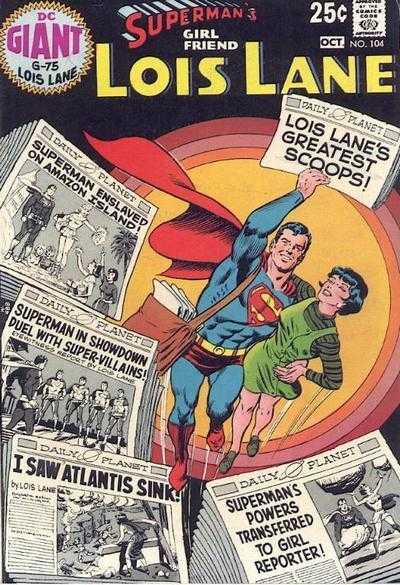
Late 1940s Superman radio stories — and Lois Lane’s reporting — focused on local-news issues more than this 1970 comic book headline retrospective.
“Trying to spoil your opponent’s political rallies is old stuff,” she tells Jimmy Olsen. But this time the threat turns out not to be an empty one… By the end of the episode she and Jimmy are clearly in danger… The corrupt politicians want The Daily Planet’s staff to end their partisan approach to reporting — with the lines drawn as clearly as a comic book with “clean government” on one side and crooks and racketeers on the other.
Lois is introduced to the crowd as “The most famous woman reporter in the country” and calls her mayoral candidate “a fine and courageous American.” His platform includes slum clearance, modern housing, more schools, playgrounds and recreational facilities, while the “wealthy and greedy owners” of Metropolis slum properties are supporting his gang-connected opponent.
Where will it all lead? The first 14 minute story ends with a cliffhanger for Lois and Jimmy. Will they survive? When will Superman get involved? (And how much Kelloggs Pep will the story sell?) No spoilers here.
The Metropolis election story also serves as an example of how much the radio show relied on the work of Daily Planet journalists to carry the continuity of cliff-hanger plots over as many as 25 days (in the case of the Hate Mongers Organization), with Clark Kent spending more time on journalism, including reporting local news, than he spent fighting the super-villains and global disasters. Those became his main target in later comic fantasies and Hollywood superhero special-effects extravaganzas. For example, even a 1970 comic cover about “Lois Lane’s Greatest Scoops” include a trip to Atlantis, an adventure where Lois acquired Superman’s powers, a “Showdown Duel with Super-Villains,” and something about Superman being enslaved by Amazons.
Perhaps a pilot for a possible series, this is the only episode of “The Fabulous Mr. Manchester” I have seen in radio collectors’ logs online. It was an ABC broadcast on May 06, 1950. Fortunately, YouTube channels about radio mysteries have posted it, so I can embed it here. (Alas, the recording is not very high quality. It even repeats 12 minutes of the 30 minute story.)
Mr. Manchester is not a journalist, but this episode features a foreign correspondent named Scott O’Hara, played by Howard Culver — not to be confused with another foreign correspondent named “O’Hara” who was the subject of a different radio series!
Culver’s OHara narrates this tale of foreign intrigue with subtle dialogue like, “I had been asking too many questions, and I was in trouble.”
He is digging into a story about the man of mystery who seems to be the power broker on an small island called Lepara… the “Mr. Manchester” of the series title, played by Sidney Greenstreet with echoes of his international man of mystery character in “The Maltese Falcon.”
Mr. Manchester tells his minions that O’Hara works for a “great American news syndicate,” the Universal News Bureau, and is a “very capable newspaperman, efficient, courageous…”
However, the tale O’Hara tells makes me want a different writer, with lines like, “their pockets were bulging, and it wasn’t with candy bars…” and “Sebastian and his stony-faced sidekicks weren’t taking me for a ride to look at the mountain scenery.”
I don’t think journalism students will learn much from this episode, except that in post-war America, 1950, the life of a foreign correspondent was still something popular culture portrayed as exciting, potentially dangerous, and well funded. O’Hara even had his own private airplane.
There is also a plot twist about the power of mysterious international news publishers who wield inordinate power, and might actually be criminals… but telling more than that would be a spoiler. I am not even sure whether the character O’Hara would have appeared in a second episode of the series.
However, that same year, Sydney Greenstreet took on the role of the brilliant, eccentric detective Nero Wolfe, whose adventures generally did not involve newspaper reporters.
Note: this is my first post to the blog using the Android app Jetpack as a replacement for the original WordPress app.
Back when I was still teaching, I did annual D-Day updates of my JHeroes pages about the “Soldiers of the Press” radio series, which dramatized the lives of United Press reporters whose bylines appeared in newspapers across America and around the world, but there were radio network reporters at work too… and I haven’t had a lot to say about them, since radio-drama and portrayals of newspaper reporters are the main focus of JHeroes.
Here’s a 1944 magazine account of how live-action news reports brought D-Day coverage to radio listeners. (Click to see a PDF copy of the magazine at WorldRadioHistory.)
Those Soldiers of the Press dramatizations have at times been mistaken for live news reports, including the ones in which actors with different voices portrayed U.P. “print” correspondents like Walter Cronkite.
Although radio-drama is still the focus of this website, this year, I gave that D-Day item a dose of real-life drama: a new closing paragraph about a non-U.P. radio war correspondent, George Hicks, whose recordings — made while his ship was under attack from German planes — were rediscovered in their original “Ameritape” format and donated to the D-Day Memorial five years ago, as described in this Washington Post story from 2019. Whether those were shipboard originals or early off-the-air copies, it’s a fascinating story about an all-but-forgotten recording technology that used celluloid similar to movie film in the days before magnetic recording tape.
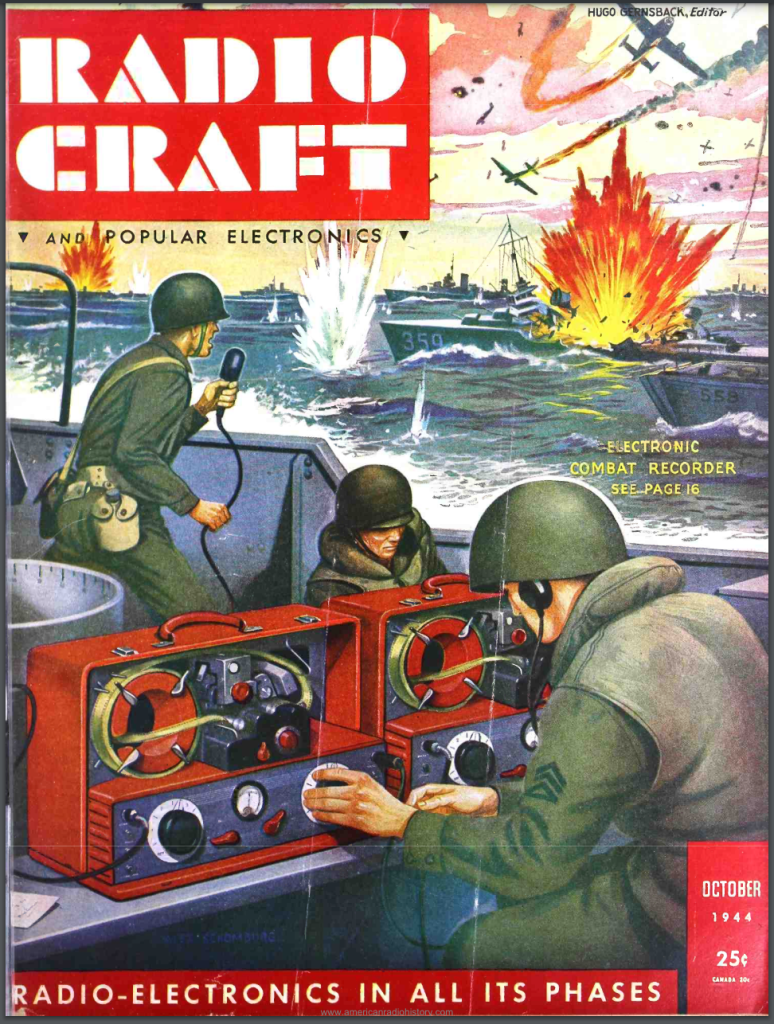
The websites about Hicks’ recordings also included a magazine-cover picture that sent me looking for this contemporary article about the “Electronic Combat Recorder,” see page 16 of this October, 1944, “Radio Craft” magazine, downloadable with a click, as a PDF file from the WorldRadioHistory publication archive.
Several other new links are included in the closing paragraphs of that 2011 D-Day page of mine, and I’ve tested and updated the page’s other links and Soldiers of the Press audio players.
“She was a newspaper woman, and a good one. Words came easily to her — fresh new interesting ways of saying what she saw, or felt, or heard. Her critics and colleagues agreed that regardless of her shortcomings as a person, Helen Conover was a superlative reporter — holder of the guild award for on-the-spot reporting, the first woman to win such an honor.”
When she gets a divorce, her husband has another assessment of her career, with a slight echo of Hildy Johnson’s speech about leaving her editor husband in “His Girl Friday.” But Helen’s husband isn’t an editor, he’s just angry about her infidelity:
“You’re a great girl, a fine reporter. I resent losing you, I admit it. It’s just too bad you didn’t take enough time out from your reporting to learn to be a woman.”
Will she be the heroine, villain or victim of her own story? Be prepared with a “what could go wrong?” routine news story about the circus coming to town, the memorable image of an attractive, confident reporter in a “red bolero jacket” (This is not an undercover assignment!), and another newspaper woman involved in the kind of double-twist ending that the Whistler’s plots were famous for. Give a listen.
 Newspaper Heroes on the Air